
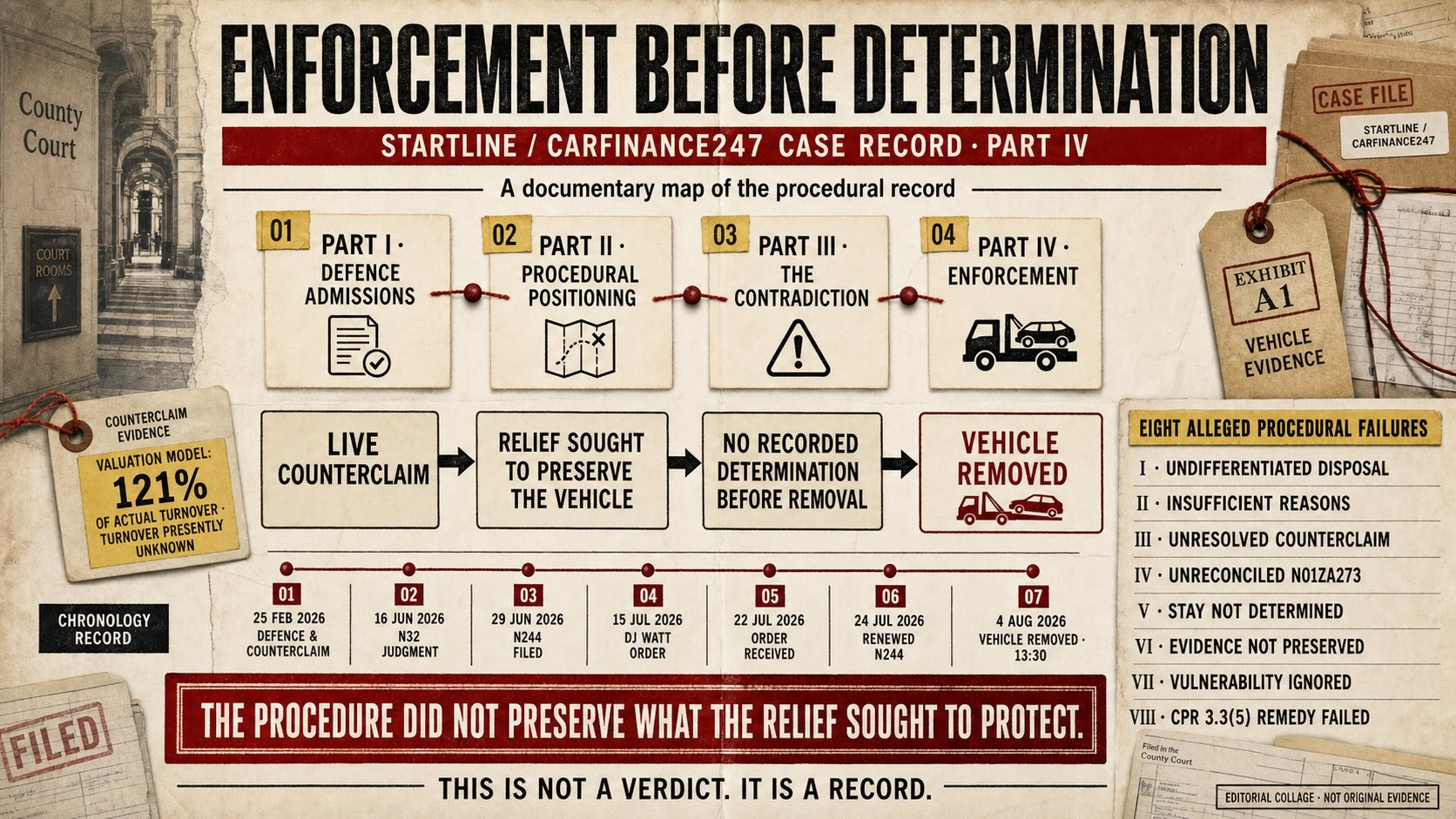
Figure 1. Enforcement Before Determination: documentary map of the four-part Startline/CarFinance247 disclosure record, seven-event chronology, live Counterclaim and eight alleged procedural failures culminating in removal of the disputed vehicle before determination of the requested stay and preservation relief.
Startline Motor Finance Limited, CarFinance247 Limited, Reading County Court and Claim Nos. M01RG980 and N01ZA273
Download PDF Summary
Introduction
This public disclosure examines the procedural handling of the connected litigation involving Endarr Carlton Ramdin, Startline Motor Finance Limited and CarFinance247 Limited concerning a Mazda CX-5 motor vehicle.
The analysis concerns two identified proceedings:
- M01RG980, in which Startline obtained an N32 Judgment for Delivery of Goods following the hearing on 16 June 2026; and
- N01ZA273, the separately issued claim brought by Endarr Carlton Ramdin against Startline and CarFinance247, evidenced by the N510 notices, N215 Certificates of Service, Civil National Business Centre filing correspondence and Post Office records.
The disclosure addresses the period from the 16 June 2026 hearing through the removal of the vehicle on 4 August 2026. Its central evidential sequence is:
a live Defence and Counterclaim concerning the vehicle, the regulated finance relationship, alleged defects, enforcement conduct, vulnerability and an alleged unfair relationship;
an N32 Judgment containing delivery-of-goods, premises-entry and costs consequences;
an urgent N244 application dated 29 June 2026 seeking substantive, interim, preservatory and case-management relief;
the order of District Judge Watt dated 15 July 2026 striking out that application without an oral hearing and directing that the challenge to the N32 Judgment should proceed by appeal;
a renewed N244 application filed on 24 July 2026 under CPR 3.3(5), seeking to set aside, vary or stay that order and requesting immediate protection of the vehicle;
express written warning that recovery before determination would alter the position and defeat the requested interim relief; and
removal of the vehicle at approximately 1.30 pm on 4 August 2026 while the renewed application remained awaiting determination.
The issue examined is not whether either N244 application guaranteed the substantive relief requested. It did not. The issue is whether the procedural handling provided a practical and effective opportunity for the requested stay, preservation, inspection, participation and case-management measures to be determined before the event they were intended to prevent occurred.
The analysis is grounded in the court orders, applications, witness evidence, draft orders, statements of case, service forms, filing correspondence and postal records identified under each alleged breach. Published Truthfarian disclosures are used as corroborating chronologies and cross-references; they do not replace the primary documentary evidence.
The term “alleged breach” is used deliberately. This disclosure identifies apparent procedural failures and the legal frameworks engaged by the documented sequence. It does not represent that any allegation has already been finally determined by an appellate court, disciplinary body or other competent tribunal.
Executive Summary
The documentary record identifies eight connected procedural failures requiring scrutiny.
I. Undifferentiated disposal of distinct forms of relief
The N244 dated 29 June 2026 sought more than reversal of the N32 Judgment. It also sought a stay, restraint of enforcement, protection against premises entry, preservation and inspection of the vehicle, preservation of the hearing record and directions concerning the Defence, Counterclaim and N01ZA273.
District Judge Watt’s order treated the application as a challenge that should proceed by appeal but did not record separate determinations of those materially different interim and case-management requests.
II. Insufficient reasons addressing the relief extinguished
The order supplied a reason for directing the substantive challenge towards appeal. It did not explain why the stay, preservation, inspection, hearing-record or case-management relief was abusive, unnecessary or incapable of separate determination.
The applicant was consequently left without a reasoned decision addressing how the vehicle, physical evidence and live pleaded claims would be protected pending any appeal.
III. Absence of recorded management of the Defence and Counterclaim
The Counterclaim concerned the same vehicle and finance relationship and had been answered by Startline through a Reply and Defence to Counterclaim.
The N32 Judgment and subsequent order did not record whether that additional claim was preserved, stayed, severed, transferred, consolidated, listed or otherwise managed. Enforcement capable of transferring control of the vehicle therefore remained operative while the pleaded Counterclaim remained unresolved.
IV. Failure to reconcile Claim No. N01ZA273
The N510 notices, N215 Certificates of Service, CNBC covering letter and Post Office records establish a documented issue, service and filing chain for N01ZA273.
The Post Office evidence records signed-for packages sent on 23 February 2026:
- to CarFinance247 at M12 6JH under reference 0211-4FB3-019F-4AD8; and
- to Startline at G3 8EP under reference 0211-4FB3-019F-4B3E.
Despite the documented existence of that claim and its relationship to the same vehicle dispute, no recorded direction determined whether it was to continue, be stayed, transferred, consolidated, severed or struck out.
V. Failure to determine effective interim protection before enforcement
Both N244 applications requested an immediate stay. The 24 July 2026 application was filed within the seven-day period specified in District Judge Watt’s order and expressly warned that vehicle recovery before determination could defeat the requested relief.
The vehicle was removed on 4 August 2026 before the requested stay and oral hearing had operated to preserve the existing position.
VI. Failure to preserve disputed physical evidence
The condition of the Mazda was a pleaded factual issue. The Counterclaim alleged multiple defects and circumstances potentially requiring independent examination.
The requested draft orders sought non-alteration, preservation and inspection safeguards. No such protocol was established before the vehicle passed from the applicant’s control, creating an evidential risk concerning its location, condition, alteration, repair, disposal and availability for independent inspection.
VII. Failure to address disclosed vulnerability and participation requirements
Type 2 diabetes, health effects, financial hardship, self-representation and the consequences of vehicle loss were disclosed in the Counterclaim and N244 evidence.
The operative orders contain no recorded consideration of vulnerability, effective participation, reasonable procedural accommodation or the effect that immediate enforcement could have on mobility, health and the applicant’s ability to conduct the proceedings.
VIII. Loss of the practical effectiveness of the CPR 3.3(5) remedy
District Judge Watt’s order expressly provided a right to apply under CPR 3.3(5). The renewed application was filed two days after receipt and sought an oral hearing, restoration, an immediate stay and preservation of the vehicle.
Removal occurred while that application remained awaiting determination. The procedural remedy therefore failed to preserve the subject matter in the condition and location required for the requested interim relief to have its intended practical effect.
Overall Evidential Finding
The eight alleged breaches are not isolated administrative complaints. They form a connected sequence:
- the Defence and Counterclaim remained unresolved;
- N01ZA273 remained without a recorded procedural disposition;
- substantive and protective remedies were disposed of together;
- reasons did not address the distinct protective relief;
- vulnerability and participation consequences were not recorded as considered;
- the renewed application was filed within the permitted period;
- no effective interim preservation arrangement intervened; and
- the vehicle was removed before the requested oral determination.
The resulting prejudice was not confined to loss of possession. Removal altered the factual and evidential position, transferred control of the disputed property, prevented the requested protection from operating in its original form and potentially impaired the effective conduct of the Defence, Counterclaim and associated proceedings.
The sections below identify the evidence supporting each alleged breach, explain precisely what each document proves and set out the corresponding common-law, procedural, statutory, human-rights and international frameworks engaged.
Legal Breaches Identified
I. Undifferentiated Strike-Out of an Application Containing Distinct Substantive, Interim, Preservatory and Case-Management Relief
The N244 application dated 29 June 2026 was not confined to challenging the substantive correctness of the N32 Judgment. It sought several distinct forms of relief, including a stay, suspension of vehicle recovery, protection against premises entry, preservation and inspection of the Mazda CX-5, preservation of the hearing record, directions concerning the Defence and Counterclaim, reconciliation of Claim No. N01ZA273 and an urgent oral hearing.
The alleged breach is the disposal of the whole application as an abuse of process on the basis that the N32 challenge should proceed by appeal, without separately determining whether the interim, preservatory and case-management components remained necessary or appropriate.
Evidence
ER6 — N244 Application Notice dated 29 June 2026. Proves that an application was made seeking relief extending beyond reversal of the N32 Judgment.
ER6 — N244 continuation sheets dated 29 June 2026. Particularise the requested stay, enforcement restraint, vehicle preservation, inspection, hearing-record and procedural-management relief.
ER6 — Proposed Draft Order dated 29 June 2026. Proves that the applicant supplied separately drafted operative provisions for the different forms of relief rather than seeking one indivisible order.
ER1 — Order of District Judge Watt dated 15 July 2026. Records that the application was struck out without notice and of the Court’s own initiative on the stated basis that the challenge to the 16 June 2026 order should proceed by appeal. It does not record a separate determination of each preservatory or case-management request.
Particulars of Counterclaim dated 25 February 2026, sections 2–5, 7.4, 10–12. Proves that the underlying dispute concerned alleged defects, diagnostic engagement, protected-goods status, vulnerability, enforcement conduct and an alleged unfair relationship. These matters establish why preservation and case-management relief was substantively different from an appeal against the N32 outcome.
N510 forms concerning Startline and CarFinance247, signed 23 February 2026. Prove that N01ZA273 was a formally identified civil claim and that directions concerning it were not an abstract or hypothetical request.
N215 Certificates of Service, CNBC covering letter dated 24 February 2026 and postal records dated 23 February 2026. Prove the documented service and filing chain underlying the request for directions concerning N01ZA273.
Published corroboration: Procedural Contradiction disclosure, Chapters 4, 6, 8, 10–13 and 18, including EX02, EX03, EX04 and EX11–EX13.
Published corroboration: Defence Structure disclosure, §§1–4 and EX01–EX13.
Legal frameworks engaged
Common-law natural justice.
Common-law procedural fairness.
Common-law right to be heard.
Common-law access-to-justice principle.
CPR 1.1(2)(a) — equal footing and full participation.
CPR 1.1(2)(d) — expeditious and fair determination.
CPR 1.2 — application of the Overriding Objective.
CPR 1.4(2)(b) — identification of issues.
CPR 1.4(2)(c) — determination of which issues require investigation or summary disposal.
CPR 1.4(2)(d) — sequencing of issues.
CPR 1.4(2)(i) — dealing with multiple aspects on the same occasion.
CPR 3.1(2)(f) — separate treatment of part of proceedings, including a counterclaim.
CPR 3.1(2)(g) — stay of proceedings or judgment.
CPR 3.1(2)(h) — consolidation.
CPR 3.1(2)(i) — concurrent trial of claims.
CPR 3.1(2)(j) — separate trial of an issue.
CPR 3.1(2)(k) — sequencing of issues.
CPR 3.1(2)(p) — further case-management orders.
CPR 3.1(7) — power to vary or revoke an order.
CPR 3.3(4) — own-initiative order without prior representations.
CPR 3.3(5) — right to apply to set aside, vary or stay.
CPR 3.3(7) — oral-hearing requirement unless the application is declared totally without merit.
CPR 23.6 — identification of the order sought and grounds.
Human Rights Act 1998, section 6.
Article 6 ECHR.
Procedural consequence: all protective relief was removed while the delivery-of-goods, premises-entry, costs and enforcement consequences remained operative.
II. Failure to Give Reasons Addressing the Distinct Relief Extinguished by the Strike-Out
ER1 gave a reason for directing the substantive challenge towards appeal. It did not record why the stay, evidence-preservation, inspection, hearing-record, Counterclaim-management or N01ZA273 directions were abusive, unnecessary or incapable of separate determination.
The alleged breach is therefore not that ER1 contained no reason at all. It is that its stated reason did not address the materially different relief extinguished by the same order.
Evidence
ER1 — Order of District Judge Watt. Provides the appellate-route reason but contains no separately recorded reasoning addressing the stay, vehicle preservation, inspection, hearing-record or case-management provisions.
ER6 — N244 Application Notice and continuation sheets dated 29 June 2026. Identify the distinct relief requiring determination.
ER6 — Supporting Witness Statement. Supplies the asserted factual grounds for the requested interim and preservatory relief.
ER6 — Proposed Draft Order. Allows direct comparison between the relief requested and the much narrower reason given in ER1.
ER2 — Pre-sealing submission dated 22 June 2026. Records that the hearing chronology, proposed order, procedural objection and need for determination before sealing had already been put before the Court.
Particulars of Counterclaim, sections 2–5, 7.4 and 10–12. Demonstrates the pleaded vehicle, protected-goods, vulnerability and enforcement issues that made the omitted relief material.
N510, N215, CNBC covering letter and postal records. Prove that the associated-claim issue omitted from ER1 related to a documented proceeding and service chain.
Published corroboration: Procedural Contradiction disclosure, §§3.9–3.14, 4.3–4.13, 5.8–5.18, 6.5–6.14, 8.6–8.20 and 18.1–18.9.
Legal frameworks engaged
Common-law duty to give sufficient reasons.
Common-law procedural fairness.
Common-law natural justice.
Common-law legal-certainty principle.
Common-law open-justice principle.
CPR 1.1.
CPR 1.2.
CPR 1.4.
CPR 3.1.
CPR 3.3(4).
CPR 3.3(5).
CPR 3.3(7).
CPR 23.6.
CPR 23.8(3).
CPR 23.8(4).
CPR Part 40.
Practice Direction 40B.
Human Rights Act 1998, section 6.
Article 6 ECHR.
ICCPR Article 14(1), as an international fair-hearing standard.
Procedural consequence: the applicant was directed towards appeal without a reasoned determination of how the vehicle, evidence and pleaded proceedings would be protected pending that process.
III. Failure to Determine or Direct the Procedural Status of the Live Defence and Counterclaim
The Counterclaim was not merely referred to in correspondence. It was a formal additional claim concerning the same vehicle and finance relationship. Startline subsequently served a Reply and Defence to Counterclaim, thereby joining issue with it.
The alleged breach is the production and continued operation of a delivery-of-goods outcome without a recorded direction preserving, staying, severing, transferring, listing or otherwise managing the live Counterclaim.
Evidence
Particulars of Counterclaim dated 25 February 2026. The cover identifies Endarr Carlton Ramdin as Defendant/Counterclaimant, Startline and CarFinance247 as Claimant/Defendants to Counterclaim and the Civil National Business Centre as the stated court.
Particulars of Counterclaim, section 1. Pleads the regulated hire-purchase transaction and the relationship between the Mazda CX-5, Startline and CarFinance247.
Sections 2–4. Plead latent defects, alleged unsafe condition, diagnostic engagement, subsequent denial and Consumer Rights Act claims.
Section 5. Pleads diabetes, burnout, financial hardship and active legal proceedings as disclosed vulnerability factors.
Sections 7.3–7.5. Plead continued collection and repossession pressure during an unresolved dispute.
Sections 10–12. Plead failure to suspend enforcement, human-rights and equality issues and systemic vulnerability-handling concerns.
Exhibits A–Q schedule. Catalogues the complaint, diagnostic, enforcement, voicemail, residential-attendance and corroborative evidence relied upon in the pleading.
Internal-document qualification. The Counterclaim cover states 25 February 2026 and £8,650,000; the concluding statement of truth states 21 July 2025; and the schedule totals £8,975,000. These inconsistencies must be disclosed and corrected or explained. They do not erase the substantive pleaded chronology but prevent the document from being described as internally uniform.
EX02 — Reading County Court letter dated 24 March 2026. As catalogued in the existing disclosure, confirms that the Defence and Counterclaim had been served and placed on the court file for the 16 June hearing.
EX04 — DWF service email. Records service of the Reply and Defence to Counterclaim and the request that it be placed on the court file.
EX12 — Reply and Defence to Counterclaim. Proves that Startline formally responded to the Counterclaim.
ER5/EX11 — N32 Judgment. Adjourns the money claim generally but contains no recorded determination of the Counterclaim’s procedural status.
ER6 — Proposed Draft Order dated 29 June 2026. Expressly requested directions concerning the Defence and Counterclaim.
Published corroboration: Defence Structure disclosure, §§1–4 and EX01–EX13.
Published corroboration: DWF Correspondence Chronology, §§1–4 and EX01–EX03.
Published corroboration: Procedural Contradiction disclosure, Chapters 6–7, §§18.1–18.9 and EX02, EX04, EX11–EX13.
Legal frameworks engaged
Common-law natural justice.
Common-law procedural fairness.
Common-law duty to give sufficient reasons.
Common-law equality-of-arms principle.
CPR 1.1.
CPR 1.2.
CPR 1.4.
CPR 3.1(2)(f).
CPR 3.1(2)(g).
CPR 3.1(2)(h).
CPR 3.1(2)(i).
CPR 3.1(2)(j).
CPR 3.1(2)(k).
CPR 3.1(2)(p).
CPR 3.1A — unrepresented parties.
CPR Part 15 — Defence and Reply.
CPR Part 16 — statements of case.
Practice Direction 16.
CPR 20.1 — convenient and effective management of counterclaims.
CPR 20.2 — scope and interpretation of additional claims.
CPR 20.3 — additional claims treated as claims.
CPR 20.4 — counterclaim by filing particulars.
CPR 20.9 — whether an additional claim should be separately managed.
CPR 20.13 — case management following a defence to an additional claim.
Consumer Credit Act 1974, sections 90–92.
Consumer Credit Act 1974, sections 140A–140B.
Consumer Rights Act 2015, sections 9–11.
Consumer Rights Act 2015, sections 19, 23 and 24.
Human Rights Act 1998, section 6.
Article 6 ECHR.
Procedural consequence: Startline obtained the practical benefit of delivery-of-goods enforcement while the additional claim concerning the same vehicle remained without a recorded procedural direction.
IV. Failure to Reconcile Claim No. N01ZA273 Despite a Documented Issue, Service and Filing Chain
N01ZA273 was a separately identified civil claim, not an informal complaint or unexplained reference. Its existence and service are evidenced by two N510 forms, two N215 certificates, a CNBC filing letter, a package label and two Post Office certificates and receipts.
Evidence
N510 — CarFinance247 Limited, signed 23 February 2026. Identifies the Civil National Business Centre, Claim No. N01ZA273, Endarr Carlton Ramdin as Claimant and CarFinance247 Limited as Defendant.
N510 — Startline Motor Finance Limited, signed 23 February 2026. Identifies the same court and claim number and Startline as Defendant.
Both N510 forms. Record reliance on CPR 6.32(1)(a) and 6.32(1)(b)(i), based on jurisdiction under the Civil Jurisdiction and Judgments Act 1982, absence of proceedings concerning the same claim in another UK jurisdiction and UK domicile.
N215 — Startline. Records service on 23 February 2026 by first-class post at Suite 4.5, Skypark 1, 8 Elliot Place, Glasgow G3 8EP, with deemed service stated as 25 February 2026.
N215 — CarFinance247. Records service on 23 February 2026 by first-class post at Universal Square, Devonshire Street North, Manchester M12 6JH, with deemed service stated as 25 February 2026.
Both N215 certificates. Identify the served documents as the Claim Form, Particulars of Claim, Form N510 and response pack and contain statements of truth dated 23 February 2026.
Post Office certificate — CarFinance247. Records posting on 23 February 2026 at 09:35 to M12 6JH under reference 0211-4FB3-019F-4AD8, with a parcel weight of 1.079 kg.
Post Office certificate — Startline. Records posting on 23 February 2026 at 09:36 to G3 8EP under reference 0211-4FB3-019F-4B3E, with a parcel weight of 1.053 kg.
Post Office payment receipts. Record separate signed-for postal transactions costing £6.90 each.
Package label. Corroborates the CarFinance247 service address at Universal Square, Devonshire Street North, Manchester M12 6JH and identifies the package as important court documentation.
CNBC covering letter dated 24 February 2026. Lists both N215 certificates, both N510 forms and proof of posting and requests that they be placed on the court file.
EX03 — Notice dated 26 March 2026. As catalogued in the published chronology, records the filing of an Acknowledgment of Service in N01ZA273.
EX05–EX07. DWF’s N244 dated 31 March 2026, Jonathan Hall’s supporting witness statement and DWF’s proposed order formally raised the alleged overlap between N01ZA273 and M01RG980.
ER6 — Proposed Draft Order dated 29 June 2026. Requested an express direction concerning N01ZA273.
ER1 — District Judge Watt’s order. Contains no recorded direction continuing, staying, transferring, consolidating, severing, dismissing or striking out N01ZA273.
Published corroboration: Procedural Contradiction disclosure, Chapter 8, especially §§8.1–8.20 and EX02–EX07, EX11 and EX13.
Published corroboration: DWF Correspondence Chronology, §§1–4 and EX01–EX03.
Legal frameworks engaged
Common-law natural justice.
Common-law procedural fairness.
Common-law abuse-of-process jurisdiction.
Common-law duty to give sufficient reasons.
Common-law legal certainty.
Civil Jurisdiction and Judgments Act 1982.
Civil Jurisdiction and Judgments Act 1982, Schedule 4.
CPR 1.1.
CPR 1.2.
CPR 1.4.
CPR 3.1(2)(f).
CPR 3.1(2)(g).
CPR 3.1(2)(h).
CPR 3.1(2)(i).
CPR 3.1(2)(j).
CPR 3.1(2)(k).
CPR 3.4.
CPR 6.14 — deemed service of a claim form.
CPR 6.29 — certificate-of-service requirements.
CPR 6.32 — service in Scotland without permission.
CPR 6.34 — notice of grounds for service without permission.
CPR 6.35 — response period following service under CPR 6.32.
CPR 6.40 — methods of service out of the jurisdiction.
CPR Part 7 — commencement of proceedings.
CPR Part 10 — acknowledgment of service.
CPR Part 11 — jurisdictional challenge.
CPR Part 15 — defence.
CPR Part 16 — statements of case.
CPR Part 23 — applications.
CPR Part 26 — case management.
Human Rights Act 1998, section 6.
Article 6 ECHR.
Procedural consequence: enforcement affecting the shared vehicle proceeded in M01RG980 without a recorded determination of the status or management of N01ZA273.
V. Failure to Determine the Expressly Requested Interim Stay Before Enforcement Altered the Position
The N32 Judgment remained capable of enforcement. The original and renewed N244 applications sought an immediate stay, but the vehicle was removed before that protection received an effective determination.
Evidence
ER5/EX11 — N32 Judgment. Records operative vehicle-delivery, premises-entry and costs provisions.
ER6 — N244 dated 29 June 2026. Expressly requests an immediate stay.
ER6 — Proposed Draft Order. Contains separate provisions restraining vehicle recovery, premises entry and costs enforcement.
ER1 — District Judge Watt’s order. Strikes out the application but does not separately record the grant or refusal of a temporary stay pending appeal.
N244 dated 24 July 2026. Renews the application to set aside, vary or stay ER1 under CPR 3.3(5).
Witness Statement dated 24 July 2026. Records receipt of ER1 on 22 July and explains the urgency and enforcement risk.
Covering letter dated 24 July 2026. Warns that recovery before determination could materially alter the position and render the requested relief ineffective.
Proposed Draft Order dated 24 July 2026. Particularises the immediate stay and enforcement-restraint provisions.
Signed urgent court update dated 4 August 2026. Records removal of the vehicle at approximately 1.30 pm while the renewed application remained awaiting determination.
Particulars of Counterclaim, §7.4. Pleads payment of more than one-third of the total agreement and the resulting protected-goods issue under section 90 of the Consumer Credit Act 1974.
Defence Structure disclosure, §4.I and Defence §§16 and 33. Records Startline’s pleaded admission that more than one-third had been paid and that possession could not be taken without a court order.
Published corroboration: Procedural Contradiction disclosure, Chapters 4 and 10–13, §§18.1–18.9.
Legal frameworks engaged
Common-law access-to-justice principle.
Common-law procedural fairness.
Common-law legal-certainty principle.
CPR 1.1.
CPR 1.2.
CPR 1.4.
CPR 3.1(2)(g).
CPR 3.1(7).
CPR 3.3(5)(a).
CPR 3.3(6).
CPR 3.3(7).
CPR 23.5.
CPR 23.6.
CPR 23.8(3).
CPR 23.8(4).
CPR 25.1(1)(a) — interim injunction.
CPR 25.1(1)(c)(i) — detention, custody or preservation of property.
CPR 25.1(1)(c)(ii) — inspection of property.
CPR 25.2 — timing of an interim remedy.
CPR 25.3 — application and supporting evidence.
CPR 40.8A — stay of execution and other relief.
CPR 52.16 — appeal does not itself operate as a stay.
CPR Part 70 — enforcement.
Consumer Credit Act 1974, section 90.
Consumer Credit Act 1974, sections 91–92.
Human Rights Act 1998, section 6.
Article 6 ECHR.
Article 8 ECHR.
Article 1 of Protocol No. 1 ECHR.
Procedural consequence: removal occurred before the stay application could preserve the position it was designed to protect.
VI. Failure to Preserve the Mazda CX-5 as Disputed Physical Evidence
The Mazda was not merely the property described in the N32 Judgment. Its physical condition was a pleaded factual issue in the Counterclaim and associated claim. Preservation and independent inspection were therefore distinct evidential requirements.
Evidence
Particulars of Counterclaim, §2. Pleads a missing parcel shelf, defective driver-side wing mirror, contaminated engine bay, previous-owner debris, stop-start battery failure and driver-door air ingress.
Particulars of Counterclaim, §2. Pleads an inference of possible prior impact, structural misalignment or bodywork damage based on the door and mirror condition.
Particulars of Counterclaim, §3. Records alleged diagnostic engagement involving CarFinance247, Hexagon and Eden Mazda.
Particulars of Counterclaim, §4. Pleads statutory non-conformity and failure to provide repair, replacement or price reduction.
Counterclaim Exhibits A–C. The exhibit schedule identifies contemporaneous diagnostic and complaint communications supporting the pleaded condition chronology.
EX12 — Reply and Defence to Counterclaim. Proves that the vehicle-condition and diagnostic allegations were formally placed in issue.
ER6 — Proposed Draft Order dated 29 June 2026, paragraphs 4–5. Requests that the vehicle not be moved, repaired, altered, transferred, dismantled, sold or disposed of and that it remain available for independent inspection.
N244 continuation sheet and proposed order dated 24 July 2026. Renew the preservation and inspection requests.
ER1. Contains no preservation, non-alteration, condition-record, location-disclosure or inspection provision.
Signed urgent update dated 4 August 2026. Records that control of the vehicle passed to the recovery contractor before a court-controlled evidential protocol was established.
Published corroboration: Procedural Contradiction disclosure, §§4.3, 6.5–6.7, Chapter 12 and §18.3.
Published corroboration: Defence Structure disclosure, §4.III and the associated exhibit schedule.
Legal frameworks engaged
Common-law procedural fairness.
Common-law natural justice.
Common-law evidential-integrity principle.
Common-law equality-of-arms principle.
Court’s inherent jurisdiction to protect the integrity of proceedings.
CPR 1.1.
CPR 1.2.
CPR 1.4.
CPR 3.1(2)(g).
CPR 3.1(2)(p).
CPR 25.1(1)(c)(i) — preservation of relevant property.
CPR 25.1(1)(c)(ii) — inspection.
CPR 25.1(1)(c)(iii) — taking a sample.
CPR 25.1(1)(c)(iv) — experiment on or with relevant property.
CPR 25.1(2) — meaning of relevant property.
CPR 25.2 — timing.
CPR 25.3 — evidence supporting an interim remedy.
CPR 31.6 — standard disclosure.
CPR 32.1 — court control of evidence.
CPR 35.1 — expert evidence restricted to what is reasonably required.
Consumer Rights Act 2015, sections 9–11.
Consumer Rights Act 2015, sections 19, 23 and 24.
Consumer Credit Act 1974, sections 90–92.
Consumer Credit Act 1974, sections 140A–140B.
Human Rights Act 1998, section 6.
Article 6 ECHR.
Article 1 of Protocol No. 1 ECHR.
Procedural consequence: the physical subject matter left the applicant’s control without an independent condition record, inspection protocol or non-alteration safeguard.
VII. Failure to Address Disclosed Medical Vulnerability, Disability and Litigant-in-Person Status
The evidence does not depend solely on a later assertion of vulnerability. Diabetes, burnout, financial hardship and participation consequences were pleaded before the impugned procedural events and repeated in the N244 material.
Evidence
Particulars of Counterclaim, §5. Records disclosures made between February and March 2024, including a diabetes diagnosis, mental and physical burnout, Universal Credit and active civil and employment proceedings.
Particulars of Counterclaim, §6. Pleads psychological harm, anxiety, reduced functioning and loss of enjoyment arising from the combined vehicle, enforcement and health circumstances.
Particulars of Counterclaim, §§7.3–7.5. Pleads continued collection and third-party contact despite the dispute and vulnerability disclosures.
Particulars of Counterclaim, §§11–12. Pleads human-rights, equality and systemic vulnerability-handling issues.
ER6 — N244 dated 29 June 2026. Records Type 2 diabetes and connects vehicle loss and enforcement with mobility, health, stress and participation consequences.
N244 dated 24 July 2026. Repeats diabetes as a disability and vulnerability factor and requests an oral hearing and protection before enforcement.
Witness Statement dated 24 July 2026. Records litigant-in-person status and explains the asserted participation consequences.
ER1. Contains no recorded reference to diabetes, health vulnerability, self-representation, participation directions or procedural accommodation.
ER5/EX11 — N32 Judgment. Contains no recorded vulnerability, participation or enforcement-safeguard finding.
Published corroboration: Medical Health Disclosure, containing the underlying medical chronology.
Published corroboration: Procedural Contradiction disclosure, Chapter 13, especially §§13.1–13.7.
Published corroboration: Defence Structure disclosure, §§4.IV–4.V.
Legal frameworks engaged
Common-law natural justice.
Common-law procedural fairness.
Common-law effective-participation requirement.
Common-law equality-of-arms principle.
CPR 1.1(2)(a).
CPR 1.1(2)(d).
CPR 1.6.
CPR 3.1A(2).
CPR 3.1A(4).
Practice Direction 1A, paragraph 1.
Practice Direction 1A, paragraphs 2–3.
Practice Direction 1A, paragraph 4(c).
Practice Direction 1A, paragraph 4(d).
Practice Direction 1A, paragraph 5.
Practice Direction 1A, paragraph 6.
Practice Direction 1A, paragraph 7.
Practice Direction 1A, paragraph 9.
Equality Act 2010, section 6.
Equality Act 2010, sections 20–21.
Equality Act 2010, section 29, insofar as applicable to HMCTS services and public functions.
Equality Act 2010, Schedule 3, Part 1, paragraph 3 — judicial-functions boundary.
Human Rights Act 1998, section 6.
Article 6 ECHR.
Article 8 ECHR.
Article 14 ECHR.
Convention on the Rights of Persons with Disabilities, Article 13, as an international access-to-justice standard.
The Equality Act judicial-functions exception must be stated expressly. The principal duties governing judicial participation arise through CPR 1.6, Practice Direction 1A, the common law and Article 6. Equality Act duties remain relevant to applicable HMCTS administrative services and non-exempt public functions.
Procedural consequence: no recorded safeguard prevented enforcement from amplifying the disclosed mobility, health and participation disadvantages before an oral determination.
VIII. Procedural Handling That Deprived the CPR 3.3(5) Remedy of Practical Effectiveness
ER1 expressly notified the affected party of the right to seek setting aside, variation or a stay. The renewed N244 was filed within the period specified. The vehicle was nevertheless removed before the requested oral hearing and interim protection were determined.
The alleged breach is not that CPR 3.3(5) guaranteed the substantive outcome sought. It is that the expressly provided procedural remedy did not operate in time to preserve the subject matter of the application.
Evidence
ER1. Records the right to apply under CPR 3.3(5) and the applicable seven-day period.
Witness Statement dated 24 July 2026. Records receipt of ER1 on 22 July 2026.
N244 dated 24 July 2026. Proves that the application was filed two days after receipt and sought setting aside, variation or a stay.
N244 continuation sheet. Requests restoration of the 29 June application, an oral hearing, an immediate stay and preservation of the vehicle.
Covering letter dated 24 July 2026. Expressly warns that vehicle recovery before determination could materially alter the position and defeat the interim relief.
Proposed Draft Order dated 24 July 2026. Provides the operative stay, restoration, oral-hearing and preservation provisions sought.
Signed urgent court update dated 4 August 2026. Records vehicle removal at approximately 1.30 pm while the CPR 3.3(5) application remained awaiting determination.
Absence of an intervening stay order served before removal. Establishes that the operative N32 position had not been displaced before the recovery event.
Published corroboration: Procedural Contradiction disclosure, Chapters 10–13 and §§18.1–18.9. Those sections document the enforcement, preservation, vulnerability and effective-remedy risks identified before the removal occurred.
Legal frameworks engaged
Common-law access-to-justice principle.
Common-law procedural fairness.
Common-law natural justice.
Common-law legal-certainty principle.
Common-law evidential-integrity principle.
CPR 1.1.
CPR 1.2.
CPR 1.4.
CPR 3.1(2)(g).
CPR 3.1(2)(p).
CPR 3.1(7).
CPR 3.3(5).
CPR 3.3(6).
CPR 3.3(7).
CPR 3.3(8).
CPR 3.3(9).
CPR 23.5.
CPR 23.6.
CPR 23.8(3).
CPR 23.8(4).
CPR 25.1.
CPR 25.2.
CPR 25.3.
CPR 40.8A.
CPR 52.16.
CPR Part 70.
Practice Direction 1A.
Human Rights Act 1998, section 6.
Article 6 ECHR.
Article 8 ECHR.
Article 1 of Protocol No. 1 ECHR.
ICCPR Article 2(3), as an international effective-remedy standard.
ICCPR Article 14(1), as an international fair-hearing standard.
Convention on the Rights of Persons with Disabilities, Article 13, as an international access-to-justice standard.
Procedural consequence: the requested protection retaining and preserving the vehicle until oral determination was overtaken by the event it was expressly intended to prevent.
Legal Frameworks Engaged
The documented sequence engages foundational common-law and constitutional principles, domestic consumer and equality legislation, the Civil Procedure Rules, Convention rights and international access-to-justice standards.
The frameworks are stated below in foundational order. Each framework is followed by the authoritative wording or recognised legal principle and an analysis of its application to the documented facts. References to an apparent breach record the evidential position disclosed; they do not represent a finding already made by an appellate court or other competent tribunal.
PART ONE: FOUNDATIONAL PRINCIPLES
Common Law and Constitutional Principles
I. Common Law — Natural Justice: Audi Alteram Partem
Verbatim
“The court must determine for itself whether a fair procedure was followed.”
— R (Osborn) v Parole Board [2013] UKSC 61, paragraph 65.
Analysis
The N244 application dated 29 June 2026 contained materially distinct requests: challenge to the N32 Judgment, an immediate stay, restraint of vehicle recovery and premises entry, preservation and inspection of the Mazda CX-5, preservation of the hearing record and directions concerning the unresolved Defence, Counterclaim and Claim No. N01ZA273.
District Judge Watt’s order addressed the proposed route for challenging the N32 Judgment but did not separately determine those protective and case-management requests. The renewed N244 dated 24 July 2026 requested an oral hearing under CPR 3.3(5). The vehicle was removed before that hearing and the requested protection were determined.
The apparent failure is therefore not the mere making of an initial paper order. It is the failure to preserve a practically effective opportunity to be heard before enforcement produced the consequence the application sought to prevent.
II. Common Law — Procedural Fairness
Verbatim
What fairness requires depends upon the character of the decision, the procedure adopted and the interests affected.
— Principle derived from Lloyd v McMahon [1987] AC 625 and Osborn.
Analysis
The interests affected included possession of the vehicle, access to disputed physical evidence, the continuing Defence and Counterclaim, the separately issued claim, health and mobility consequences and the practical ability to pursue the proceedings.
Those interests required the Court to distinguish the substantive appellate issue from the requests for interim preservation and case management. Disposing of the application without separately addressing those matters, followed by removal before reconsideration, supports an allegation that the procedure was not calibrated to the actual interests at risk.
III. Constitutional Right of Access to Justice
Verbatim
“The constitutional right of access to the courts is inherent in the rule of law.”
— R (UNISON) v Lord Chancellor [2017] UKSC 51, paragraph 66.
Analysis
Access to justice requires more than the formal availability of an application form. The procedure must allow the Court to determine material relief while that relief can still operate effectively.
The 24 July 2026 application was filed within the period specified by District Judge Watt’s order. It expressly sought an oral hearing, an immediate stay and preservation of the vehicle. Removal on 4 August 2026 altered possession and control before those requests were determined. The evidence therefore engages the constitutional requirement that access to the Court be practical and effective rather than merely theoretical.
IV. Common Law — Equality of Arms
Principle
Each party must have a reasonable and effective opportunity to present its case without being placed at a substantial procedural disadvantage.
Analysis
Startline was represented by solicitors. The Defendant was a litigant in person with disclosed health and financial vulnerabilities. Startline obtained an operative delivery-of-goods judgment while the Defendant’s Counterclaim, associated claim and urgent applications remained unresolved.
Removal transferred possession and evidential control of the vehicle to the finance side of the dispute before an independent inspection protocol had been established. That change potentially placed the Defendant at a substantial disadvantage in proving the pleaded defects and contesting the enforcement history.
V. Common Law — Duty to Give Sufficient Reasons
Principle
Reasons must disclose why the material issues were decided as they were and permit the affected party to understand the basis of the decision.
Analysis
The recorded reason in District Judge Watt’s order concerned the route for challenging the N32 Judgment. It did not explain why the independent requests for a stay, preservation, inspection, protection against premises entry, preservation of the hearing record or management of the Counterclaim and N01ZA273 were struck out.
Because an appeal did not automatically suspend enforcement, directing the substantive challenge towards appeal did not answer the separate question of what protection should operate pending that process. The absence of reasons addressing those distinct requests is therefore legally material.
VI. Common Law — Legal Certainty
Principle
Court orders must identify the legal and procedural position with sufficient certainty for the parties to know their rights, obligations and continuing procedural status.
Analysis
The N32 Judgment imposed delivery, premises-entry and costs consequences. The record did not clearly state what had happened to the live Defence and Counterclaim, whether they remained pending, or how N01ZA273 was to be managed.
The subsequent order did not resolve whether those proceedings were stayed, severed, transferred, consolidated, dismissed or continuing independently. Enforcement therefore proceeded against the shared physical subject matter while the procedural status of the connected claims remained uncertain.
VII. Common Law — Finality and Abuse-of-Process Control
Principle
The Court must prevent misuse of its process while ensuring that the abuse jurisdiction is not applied more widely than justice requires.
Analysis
The 29 June 2026 application sought several different remedies. A conclusion that the substantive challenge should proceed by appeal did not automatically establish that the applications for a temporary stay, preservation, inspection and case-management directions were abusive.
Treating the whole application as procedurally improper without separately analysing those distinct remedies risks extending abuse-of-process reasoning beyond the issue to which the recorded reason related.
VIII. Court’s Inherent Jurisdiction — Integrity of Proceedings and Evidence
Principle
The Court possesses inherent authority to protect the integrity of its proceedings and prevent material evidence from being destroyed, altered or placed beyond effective examination.
Analysis
The vehicle’s physical condition was expressly pleaded. The Counterclaim identified defects involving the wing mirror, engine bay, battery, door alignment, air ingress and missing components. The proposed orders requested preservation, non-alteration and independent inspection.
Removal occurred without a court-controlled condition record, location-disclosure requirement or inspection protocol. The vehicle’s transfer from the Defendant’s control therefore engaged the Court’s responsibility to preserve relevant physical evidence.
PART TWO: DOMESTIC STATUTORY FRAMEWORKS
IX. Consumer Credit Act 1974 — Section 56: Antecedent Negotiations
Verbatim
Negotiations conducted by a credit-broker are treated as conducted in the capacity of agent of the creditor.
Analysis
CarFinance247 acted within the finance and vehicle-acquisition chain that resulted in the regulated agreement with Startline. The Counterclaim relies upon representations, diagnostic communications and conduct involving both entities.
Section 56 is engaged because the separation between broker and creditor does not necessarily isolate Startline from antecedent negotiations attributed by statute to the creditor. That issue remained live when the vehicle was removed.
X. Consumer Credit Act 1974 — Section 75: Connected-Lender Liability
Verbatim
The debtor has a like claim against the creditor, who is jointly and severally liable with the supplier.
Analysis
The Counterclaim concerns alleged vehicle defects, non-conformity and failures within a financed acquisition. To the extent section 75 applies to the transaction, the statutory connection between supplier breach and creditor liability reinforces why the substantive consumer issues could not be treated as legally unrelated to Startline’s enforcement claim.
The unresolved statutory claim concerned the same vehicle delivered under the N32 Judgment.
XI. Consumer Credit Act 1974 — Section 90: Recovery of Protected Goods
Verbatim
The creditor is not entitled to recover possession of the goods from the debtor except on an order of the court.
Analysis
The Counterclaim pleads that more than one-third of the total price had been paid. Startline’s pleaded position reportedly acknowledged that threshold and the requirement for a court order.
Section 90 explains why the N32 Judgment had immediate statutory significance. It also explains why the Defendant’s stay application required determination before removal: once the vehicle was recovered under the operative order, the position the application sought to preserve had been altered.
XII. Consumer Credit Act 1974 — Section 91: Consequences of Contravening Section 90
Verbatim
If goods are recovered in contravention of section 90, the agreement shall terminate.
Analysis
Section 91 creates substantive consequences where protected goods are recovered otherwise than in accordance with section 90. Whether the removal was authorised by a valid and operative order is therefore central.
The renewed N244 challenged the procedural foundation and continued operation of the N32 Judgment. Removal before that challenge and the requested stay were determined created a direct risk that the statutory consequences could become contested after possession had already changed.
XIII. Consumer Credit Act 1974 — Section 92: Entry onto Premises
Verbatim
An entry shall not be made into any premises to take possession of protected goods except under an order of the court.
Analysis
The N32 Judgment included premises-entry permission. Both N244 applications sought protection against enforcement and entry.
The statutory restriction shows that premises entry was not incidental to the dispute. It required a clear lawful basis and justified separate consideration of the requested stay, particularly where disability, health, home-life and participation consequences had been disclosed.
XIV. Consumer Credit Act 1974 — Section 140A: Unfair Relationships
Verbatim
The court may determine that the relationship between the creditor and debtor is unfair to the debtor.
Analysis
The Counterclaim pleaded an unfair relationship based upon contractual, enforcement, complaint-handling and vulnerability-related conduct. Section 140A expressly permits examination of the agreement’s terms, the creditor’s exercise or enforcement of rights and anything done or omitted by or on behalf of the creditor.
Those pleaded issues extended beyond possession alone. They required procedural management and determination notwithstanding the delivery-of-goods judgment.
XV. Consumer Credit Act 1974 — Section 140B: Court’s Remedial Powers
Verbatim
An order under this section may require the creditor to repay any sum paid by the debtor.
Analysis
Section 140B provides wide remedial powers once an unfair relationship is established, including repayment, reduction or discharge of sums and alteration of the agreement.
The existence of those potential remedies confirms that the Counterclaim was capable of producing substantive relief independently of Startline’s possession claim. The absence of a recorded procedural disposition of that Counterclaim therefore had material consequences.
XVI. Consumer Rights Act 2015 — Section 9: Satisfactory Quality
Verbatim
Every contract to supply goods is to be treated as including a term that the quality of the goods is satisfactory.
Analysis
The Counterclaim alleges multiple defects and conditions present in the Mazda CX-5. Those allegations directly engage the statutory satisfactory-quality term.
Because the physical condition of the vehicle remained contested, recovery without an independent inspection or preservation protocol potentially affected the Defendant’s ability to prove the section 9 claim.
XVII. Consumer Rights Act 2015 — Section 10: Fitness for Particular Purpose
Verbatim
The contract is to be treated as including a term that the goods are reasonably fit for that purpose.
Analysis
The allegations concerning battery failure, air ingress, mirror condition, possible misalignment and engine-bay contamination concern whether the vehicle was fit for its ordinary and communicated purposes.
Those matters were live pleaded issues. Transfer of the vehicle before independent inspection created a risk that later repair, alteration, storage or disposal could affect the evidence needed to determine fitness.
XVIII. Consumer Rights Act 2015 — Section 11: Goods as Described
Verbatim
Every contract to supply goods by description is to be treated as including a term that the goods will match the description.
Analysis
Any discrepancy between the vehicle as represented and its delivered condition engages section 11. The Counterclaim’s pleaded defects and missing components formed part of that dispute.
The framework reinforces the evidential importance of preserving the vehicle in the condition in which the alleged non-conformity existed.
XIX. Consumer Rights Act 2015 — Section 19: Consumer’s Rights to Enforce Terms About Goods
Verbatim
If the goods do not conform to the contract, the consumer’s rights include the right to reject and remedies under this section.
Analysis
Section 19 connects breach of the statutory terms with the available consumer remedies. The Counterclaim alleged that the vehicle did not conform and that appropriate remedies were not supplied.
Those substantive rights remained capable of determination independently of Startline’s enforcement claim. Their unresolved status required recorded case management before control of the vehicle changed.
XX. Consumer Rights Act 2015 — Section 23: Repair or Replacement
Verbatim
The consumer may require the trader to repair or replace the goods.
Analysis
The Counterclaim records alleged failures to provide an effective repair or replacement response after defects were reported. Section 23 therefore formed part of the underlying consumer dispute.
Removal without a condition record also makes it more difficult to distinguish pre-existing defects from later repair, alteration, deterioration or storage consequences.
XXI. Consumer Rights Act 2015 — Section 24: Price Reduction or Final Right to Reject
Verbatim
The consumer has the right to a price reduction or the final right to reject.
Analysis
The pleaded history includes alleged failures to resolve the vehicle’s non-conformity after diagnostic and complaint engagement. Section 24 may therefore govern the remedy sought if the statutory conditions are established.
The continued existence of that remedial claim contradicts any assumption that delivery of the vehicle necessarily disposed of the whole consumer dispute.
XXII. Equality Act 2010 — Section 6: Disability
Verbatim
A person has a disability if the person has a physical or mental impairment with a substantial and long-term adverse effect.
Analysis
The Defendant disclosed Type 2 diabetes and its practical effects. Whether the statutory definition is ultimately satisfied is a fact-sensitive question, but the evidence was sufficient to engage consideration of disability and vulnerability.
The applications linked vehicle loss and enforcement with mobility, health, stress and participation consequences. Those matters required recognition within the applicable procedural framework.
XXIII. Equality Act 2010 — Section 20: Duty to Make Reasonable Adjustments
Verbatim
The duty comprises requirements to take reasonable steps to avoid substantial disadvantage.
Analysis
The disclosed health condition, litigant-in-person status and enforcement urgency were capable of creating substantial procedural disadvantage. Potential adjustments included an oral hearing, prioritised consideration of the stay, accessible communication and procedure adapted to effective participation.
The operative orders contain no recorded consideration of whether any such procedural support was required.
XXIV. Equality Act 2010 — Section 21: Failure to Comply with the Adjustment Duty
Verbatim
A failure to comply with the first, second or third requirement is a failure to comply with the duty.
Analysis
Section 21 supplies the statutory consequence where an applicable reasonable-adjustment duty is not met. Its relevance depends upon the scope of the service or public function involved and the judicial-function exception.
The disclosure therefore does not treat section 21 as automatically determining judicial liability. It records its potential application to non-exempt HMCTS administrative services and procedural support.
XXV. Equality Act 2010 — Section 29 and Schedule 3 Judicial-Functions Boundary
Verbatim
A person concerned with the provision of a service to the public must not discriminate against a person requiring the service.
Analysis
Section 29 applies to services and public functions, including applicable HMCTS administrative activity. Schedule 3 excludes judicial acts and things done on the instructions or on behalf of a person acting in a judicial capacity.
The alleged judicial failures must therefore be analysed principally through the CPR, common law and Article 6. Equality Act duties remain relevant to non-exempt administrative handling, accessibility, communication and support functions.
XXVI. Human Rights Act 1998 — Section 6
Verbatim
“It is unlawful for a public authority to act in a way which is incompatible with a Convention right.”
Analysis
A court is a public authority for section 6 purposes. The procedural handling must therefore be compatible with the Convention rights engaged by determination of civil rights, home-entry authority, possession, disability-related disadvantage and access to an effective hearing.
Section 6 is the domestic statutory route through which Articles 6, 8, 14 and Article 1 of Protocol No. 1 are engaged.
XXVII. Civil Jurisdiction and Judgments Act 1982 — Schedule 4
Principle
Jurisdiction within the United Kingdom is governed by the statutory allocation rules in Schedule 4, including rules concerning defendants domiciled in different parts of the United Kingdom.
Analysis
Startline’s registered address is in Scotland, while the associated claim N01ZA273 was issued through the Civil National Business Centre in England and Wales.
The N510 notices, N215 Certificates of Service, covering letter and postal evidence form part of the jurisdiction-and-service record. The absence of a recorded direction concerning N01ZA273 left unresolved how that connected proceeding was to be managed alongside M01RG980.
PART THREE: CIVIL PROCEDURE RULES AND PRACTICE DIRECTIONS
XXVIII. CPR 1.1 — Overriding Objective
Verbatim
The overriding objective is enabling the court to deal with cases justly and at proportionate cost.
Analysis
Dealing justly included maintaining equal footing, enabling full participation, resolving the case fairly and managing the connected claims efficiently.
Allowing enforcement to change possession and evidential control before determining the renewed stay, while the Counterclaim and N01ZA273 remained without recorded directions, engages each of those requirements.
XXIX. CPR 1.2 — Application of the Overriding Objective
Verbatim
The court must seek to give effect to the overriding objective when it exercises any power or interprets any rule.
Analysis
The duty applied when the Court exercised its powers under CPR 3.3, considered striking out the application, managed the Counterclaim and determined whether interim preservation or a stay was required.
The powers could not be considered in isolation from their effect on fairness, participation, evidence and the connected proceedings.
XXX. CPR 1.4 — Active Case Management
Verbatim
“The court must further the overriding objective by actively managing cases.”
Analysis
Active management required identification of the live issues, determination of their proper sequence and directions controlling the Defence, Counterclaim, N32 enforcement and N01ZA273.
No recorded direction established whether the Counterclaim or associated claim was stayed, consolidated, transferred, severed, listed or otherwise managed. Enforcement nevertheless proceeded against the property central to all of them.
XXXI. CPR 1.6 and Practice Direction 1A — Vulnerable Parties
Verbatim
Practice Direction 1A makes provision for giving effect to the overriding objective in relation to vulnerable parties or witnesses.
Analysis
The Defendant disclosed diabetes, burnout, health consequences, financial hardship and self-representation. The applications also explained how vehicle loss would affect mobility and participation.
The orders contain no recorded vulnerability finding, participation direction or accommodation. The documented circumstances therefore engaged CPR 1.6 and Practice Direction 1A before enforcement altered the Defendant’s position.
XXXII. CPR 3.1(2)(f) — Separate Treatment of a Counterclaim
Verbatim
The court may direct that part of proceedings, such as a counterclaim, be dealt with as separate proceedings.
Analysis
The Rule supplied an available mechanism for preserving and separately managing the Counterclaim if it was not to be determined with Startline’s possession claim.
No recorded order states that this occurred. The resulting uncertainty is material because the Counterclaim concerned the same vehicle, agreement and enforcement relationship.
XXXIII. CPR 3.1(2)(g) — Stay of Proceedings or Judgment
Verbatim
The court may stay the whole or part of any proceedings or judgment.
Analysis
Both N244 applications expressly sought a stay. The power existed to suspend the N32 Judgment or the relevant enforcement provisions pending reconsideration or appeal.
Because an appeal did not automatically create a stay, separate determination under CPR 3.1(2)(g) was necessary if the existing position was to be preserved.
XXXIV. CPR 3.1(2)(h)–(k) — Consolidation and Ordering of Issues
Verbatim
The court may consolidate proceedings, try claims together, direct a separate trial and decide the order in which issues are tried.
Analysis
M01RG980, the Counterclaim and N01ZA273 concerned overlapping parties, the same vehicle and the same finance relationship.
These powers supplied several lawful case-management routes. The record does not identify which route was selected or why enforcement should precede determination of the overlapping consumer and evidential issues.
XXXV. CPR 3.1(2)(p) — Residual Case-Management Power
Verbatim
The court may take any other step or make any other order for managing the case and furthering the overriding objective.
Analysis
This residual power permitted tailored preservation, location-disclosure, non-alteration, inspection and interim-control provisions.
The proposed draft orders specified those protections. Their absence before removal was not attributable to an absence of procedural power.
XXXVI. CPR 3.1(7) — Power to Vary or Revoke an Order
Verbatim
A power of the court to make an order includes a power to vary or revoke the order.
Analysis
The 24 July 2026 application sought to set aside, vary or stay District Judge Watt’s order and restore the earlier application.
CPR 3.1(7) confirms the Court’s continuing case-management power. Removal before that power was exercised reduced the practical capacity of variation to restore the original position.
XXXVII. CPR 3.1A — Case Management Where a Party Is Unrepresented
Verbatim
The court must have regard to the fact that at least one party is unrepresented.
Analysis
The Defendant was acting without legal representation while Startline was represented. His applications attempted to identify separately the substantive challenge, interim restraint, preservation, inspection and case-management relief.
The Rule required the Court to take his unrepresented status into account when managing those requests rather than allowing technical categorisation to obscure their substantive purpose.
XXXVIII. CPR 3.3(4) — Own-Initiative Order Without Representations
Verbatim
The court may make an order of its own initiative without hearing the parties or giving them an opportunity to make representations.
Analysis
The disclosure does not allege that the initial paper procedure was automatically unlawful. CPR 3.3(4) expressly authorised it.
The legal issue arises because the safeguards contained in CPR 3.3(5)–(9) then governed the affected party’s opportunity to obtain reconsideration, variation or a stay.
XXXIX. CPR 3.3(5)–(6) — Right to Apply to Set Aside, Vary or Stay
Verbatim
An affected party may apply to have the order set aside, varied or stayed.
Analysis
District Judge Watt’s order expressly notified the Defendant of this right. He received the order on 22 July 2026 and filed the renewed N244 on 24 July 2026.
That application sought the precise relief permitted by the Rule. Removal before its determination deprived the requested stay and preservation relief of much of their intended practical effect.
XL. CPR 3.3(7)–(9) — Oral Hearing and Totally-Without-Merit Safeguard
Verbatim
An application under paragraph (5)(a) shall be considered at an oral hearing unless declared totally without merit in an order.
Analysis
The renewed application expressly requested an oral hearing. On the disclosed record, no intervening order declared it totally without merit and no oral determination occurred before the vehicle was removed.
The Rule is therefore directly engaged. The procedure identified by the Court’s own order was overtaken by enforcement before its oral-hearing safeguard could operate.
XLI. CPR 3.4 — Power to Strike Out
Verbatim
The court may strike out where there are no reasonable grounds, abuse of process or procedural non-compliance.
Analysis
The strike-out power is ground-specific. A reason directed to the appellate route for challenging the N32 Judgment did not necessarily dispose of the separate stay, preservation, inspection and case-management requests.
The apparent absence of an identified CPR 3.4 ground for each distinct form of relief supports the allegation of undifferentiated disposal.
XLII. CPR 6.32 — Service in Scotland or Northern Ireland
Principle
A claim form may be served in Scotland or Northern Ireland without the Court’s permission where the statutory jurisdictional requirements are satisfied.
Analysis
N01ZA273 named Startline at its Scottish address. The N510, N215 and postal documents establish a recorded issue-and-service sequence.
CPR 6.32 is therefore part of the framework governing whether and how the associated claim proceeded against Startline outside England and Wales but within the United Kingdom.
XLIII. CPR 6.34–6.35 — Notice of Grounds and Response Period
Principle
Where service proceeds without permission under CPR 6.32, the claimant must serve the prescribed jurisdictional notice and the defendant receives the applicable response period.
Analysis
The procedural status of N01ZA273 depended not merely upon physical posting but upon compliance with the rules governing intra-UK service, jurisdictional notice and response time.
That status required determination or case-management directions. The record disclosed does not show that the connected claim was reconciled before enforcement proceeded in M01RG980.
XLIV. CPR 6.40 — Methods of Service Outside the Jurisdiction
Principle
Service outside England and Wales must use a method permitted by the applicable procedural and territorial rules.
Analysis
The signed-for postal records and N215 Certificates are relevant to the method, address and date of service on Startline in Scotland.
CPR 6.40 forms part of the procedural chain that had to be considered when determining the status of N01ZA273 rather than leaving it without a recorded disposition.
XLV. CPR Part 20 — Counterclaims and Additional Claims
Verbatim
A counterclaim or other additional claim is treated as a claim for the purposes of the Rules.
Analysis
The Defendant’s Counterclaim was not merely an informal objection to Startline’s claim. It was an additional claim with its own pleaded allegations, remedies and procedural existence. Startline filed a Reply and Defence to Counterclaim.
The N32 Judgment and subsequent order did not record that the Counterclaim had been tried, dismissed or struck out. Part 20 therefore required its continuing status to be recognised and managed.
XLVI. CPR 23.5–23.6 — Timing and Service of Applications
Principle
An application must be made as soon as it becomes apparent that it is necessary and must identify the order sought and the reasons for seeking it.
Analysis
The applications identified the requested stay, preservation, inspection and procedural directions. The renewed application was filed two days after receipt of District Judge Watt’s order and within the specified period.
The documentary sequence therefore supports prompt invocation of the available procedure rather than delay by the Defendant.
XLVII. CPR 23.8 — Disposal of Applications Without a Hearing
Principle
The Court may deal with an application without a hearing only in the circumstances authorised by the Rule.
Analysis
The nature of the relief, disputed procedural history, vehicle-preservation risk and expressly requested oral hearing were relevant to whether paper disposal was appropriate.
For the CPR 3.3(5) application, the specific oral-hearing requirement in CPR 3.3(7) also applied unless the application was declared totally without merit.
XLVIII. CPR 25.1 — Interim Remedies and Preservation of Property
Verbatim
The court may grant an interim injunction and make an order for the detention, custody, preservation or inspection of relevant property.
Analysis
The Mazda CX-5 was relevant property because its condition, possession and treatment were disputed in the proceedings.
The proposed orders requested non-removal, non-alteration, preservation and independent inspection. CPR 25.1 provided a direct procedural basis for that relief before the vehicle left the Defendant’s control.
XLIX. CPR 25.2–25.3 — Timing and Evidence for Interim Remedies
Principle
An interim remedy may be granted before or during proceedings where urgency and the supporting evidence justify protection.
Analysis
The applications, witness statement, covering letter and draft orders identified the imminent recovery risk and explained why later relief might be ineffective.
The vehicle’s removal on 4 August 2026 demonstrates that the stated risk was not speculative. It was the precise event the requested interim remedy sought to prevent.
L. CPR 31.6 — Standard Disclosure
Verbatim
Standard disclosure requires documents on which a party relies and documents adversely affecting or supporting a party’s case.
Analysis
The vehicle itself was physical evidence, while the condition, recovery, storage, alteration, inspection and disposal records generated after removal could become disclosable documents.
The absence of an early preservation protocol increased the risk of evidential disputes concerning what happened to the vehicle after control passed from the Defendant.
LI. CPR 32.1 — Court’s Power to Control Evidence
Verbatim
The court may control the evidence by giving directions as to the issues requiring evidence and how that evidence is placed before the court.
Analysis
The Court could have directed condition photography, location disclosure, inspection, expert access or restrictions on alteration.
The requested draft orders sought such control. Removal without corresponding directions left the evidential process dependent upon the party or contractor holding the vehicle.
LII. CPR 35.1 — Restriction of Expert Evidence
Verbatim
Expert evidence shall be restricted to that which is reasonably required to resolve the proceedings.
Analysis
The pleaded vehicle defects and possible impact or alignment issues may require independent expert inspection. Such evidence can be proportionate only if the vehicle remains identifiable, accessible and materially preserved.
Removal without an inspection protocol risked impairing the Court’s later ability to obtain reliable, focused expert evidence.
LIII. CPR 39.9 — Recording of Hearings and Access to Transcripts
Principle
Hearings must be officially recorded unless the Court directs otherwise, and transcripts may be obtained in accordance with the Rule.
Analysis
The 29 June 2026 application sought preservation of the 16 June hearing record because the Defendant disputed how the Counterclaim and the alleged “£12 million” reference were treated.
The recording was material to any appeal, reconsideration or inquiry into the basis of the N32 Judgment. Preservation of that record was therefore a distinct request requiring determination.
LIV. CPR 40.8A — Stay of Execution and Other Relief
Principle
The Court may stay execution or grant other relief concerning enforcement of a judgment or order.
Analysis
The N32 Judgment remained enforceable unless stayed. The applications expressly sought suspension of vehicle recovery, premises entry and costs enforcement.
Directing the substantive challenge towards appeal did not itself activate a stay. The requested CPR 40.8A relief therefore required separate determination.
LV. CPR 52.16 — Appeal Does Not Operate as a Stay
Verbatim
Unless ordered otherwise, an appeal shall not operate as a stay of any order or decision of the lower court.
Analysis
This provision is central to the procedural contradiction. District Judge Watt’s order directed the substantive challenge towards appeal, but that direction did not protect the vehicle pending appeal.
A separate stay remained necessary. The vehicle was removed while the renewed stay application was awaiting determination, demonstrating why the appellate route did not answer the interim-protection issue.
PART FOUR: HUMAN RIGHTS ACT 1998 AND CONVENTION RIGHTS
LVI. Article 6(1) ECHR — Right to a Fair Hearing
Verbatim
“Everyone is entitled to a fair and public hearing within a reasonable time by an independent and impartial tribunal established by law.”
Analysis
The proceedings determined civil rights and obligations concerning possession, contractual liability, consumer remedies and the Counterclaim.
Article 6 required a practical opportunity to present the case, sufficient reasons, equality of arms and effective determination of material applications. Removal before the CPR 3.3(5) hearing and before the preservation request was decided engages those requirements.
LVII. Article 8 ECHR — Private Life, Family Life, Home and Correspondence
Verbatim
“Everyone has the right to respect for his private and family life, his home and his correspondence.”
Analysis
The N32 Judgment included authority connected with entry onto premises, while the applications disclosed health, mobility and home-life consequences arising from recovery.
Article 8 does not create an absolute prohibition on lawful enforcement. It requires that interference be lawful, pursue a legitimate aim and remain necessary and proportionate. The absence of recorded consideration of the disclosed personal consequences makes the right relevant.
LVIII. Article 14 ECHR — Prohibition of Discrimination
Verbatim
Convention rights shall be secured without discrimination on grounds including “other status”.
Analysis
Article 14 operates with another Convention right. Here it is capable of operating with Articles 6 and 8 where disability or health status created a materially different participation or enforcement impact.
The issue is whether the procedure adequately accounted for that difference, not whether every adverse procedural decision constitutes discrimination.
LIX. Article 1 of Protocol No. 1 ECHR — Protection of Property
Verbatim
“Every natural or legal person is entitled to the peaceful enjoyment of his possessions.”
Analysis
The Defendant’s possessory and financial interests in the vehicle engage the protection of possessions, notwithstanding Startline’s competing rights under the regulated agreement and N32 Judgment.
Interference may be lawful where authorised, proportionate and procedurally safeguarded. The unresolved Counterclaim, protected-goods provisions and pending stay application are therefore relevant to the proportionality and procedural integrity of the removal.
PART FIVE: INTERNATIONAL ACCESS-TO-JUSTICE STANDARDS
LX. International Covenant on Civil and Political Rights — Article 2(3)
Verbatim
States must ensure an effective remedy for persons whose recognised rights or freedoms are violated.
Analysis
The Covenant is not a free-standing domestic cause of action equivalent to the Human Rights Act. It nevertheless supplies an international effective-remedy standard relevant to the interpretation of access to justice.
A reconsideration procedure that did not operate before the disputed property was removed raises the precise distinction between a formally available remedy and a practically effective one.
LXI. International Covenant on Civil and Political Rights — Article 14(1)
Verbatim
“All persons shall be equal before the courts and tribunals.”
Analysis
Article 14(1) reinforces equality, fairness and competent determination in civil proceedings. It is relevant to the Defendant’s position as an unrepresented and medically vulnerable party opposing represented corporate parties.
Its significance lies in the cumulative procedural structure: unresolved claims, undetermined interim protection and changed evidential control before an oral hearing.
LXII. Convention on the Rights of Persons with Disabilities — Article 13
Verbatim
States shall ensure effective access to justice for persons with disabilities on an equal basis with others.
Analysis
Article 13 requires procedural accommodation capable of facilitating effective participation. It operates here as an international interpretive standard alongside CPR 1.6, Practice Direction 1A, Article 6 and applicable Equality Act duties.
The disclosed diabetes, health effects, self-representation and mobility consequences required consideration before enforcement materially altered the Defendant’s ability to participate and preserve evidence.
Consolidated Legal Position
The frameworks disclose a connected legal structure rather than isolated procedural complaints.
The Defence and Counterclaim constituted a live additional claim. N01ZA273 had a documented issue-and-service chain. The vehicle remained the physical subject matter and potential evidence in those proceedings. The Court possessed express powers to stay enforcement, preserve property, order inspection, manage the Counterclaim, consolidate or separate proceedings, accommodate vulnerability and conduct an oral reconsideration.
District Judge Watt’s order directed the substantive challenge towards appeal but did not record separate determinations of the stay, preservation, inspection, hearing-record and case-management requests. CPR 52.16 meant that the appellate route did not itself suspend enforcement.
The renewed application was filed within the period specified under CPR 3.3(5). CPR 3.3(7) required an oral hearing unless the application was declared totally without merit in an order. The vehicle was removed before the requested hearing and protective relief were determined.
The combined legal issue is therefore whether the procedure remained fair, reasoned, certain and practically effective when enforcement altered possession, evidential control, mobility and the status quo before the Court determined the relief expressly designed to preserve them.
The operative wording was checked against the current Civil Procedure Rules, UK legislation and Human Rights Act 1998 Convention rights.
Core Exhibits
| Exhibit | Description | Breaches aligned |
| EX1 — N32 Judgment | Judgment arising from the hearing on 16 June 2026 and received on 23 June 2026. It ordered delivery of the Mazda CX-5, authorised premises entry, awarded fixed costs and adjourned the money claim generally, without recording a determination of the live Counterclaim or associated claim. | III, IV, V, VI and VII |
| EX2 — N244 Application dated 29 June 2026 | Application seeking substantive and protective relief, including a stay of enforcement, suspension of vehicle recovery, protection against premises entry, preservation and independent inspection of the vehicle, preservation of the hearing record and directions concerning the Counterclaim and N01ZA273. | I, II, III, IV, V, VI and VII |
| EX3 — Order of District Judge Watt dated 15 July 2026 | Order striking out the 29 June N244 application without an oral hearing, directing the substantive challenge toward appeal and recording the right to apply under CPR 3.3(5). It did not separately determine the requested stay, preservation, inspection or case-management relief. | I, II, III, IV, V, VI, VII and VIII |
| EX4 — Photographic postal evidence relating to the N32 Judgment | Photographic evidence recording the postal delivery and receipt of the N32 Judgment. It establishes the document-receipt chronology and the time available for seeking urgent protective relief. | V and VIII |
| EX5 — Photographic postal evidence relating to the N244 Application | Photographic evidence recording the posting, delivery or submission of the N244 material. It corroborates that the application and requested protective relief were submitted before enforcement and removal of the vehicle. | V and VIII |
Structural Impact Formula
The Structural Impact Score ($SIS$) is defined as:
$SIS = \left( w_P + w_C + w_D + w_T + w_V + w_R + w_I \right)\left( 1 + \lambda \cdot 21 \right)$
Where:
- $P$ = Procedural Breakdown
- $C$ = Court Administrative Capture
- $D$ = Defence / Counterparty Interference
- $T$ = Tribunal / Welfare Disruption
- $V$ = Vulnerability Amplifier
- $R$ = Rights / Regulatory Misstatement
- $I$ = Institutional Interlock
The interaction multiplier $\left(1 + \lambda \cdot 21\right)$ reflects $\binom{7}{2} = 21$ co-occurring structural interaction pairs.
Landlord / Safety Failure ($L$) is not activated and is therefore excluded from this calculation.
Structural Impact Result
Seven structural dimensions are activated: $P$, $C$, $D$, $T$, $V$, $R$ and $I$.
Using unit activation weights, the base structural score is:
$w_P + w_C + w_D + w_T + w_V + w_R + w_I = 7$
Seven active dimensions produce:
$\binom{7}{2} = 21$
possible pairwise structural interactions. The resulting score is therefore:
$SIS = 7\left(1 + 21\lambda\right)$
- Active structural dimensions: 7
- Potential interaction pairs: 21
- Excluded dimension: Landlord / Safety Failure ($L$)
- Impact classification: Compound and non-linear structural impact
A final numerical value requires the interaction coefficient $\lambda$ to be defined. No unsupported numerical coefficient is assumed.
Structural Impact Meaning
An $SIS$ produced by seven concurrently active structural variables with $\binom{7}{2} = 21$ interaction pairs indicates compound systemic procedural distortion rather than an isolated contractual or vehicle-condition dispute.
The co-activation of procedural breakdown $P$, court administrative capture $C$, defence or counterparty interference $D$, tribunal or welfare disruption $T$, vulnerability amplification $V$, rights and regulatory misstatement $R$, and institutional interlock $I$ demonstrates mutually reinforcing defects across regulated consumer-credit litigation, court administration, case management, enforcement conduct, effective participation and institutional decision-making.
The interaction multiplier $\left(1 + \lambda \cdot 21\right)$ represents non-linear escalation. The N32 delivery-of-goods judgment, unresolved Defence and Counterclaim, unreconciled Claim N01ZA273, two N244 applications, disclosed vulnerability and removal of the disputed vehicle before determination of the requested stay, preservation measures and oral hearing reinforce one another within the documented chronology.
Within the Truthfarian / Sansana model, this represents a cumulative systemic condition in which procedural handling, regulatory obligations, counterparty conduct, vulnerability, institutional interaction and enforcement timing combine to increase procedural disadvantage and evidential risk. It is an analytical classification of the disclosed record, not a judicial finding.