
Judicial Irregularity — The 12 September 2025 Letter
Reading CC, Procedural Misstatement, Ultra Vires Commentary, and International Rights Interference
Suppressed audit trail, irregular judicial commentary, and procedural misstatement — evidence of systemic malfunction within Reading County Court.
1. Overview – The Letter That Escaped the Record
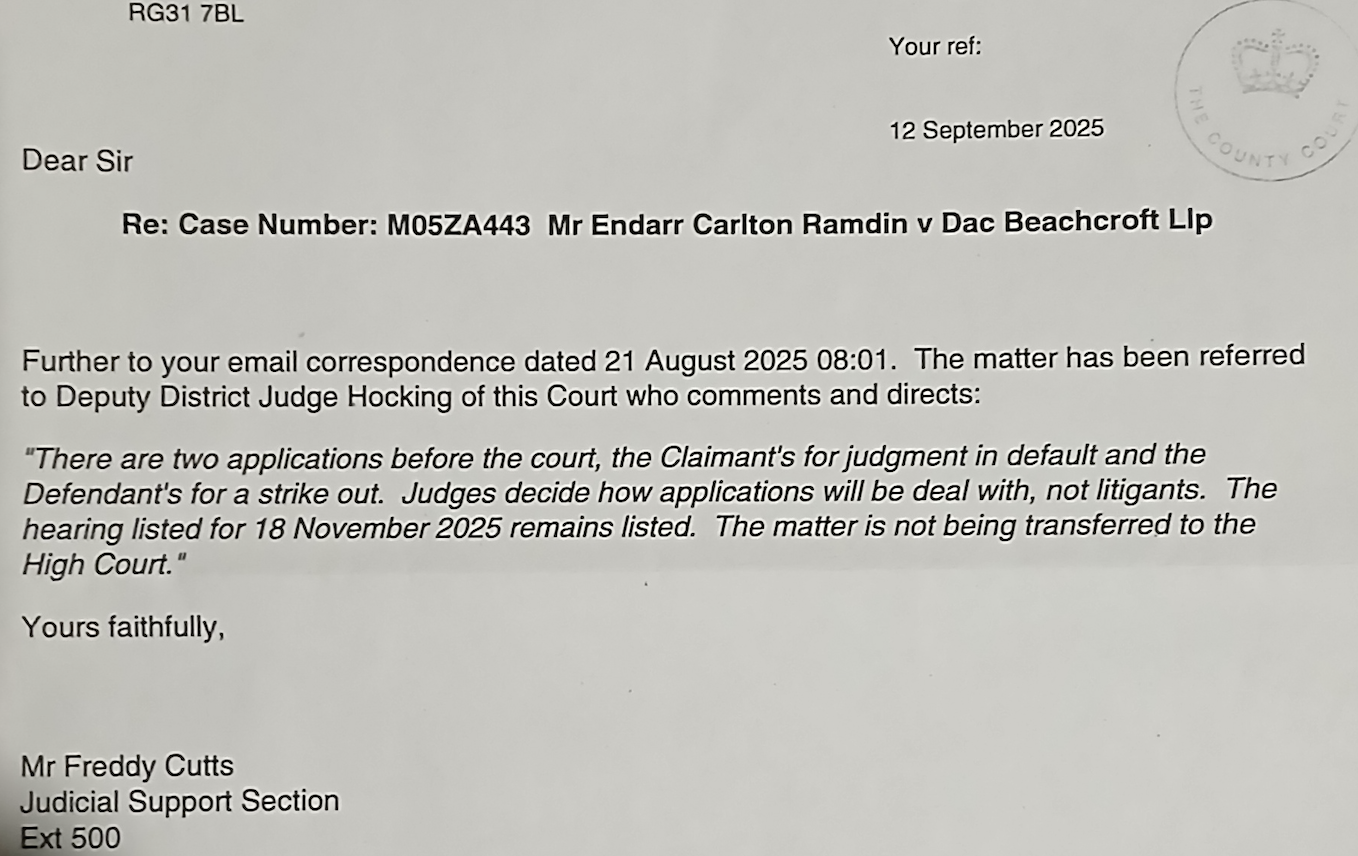
On 12 September 2025, HMCTS issued a postal-only letter in response to email correspondence from the Claimant regarding the mislisting of multi-million-pound civil action (M05ZA443). The letter was:
• not emailed
• not digitally logged
• not sealed
• not issued as a court order
• attributed to DDJ Hocking via Judicial Support Officer Freddy Cutts
The letter contains factual inaccuracies, jurisdictional excess, and omissions inconsistent with the Civil Procedure Rules.
2. Evidence – Extracts from the 12 September Letter
“There are two applications before the court, the Claimant’s for judgment in default and the Defendant’s for a strike out.”
“Judges decide how applications will be dealt with, not litigants.”
“The matter is not being transferred to the High Court.”
These statements are examined against governing law and procedure below.
3. CPR Analysis – Procedural Misstatement
I. CPR r.23.6 — Requirements for Valid Applications
No N244 was filed by the Defendant.
A “draft order” has no procedural standing.
ANALYSIS:
THE STATEMENT THAT A STRIKE-OUT APPLICATION WAS “BEFORE THE COURT” IS INCONSISTENT WITH CPR 23.6 AND CPR 3.4.
ONLY THE CLAIMANT’S N244 (FILED 14 APRIL 2025) IS FORMALLY RECOGNISED.
II. CPR r.17.3 — Amendments to Statements of Case
The Claimant’s amendment application must be determined first.
ANALYSIS:
THE LETTER OMITS THE LIVE AMENDMENT APPLICATION, MISREPRESENTING THE ACTIVE PROCEDURAL POSTURE.
III. CPR r.1.1 — Overriding Objective
Accuracy, fairness, and proper case management were not observed.
ANALYSIS:
PROCEEDING AS IF A STRIKE-OUT EXISTS UNDERMINES ACCURACY AND FAIRNESS UNDER THE OVERRIDING OBJECTIVE.
4. Jurisdictional Analysis – Venue and Transfer
I. Practice Direction 7A, Paragraphs 2.4, 2.5, and 2.6 — High-Value Claims
Claims greater than £100,000 must be transferred to the High Court unless a Master or Designated Civil Judge directs otherwise.
ANALYSIS:
THE CLAIMANT’S AMENDED VALUE EXCEEDS £10 MILLION.
A DEPUTY DISTRICT JUDGE CANNOT DETERMINE TRANSFER.
THE STATEMENT “NOT BEING TRANSFERRED” IS ULTRA VIRES.
5. Record-Keeping Analysis – Absence of Digital Trail
I. HMCTS Digital Communications Protocol (2024)
Responses must use the same channel unless a sealed order is produced.
ANALYSIS:
A POSTAL-ONLY RESPONSE TO AN EMAIL PREVENTS AUDIT, METADATA, CE-FILE INDEXING, AND BREACHES:
• PUBLIC RECORDS ACT 1958, s.3
• DATA PROTECTION ACT 2018 (ACCOUNTABILITY PRINCIPLE)
• HMCTS RM POLICY
6. International-Law Obligations
I. ICCPR — International Covenant on Civil and Political Rights
Article 2(3) — Effective remedy.
Article 14(1) — Fair hearing.
ANALYSIS:
MISSTATEMENT OF APPLICATIONS AND VENUE UNCERTAINTY CONTRADICT FAIR-PROCESS REQUIREMENTS.
II. UDHR — Universal Declaration of Human Rights
Article 7 — Equal protection.
Article 8 — Remedy.
Article 10 — Fair hearing.
ANALYSIS:
PROCEDURAL INCONSISTENCIES IMPAIR EQUAL PROTECTION.
III. ECHR — Human Rights Act 1998
Article 6 — Fair trial.
Article 13 — Remedy.
Article 8 — Data transparency.
ANALYSIS:
NON-RECORDED JUDICIAL CORRESPONDENCE DAMAGES TRANSPARENCY AND CONFIDENCE IN ADJUDICATION.
7. Truthfarian Equilibrium Analysis
Quantitative Breakdown
Let:
• 𝓟 = Procedural Integrity
• 𝓡 = Rights Recognition
• 𝓛 = Lawfulness
• 𝓔 = Ethical Neutrality
Eq(𝓢) = f(𝓟, 𝓡, 𝓛, 𝓔)
PROCEDURAL INTEGRITY ↓
RIGHTS RECOGNITION ↓
LAWFULNESS ↓
ETHICAL NEUTRALITY ↓
THEREFORE Eq(𝓢) → 0
8. Conclusion – A Procedural Record Incompatible with Equilibrium
This correspondence demonstrates factual misstatement, omission of the Claimant’s N244 amendment, jurisdictional excess, absence of digital record, and ambiguity affecting rights under domestic and international law.
9. Exhibits / Source Index
• Exhibit A – Letter dated 12 September 2025
Structural Impact Formula
The Structural Impact Score is defined as:
$SIS = \left( \sum_{i} w_i \cdot x_i \right)\!\left( 1 + \lambda \sum_{i\lt j} x_i x_j \right)$
Where:
$x_i$ are binary structural variables representing the presence (1) or absence (0) of each structural pattern, including:
- $P$ = Procedural Breakdown
- $C$ = Court / Authority Administrative Capture
- $R$ = Rights / Regulatory Misstatement
- $V$ = Vulnerability Amplifier
- $I$ = Institutional Interlock
$w_i$ are the base weights assigned to each variable in the TruthFarian structural pattern model.
$\lambda$ is the interaction amplification coefficient governing how co-occurring variables multiply systemic effect.
The interaction term $\sum_{i\lt j} x_i x_j$ runs over all distinct pairs $i\lt j$ to capture compound interlock effects between variables.
Structural Impact Result
$SIS = (w_P + w_C + w_R + w_V + w_I)\cdot(1 + \lambda \cdot 10)$
Activated Structural Variables:
- $P = 1$
- $C = 1$
- $R = 1$
- $V = 1$
- $I = 1$
Interaction Pair Count: $10$ co-occurring variable pairs
Structural Impact Meaning
An $SIS$ at this level reflects ultra vires judicial commentary and procedural misstatement operating outside lawful adjudicative scope, rather than clerical error or permissible discretion.
The active configuration — procedural breakdown ($P$), administrative capture ($C$), rights and regulatory misstatement ($R$), vulnerability amplification ($V$), and institutional interlock ($I$) — evidences distortion of jurisdictional boundaries and erosion of procedural certainty.
Co-occurring structural patterns amplify one another, confirming escalation beyond isolated misstatement into governance-level breach. Within the TruthFarian Structural Pattern Model, this profile engages public-law thresholds concerning lawful authority, judicial restraint, equality of arms, and institutional accountability.