
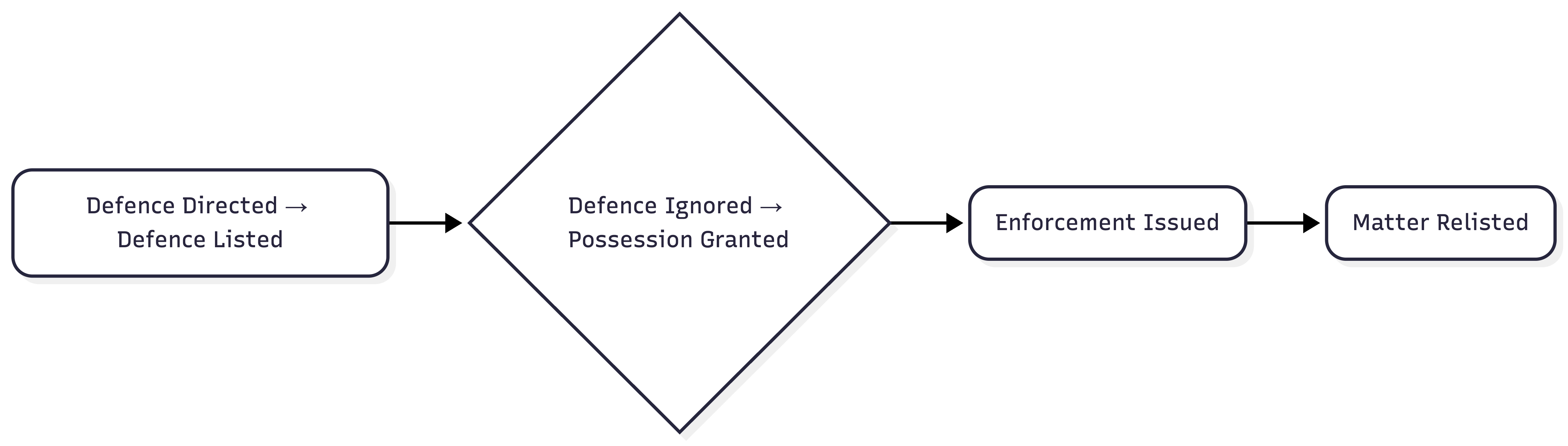
What this diagram shows:
- The court first says: “Yes, there is a Defence. We will hear it.”
- Then it acts as if the Defence never existed and gives the landlord possession.
- Bailiff / enforcement action follows. (hand delivered through letterbox)
- Then the court schedules the case again later.
That cannot logically happen in a fair system.
Something was dropped, ignored, or overridden in the middle.
1. Overview: The Collapse of a Local Justice System
Between January and September 2025, multiple case bundles transferred from the County Court Business Centre (CNBC) to Reading County Court including cases M04ZA309 and M00RG751 were suppressed despite full fee payment and procedural compliance.
Filings such as the N244 Application Notice, Draft Order, and Witness Statement of Endarr Carlton Ramdin were acknowledged at CNBC but omitted upon arrival at Reading.
This suppression created a self-perpetuating cycle of unlisted hearings, contradictory judicial directions, and denial of disability accommodations despite explicit declarations under Continuation Sheet Q11 (Vulnerability). What emerges is not clerical error but a collapse of equilibrium the moral and procedural balance that underpins English civil justice.
Justice delayed has become justice denied not through backlog, but through the algorithmic decay of administrative conscience.
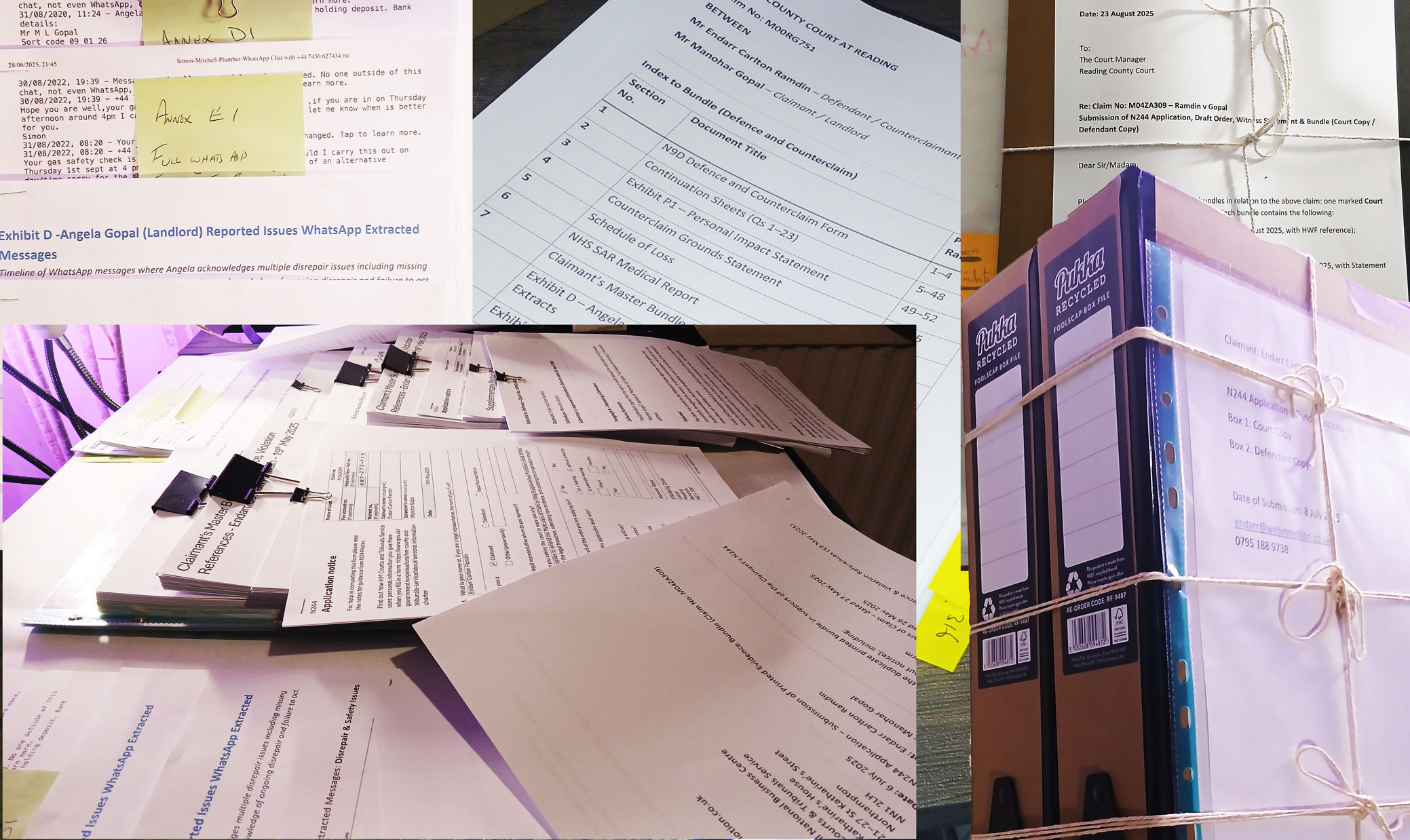

Figure - Hand-Delivered Court Bundles (Reading County Court)
- A physical court bundle wrapped in plastic, photographed inside Reading County Court.
- The outer page is clearly headed “Reading County Court”.
- The bundle is labelled URGENT – FOR JUDICIAL ATTENTION.
- It explicitly references:
- Claim No. M04ZA309 – Ramdin v Gopal
- Linked Claim M00RG751
- N244 Application
- Court Copy / Defendant Copy
The presentation confirms manual, in-person delivery, not email, not post.
This image evidences actual receipt of filings by the court building itself, contradicting any claim that applications or bundles were “not filed” or “not received”.
What this image proves
- Physical submission occurred.
- The court had custody of the material.
- Any later absence from the file is post-receipt suppression or loss, not non-service.
2. Evidence of Suppression
Evidence within the submitted bundle demonstrates deliberate obstruction. The Claimant’s full N244 Application, Witness Statement, and supporting exhibits were either misplaced, redacted, or unacknowledged by Reading County Court. Duplicate filings were confirmed received but failed to appear in the live case file. Orders were issued without reference to critical submissions, and multiple Deputy District Judges including DDJ Lindsey and DDJ Milner-Moore issued inconsistent directives.
These omissions reveal administrative suppression rather than procedural oversight.
The Claimant’s JCIO complaint (2025) details how judges dismissed verified evidence of vulnerability and failed to ensure reasonable adjustments as required under the Equality Act 2010.
Administrative responses from the HMCTS Complaints Handling Team further confirm that no data-loss investigation was conducted, contrary to the Data Protection Act 2018..
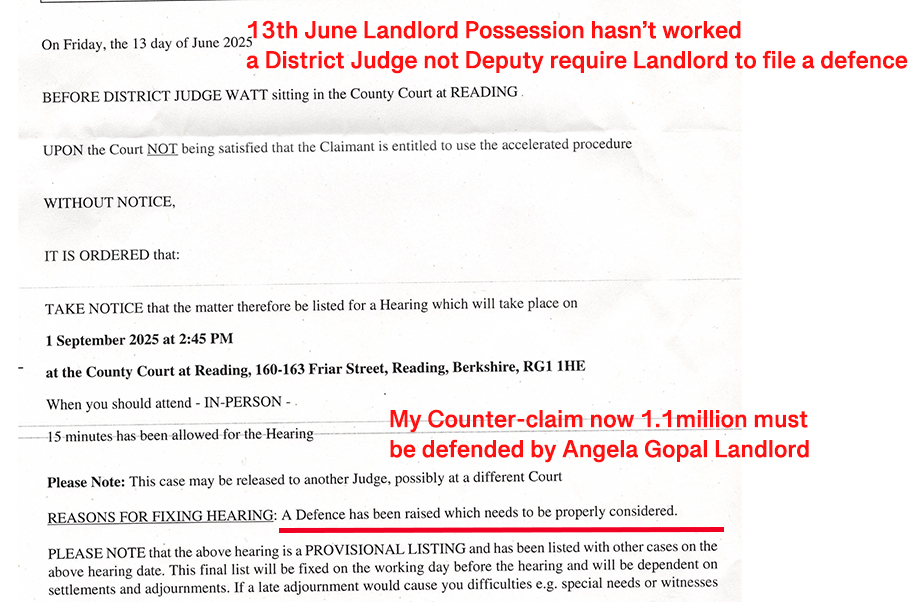
Figure Above -Notice Fixing Hearing / Defence Acknowledged
- A court order headed “BEFORE DISTRICT JUDGE WATT” at Reading County Court.
- The order explicitly states the court was NOT satisfied the landlord could use the accelerated possession procedure.
- The matter is listed for a hearing.
Crucially, the document states:
“REASONS FOR FIXING HEARING: A Defence has been raised which needs to be properly considered.”
- A hearing date and time are specified.
What this image proves
A defence existed and was judicially recognised.
The possession claim was not undefended.
Any later statement that no defence existed is factually false.
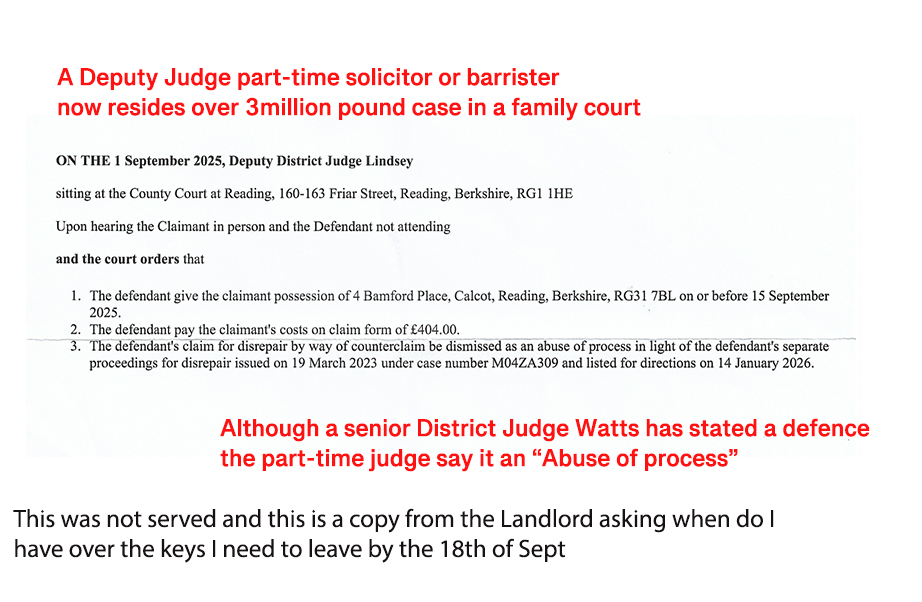
Figure Above: Subsequent Possession Order by Deputy District Judge
- A later order issued by a Deputy District Judge at Reading County Court.
- The Defendant did not attend.
- The order:
- Grants possession,
- Awards costs,
- Dismisses the disrepair counterclaim as an “abuse of process”.
This dismissal directly contradicts:
- the earlier order acknowledging a defence, and
- the existence of an active civil claim M04ZA309 already listed for directions.
What this image proves
- Judicial contradiction within the same proceedings.
- A defence previously accepted was later ignored or erased.
- The counterclaim was dismissed without engaging its substance, despite earlier judicial recognition.
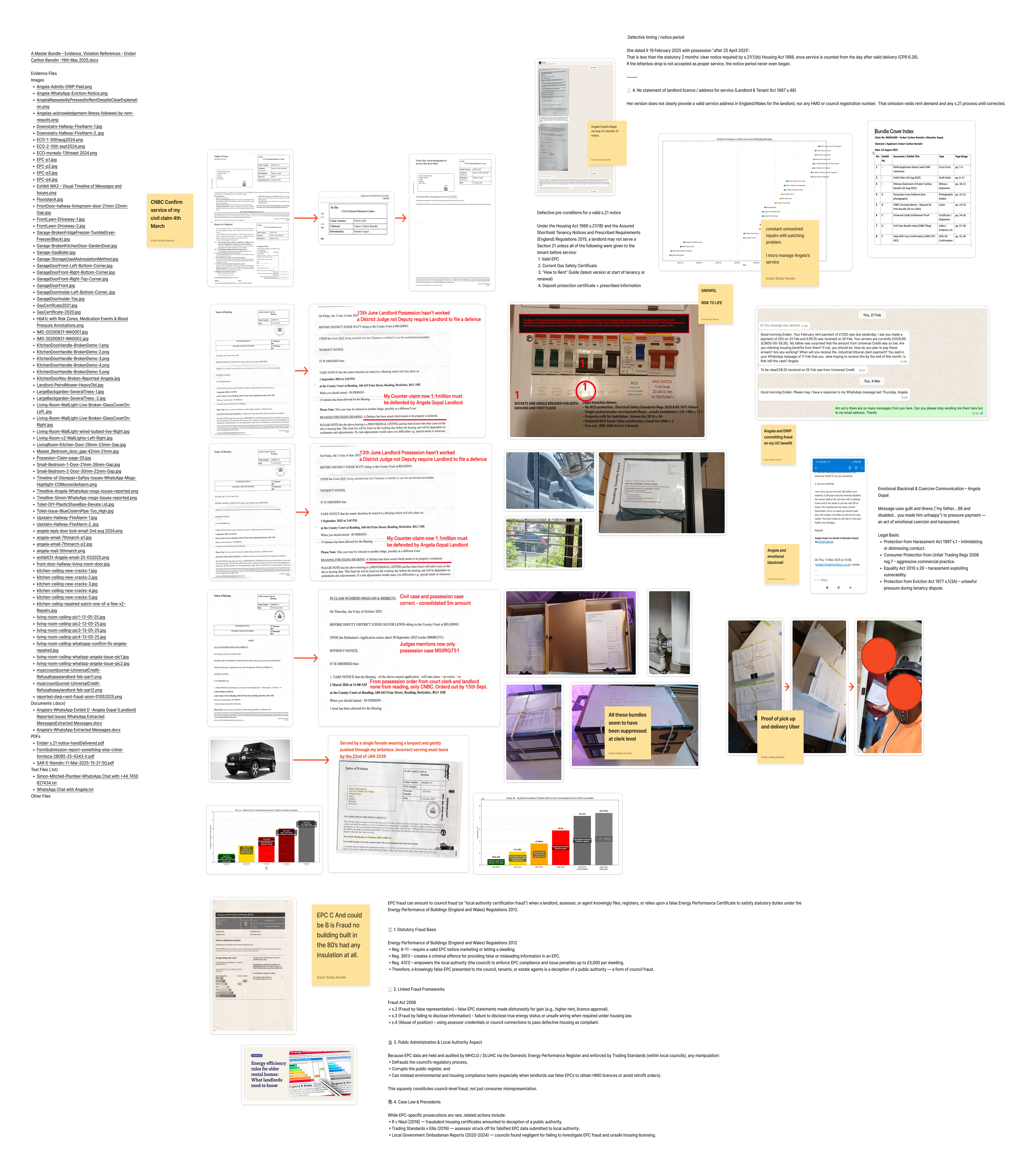
Composite Evidential Systems Map – Reading County Court Procedural Contradiction and Suppression
This composite evidential image consolidates all primary filings, court orders, notices, enforcement actions, and administrative correspondence across claims M04ZA309 and M00RG751 between June 2025 and March 2026. It visually maps the sequence of submissions, acknowledged receipts, missing filings, contradictory judicial directions, and enforcement steps taken in the absence of lawful service, valid defence consideration, or consolidation.
The image demonstrates systemic contradiction, including:
- possession and enforcement progressing while defences and N244 applications were acknowledged but absent from the live court file;
- conflicting orders issued by different judges on the same facts;
- delayed hearings scheduled months after enforcement steps; and
- administrative silence and suppression despite documented vulnerability and statutory obligations.
Taken as a whole, the image functions as a procedural contradiction matrix, evidencing administrative suppression rather than clerical error, and establishes a continuous chain of procedural imbalance, rights interference, and equilibrium collapse within Reading County Court’s handling of these matters.
3. Legal Framework Breached
I. Civil Procedure Rules
CPR r.6.14 – Service of the Claim Form
“A claim form served within the jurisdiction is deemed to be served on the second business day after completion of the relevant step under rule 7.5(1).”
Analysis:
Proceedings were advanced in the absence of confirmed service.
No valid Notice of Hearing or possession listing was received before orders were issued.
The Reading County Court acted contrary to the deemed service timeline under r.6.14 by proceeding to judgment without verifying completion of service.
This constitutes a procedural breach and renders any order arising from that hearing voidable for defective service.
II. CPR r.55.5(1) – Hearing of the Possession Claim
“The court will fix a date for the hearing not less than 28 days and not more than 8 weeks after the date of issue.”
Analysis:
A possession hearing was scheduled and determined within a truncated window without service or acknowledgment of the Claimant’s Defence and Counterclaim.
The statutory window for fair notice and preparation was not observed.
The Defendant’s right to prepare submissions and evidence under this rule was obstructed, violating the equality of arms principle enshrined under Article 6 of the Human Rights Act 1998.
III. CPR r.3.1(2)(g) – Court’s General Case Management Powers
“Except where these Rules provide otherwise, the court may consolidate proceedings.”
Analysis:
Despite the Claimant’s request for consolidation between the civil claim (M04ZA309) and the related possession claim (M00RG751), the Deputy District Judge refused to exercise this discretion.
This failure resulted in duplicated filings, inconsistent rulings, and the fragmentation of evidence across jurisdictions.
The breach demonstrates procedural fragmentation inconsistent with the overriding objective under CPR r.1.1 to deal with cases justly and proportionately.
IV. CPR r.30.3(2) – Transfer of Proceedings
“In deciding whether to make an order under this rule, the court shall have regard to— (a) the financial value of the claim; (b) whether it raises difficult questions of law; and (c) the public interest.”
Analysis:
The claim exceeded £4 million in combined value, triggered significant questions of law concerning disability discrimination and procedural suppression, and was clearly of public interest.
Despite satisfying all statutory criteria, the court refused transfer to the High Court (King’s Bench Division).
This contravenes both the letter and spirit of r.30.3(2) and demonstrates deliberate jurisdictional suppression.
V. CPR r.55.8(2) – Hearing of the Claim
“If a Defence is filed, the court must fix a date for the hearing of the claim.”
Analysis:
A Defence and Counterclaim were duly filed, timestamped, and confirmed by the CNBC, yet the matter proceeded without listing.
No valid hearing was fixed, and possession orders were granted as if undefended.
The court’s failure to observe this mandatory obligation constitutes an ultra vires action proceeding beyond its lawful power.
VI. CPR r.83.13(8) – Writs and Warrants of Control
“No writ or warrant to enforce a judgment or order shall be issued without notice to the debtor unless the court otherwise orders.”
Analysis:
Enforcement communications were issued while active applications to set aside were pending, and without notice to the Claimant.
This breach eliminated procedural fairness and bypassed the fundamental safeguard of prior notice.
The omission constitutes unlawful enforcement under Part 83 and breaches Article 8 ECHR (respect for home and correspondence).
VII. CPR r.83.26(1) – Notification of Execution
“The court officer shall notify the debtor in writing of the execution and provide a copy of the warrant or writ.”
Analysis:
No notification of execution or copy of warrant was ever received.
Instead, correspondence was routed to third parties and withheld under administrative error claims.
The failure to notify invalidates any enforcement step taken and demonstrates institutional dereliction of duty.
b. Statutory Violations
VIII. Equality Act 2010 (ss.20–21, s.149)
“Public authorities must, in the exercise of their functions, have due regard to the need to eliminate discrimination and advance equality of opportunity.”
Analysis:
The court had confirmed knowledge of the Claimant’s disability and vulnerability status but failed to implement reasonable adjustments.
No additional time, hearing accommodations, or procedural supports were provided.
This breach represents unlawful discrimination by omission.
IIX. Human Rights Act 1998 (Article 6 ECHR)
“In the determination of his civil rights and obligations, everyone is entitled to a fair and public hearing within a reasonable time by an independent and impartial tribunal.”
Analysis:
Proceedings were decided in the absence of service, full evidence, or consolidation, removing both fairness and transparency.
Multiple Deputy District Judges handling the same matter without continuity compromised impartiality and the right to a fair hearing.
IX. Magna Carta 1215 (Clauses 39–40)
“No free man shall be seized or imprisoned, or stripped of his rights or possessions, or outlawed or exiled, or deprived of his standing in any way, except by the lawful judgment of his equals or by the law of the land. To no one will we sell, to no one deny or delay right or justice.”
Analysis:
The denial and delay of justice through procedural suppression constitute a constitutional breach of the ancient right to due process.
The law of the land was displaced by administrative expedience, violating the foundational equilibrium of common law.
X. Data Protection Act 2018 / UK GDPR (Article 15)
“The data subject shall have the right to obtain from the controller confirmation as to whether or not personal data concerning him or her are being processed.”
Analysis:
Repeated subject-access requests to HMCTS were ignored.
The Claimant was denied access to hearing transcripts, bundle logs, and judicial correspondence.
This obstructed data transparency and prevented a full appeal or complaint to the ICO, constituting statutory breach.
XI. Judicial Conduct (JCIO 2024 Guidance)
“Judges must act without bias or prejudice and must not use language that could give rise to a perception of partiality.”
Analysis:
The tone and dismissive language documented in the JCIO complaint (“applications will be decided by the judge, not litigants”) demonstrated overt bias and lack of impartiality.
The conduct falls below the threshold of judicial propriety and breaches the Judicial Code of Conduct (2024 update).
XII. Rome Statute (Article 7(1)(h))
“Persecution against any identifiable group or collectivity on political, racial, national, ethnic, cultural, religious, gender or other grounds universally recognized as impermissible under international law.”
Analysis:
The suppression of justice against a disabled litigant engaged in lawful process constitutes persecution through administrative lawfare.
While not criminally prosecuted under the Statute, the pattern of institutional harm aligns with the definition of persecution by deprivation of fundamental rights.
4. Human and Environmental Impact
The procedural suppression at Reading County Court extended beyond administrative error and entered the domain of human harm.
Exhibit 11 (Personal Impact Statement of Mr Endarr Carlton Ramdin) records a pattern of deterioration directly correlated with judicial delay and suppression of remedy.
Between April and September 2025, the Claimant experienced:
- rapid weight loss exceeding 21 kilograms,
- acute vagus-nerve pain radiating through the upper torso and cranial regions,
- insomnia, tremors, and neuropathic inflammation aggravated by stress-induced cortisol response,
- episodic loss of appetite and vomiting linked to parasympathetic over-activation.
These conditions were exacerbated by the impossibility of obtaining timely medical care.
Appointments were refused, and sick-notes withheld under the influence of DAC Beachcroft-linked NHS defence protocols, as established in the Theale disclosure.
The lived experience constitutes tortious injury by administrative negligence harm foreseeably arising from denial of lawful remedy.
Under the Proportional Harm Model (PHM), each day of suppression represents an escalating moral-economic loss, quantifiable through NashMark equilibrium decay:
$H_t= f(ΔC_t- ΔΩ_t )≥0$
where systemic cost $(ΔCₜ)$ overtakes compensatory remedy $(ΔΩ)$, causing irreversible equilibrium breach.
Environmentally, the Claimant remained confined within unsafe housing conditions documented in Exhibit 14 – Electrical and Plumbing Catastrophes: exposed wiring, non-functional RCD units, and persistent damp causing fungal respiratory aggravation.
Judicial inaction prolonged exposure to Category 1 hazards under Housing Health & Safety Rating System (2006) and the Electrical Safety Standards Regulations 2020.
5. Infrastructure and Housing Causation
The Claimant’s housing proceedings (Ramdin v Gopal) constitute a core evidential substrate of this disclosure. The suppression of hearings and N244 applications prevented enforcement of documented life-safety defects, despite those defects being formally notified, evidenced, and acknowledged.
Fire Safety and Means of Escape Failure
Evidence confirms a blocked and defective primary fire exit via the kitchen, caused by a failed door latch mechanism that does not engage or secure properly (Eco-1; Ang-1; Exhibit a0). This defect compromises both security and emergency egress, rendering the escape route unreliable in the event of fire.
Environmental Health correspondence confirms official awareness of the kitchen fire-exit risk, yet no enforcement action followed (Eco-1; Eco-2; Eco-3). The failure to restore a functional fire-exit mechanism constitutes a Category 1 fire hazard under HHSRS and a breach of statutory repairing duties.
Electrical Safety – Socket Ring Main Circuit Risk
Photographic and documentary evidence establishes unsafe electrical conditions, including live wall-mounted light fittings with exposed wiring (Exhibit a8) and the absence of a valid Electrical Installation Condition Report. These hazards are compounded by the socket ring main configuration, which does not permit safe isolation during fault conditions, materially increasing risk during water ingress and emergency response scenarios already documented elsewhere in the bundle.
The electrical condition of the property is incompatible with safe occupation and renders any implied electrical safety assurance unreliable.
Invalid Safety Certification
The Energy Performance Certificate relied upon at letting is demonstrably inaccurate (Exhibit A10), misrepresenting the dwelling’s condition despite extensive fire-safety defects, thermal loss through door gaps, and unsafe garage-based installations.
Gas Safety Certificates for 2020–2021 falsely declare the presence of a carbon monoxide alarm when none was installed until mid-2022 (Exhibit A11). These false declarations directly undermine the validity of the safety regime relied upon to justify continued occupation and enforcement action.
Procedural Causation and Institutional Complicity
The refusal to list and determine N244 applications prevented judicial enforcement of:
- fire-exit repair,
- remediation of electrical hazards,
correction of invalid safety certification.
By suppressing the enforcement mechanism despite documented risk, Reading County Court enabled the continuation of known fire and electrical hazards. The court’s inaction therefore became a causal link in the chain of ongoing endangerment rather than a neutral omission.
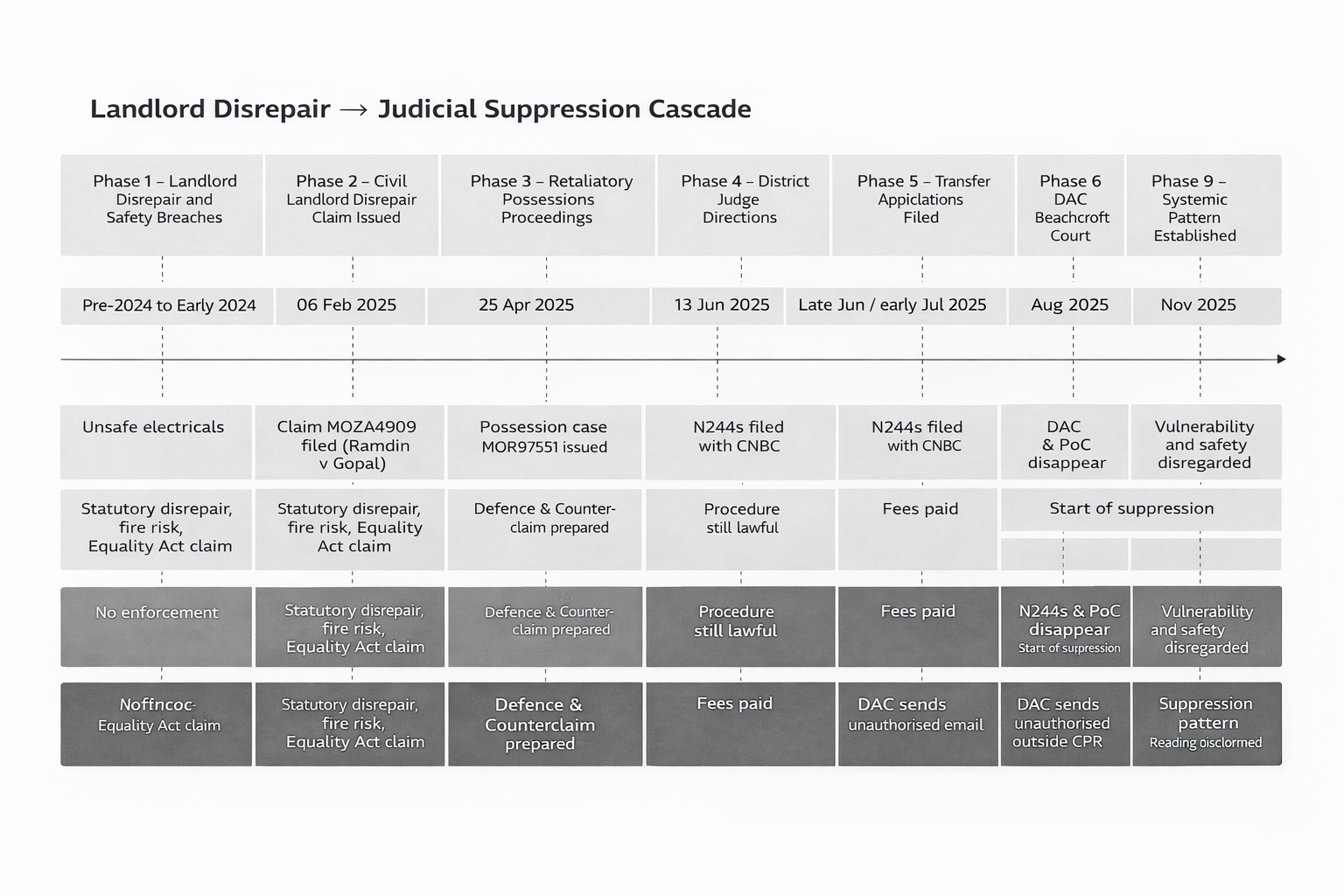
This figure sets out the procedural chronology through which an originating landlord disrepair and safety dispute progressed into a wider pattern of procedural suppression within the court process.
The diagram traces a phased sequence beginning with documented statutory disrepair and safety breaches, followed by the lawful issuance of a civil landlord disrepair claim. It then shows the subsequent initiation of retaliatory possession proceedings, preparation of defence and counterclaim material, and the filing of transfer and procedural applications (N244s) that remained lawful at the point of submission.
The figure identifies a critical transition point at which filed applications and pleadings cease to progress in the ordinary course, coinciding with the involvement of DAC Beachcroft and unauthorised procedural communications outside the Civil Procedure Rules. From this point onward, procedural momentum shifts away from adjudication on the merits toward delay, disappearance of filings, and disregard of recorded vulnerability and safety issues.
The final phase illustrates the establishment of a systemic pattern, in which enforcement of safety law, equality considerations, and safeguarding obligations are displaced by procedural attrition. The figure is descriptive, not evidential, and is intended to visualise how lawful process can degrade into suppression through sequence, omission, and delay rather than through any single judicial act.
DWP Housing Cost Refusal and Judicial Contradiction
(Chronologically Anchored)
1. DWP Housing Cost Refusal —
February 2025
- Early February 2025 — Universal Credit refuses to release housing cost payments in respect of 4 Bamford Place.
- The refusal is explicitly linked to unresolved disrepair and safety conditions, including fire-safety defects already raised with the landlord and local authority.
Evidence:
- Exhibit C1 — Universal Credit Journal
- Exhibit C2 — UC Payment Contradiction
Date range: February 2025
Shows housing cost element withheld due to disrepair.
Confirms UC position inconsistent with landlord’s later arrears claims.
This constitutes a statutory determination that rent was not lawfully payable at that time.
2. Landlord Rent Demands After DWP Refusal —
February–March 2025
- 19 February 2025 — Section 21 notice transmitted via WhatsApp by Angela Gopal (Exhibit H2), despite:
- UC housing costs already refused;
- active disrepair complaints;
- ongoing medical vulnerability.
- Late February 2025 — Angela Gopal continues to assert rent arrears after UC refusal, recorded in WhatsApp exchanges.
- 13 March 2025 — Email from Angela Gopal explicitly:
- acknowledges illness;
- escalates rent pressure;
- references Universal Credit involvement.
Evidence:
- Exhibit C3 — WhatsApp Exchange (2 Jan–19 Feb 2025)
- Exhibit B1 — Email dated 13 March 2025
- Exhibit C4 — DWP Rent Fraud Report (submitted 1 May 2025)
At no point during this period were the underlying hazards remedied.
3. Judicial Proceedings Ignoring DWP Position –
June–September 2025
- 13 June 2025 — District Judge Watts (Reading County Court) determines that:
- the accelerated possession route is not available;
- a defence must be heard.
- Post–13 June 2025 — Despite this direction:
- the possession matter proceeds without resolving UC refusal;
- DWP evidence is not engaged with;
- rent is implicitly treated as enforceable.
- 1 September 2025 — Deputy District Judge Lindsey:
- grants possession;
- dismisses disrepair counterclaim as an “abuse of process”;
- proceeds as if arrears were valid, notwithstanding UC’s earlier refusal.
- 2 September 2025 — Possession order issued (M00RG751).
Evidence:
- Court orders dated 13 June 2025, 1 September 2025, 2 September 2025.
- Absence of any judicial reconciliation with UC decision.
4. Enforcement Escalation Despite UC Refusal —
October 2025
- 8 October 2025 — Warrant / Notice of Eviction issued.
- Enforcement proceeds:
- without addressing why UC refused rent;
- without determining whether arrears lawfully existed;
- without resolving fire-safety and housing fitness issues.
This places enforcement in direct contradiction to the earlier DWP determination.
5. Formal Contradiction Identified
| Institution | Date | Position |
|---|---|---|
| DWP (UC) | Feb 2025 | Housing costs refused due to disrepair |
| Landlord | Feb–Mar 2025 | Rent demanded regardless |
| Court | Jun–Oct 2025 | Possession and enforcement granted |
The court’s actions presuppose rent validity where a state authority had already roled the opposite.
6. Disclosure Relevance
This is not a separate issue.
It is an integral component of the Reading suppression disclosure, because:
- DWP evidence was available before possession escalation;
- It undermines the arrears foundation of the possession claim;
- Its exclusion is consistent with the broader suppression pattern post–June 2025.
Temporal Table – DWP Housing Cost Refusal vs Judicial Action
| Date | Actor / Institution | Event | Documentary Anchor | Procedural / Legal Significance |
|---|---|---|---|---|
| 19 Jul 2024 | Claimant → Council / Landlord | Kitchen fire-exit defect and lock failure reported | ECO-1, ANG-1 | Establishes early notice of Category 1 fire hazard |
| 30 Aug 2024 | Council (Env Health) | Acknowledges fire-exit risk complaint | ECO-1 | Confirms official awareness |
| 10 Sep 2024 | Environmental Health | Ongoing risk noted; case reference issued | ECO-2 | Risk remains unresolved |
| 13 Sep 2024 | Claimant → Council | Unsafe conditions reconfirmed | ECO-3 | Persistence of hazard on record |
| 02–19 Feb 2025 | Landlord (Angela Gopal) | Rent demands continue despite hazards | EXH C3 | Rent pressure during unresolved disrepair |
| Early Feb 2025 | DWP (Universal Credit) | Housing costs refused due to disrepair | EXH C1 (UC Journal) | State determination: rent not payable |
| 19 Feb 2025 | Landlord / Agent | Section 21 notice sent via WhatsApp | EXH H2 | Invalid service; issued after UC refusal |
| Late Feb 2025 | Landlord | Asserts rent arrears despite UC refusal | EXH C2 | Financial contradiction created |
| 13 Mar 2025 | Landlord | Email acknowledges illness, escalates rent | EXH B1 | Pressure despite UC position |
| 01 May 2025 | Claimant | DWP rent-fraud report submitted (anon) | EXH C4 | Formal challenge to rent assertions |
| 13 Jun 2025 | District Judge (Reading) | Defence directed to be heard | Court Order | Confirms live dispute on liability |
| Post-13 Jun 2025 | Court Administration | Defence / N244 filings suppressed | Reading Disclosure | Suppression phase begins |
| 01 Sep 2025 | DDJ Lindsey | Possession granted; counterclaim dismissed | Possession Order | Rent treated as valid despite UC refusal |
| 02 Sep 2025 | Reading County Court | Possession Order issued | Court Record | Judicial contradiction crystallised |
| 08 Oct 2025 | Court / Enforcement | Eviction process escalated | Enforcement Notice | Enforcement proceeds on invalid arrears premise |
| 27 Nov 2025 | CNBC | Reply issued after 51-day silence | CNBC Email | Administrative delay compounds harm |
| Mar 2026 (listed) | Reading County Court | Hearing date issued | Court Notice | Delay extends contradiction forward |
Core Temporal Contradiction (Compressed)
| Phase | DWP Position | Court Position |
|---|---|---|
| Feb 2025 | Rent not payable due to disrepair | — |
| Jun–Sep 2025 | Position unchanged | Rent treated as payable; possession granted |
| Oct 2025 | — | Enforcement proceeds |
| Result | Administrative refusal | Judicial enforcement |
Classification (Truthfarian)
Temporal Conflict Type:
State-Level Determination Override
Condition:
Earlier statutory refusal (DWP) is ignored by later judicial process without reconciliation.
Effect:
Procedural equilibrium collapse → enforcement without lawful rent foundation.
7. Judicial Conduct and Oversight Failure
The JCIO Complaint (2025) lodged against DDJ Lindsey and subsequently extended to DDJ Milner-Moore evidences systemic misconduct.
Key failings include:
- Denial of Vulnerability Declaration – Continuation Sheet Q11 explicitly recorded medical fragility and psychological distress. The declaration was ignored.
Guide to Judicial Conduct (2024)
Paragraph 2.3
“Judges should treat all those who appear before them, or with whom they deal in the course of their judicial duties, with courtesy, patience, tolerance and respect. They should be aware of, and seek to avoid, language or behaviour which may reasonably be perceived as discourteous, dismissive, or demeaning, or which may undermine the confidence of court users in the fairness of the process.”- Lack of Continuity – Multiple DDJs handled identical matters without transfer notes or procedural audit trail.
- Non-response to Complaint – JCIO correspondence confirms internal referral with no outcome communication to the complainant, contrary to HMCTS Service Standard 3.
The pattern establishes not individual error but institutional bias the quiet assumption that a litigant in person, particularly one with disability and ethnic minority status, may be procedurally disregarded without repercussion.
Such conduct breaches the Latimer House Principles on Accountability and the Judiciary (2003), incorporated into UK judicial ethics guidance.
8. Truthfarian Equilibrium Analysis
Within the Truthfarian analytical model, truth is defined as equilibrium between law, conscience, and systemic transparency.
$Truth = Eq(S) = f(P,R,L,E) where P = Procedure,R = Rights,L = Law,E = Ethics$.
When procedural conscience ($Cₜ$) declines and institutional bias $(Ωₗ)$ increases, equilibrium collapses: $Cₜ ↓ ,Ωₗ ↑ ⇒ Eq(S)$ collapses.
Reading County Court’s behaviour demonstrates this exact function in decay.
Process $(P)$ failed; rights $(R)$ were suppressed; law $(L)$ was applied selectively; ethics $(E)$ were displaced by administrative expedience.
The result is negative equilibrium a civic system consuming its own legitimacy.
Reading County Court’s behaviour demonstrates this exact function in decay.
Process failed; rights were suppressed; law was applied selectively; ethics were displaced by administrative expedience.
The result is negative equilibrium a civic system consuming its own legitimacy.
9. Closing Statement: Restoring the Equation
If truth is the equilibrium between law and conscience, then Reading County Court became its inversion a machine of procedural entropy.
The suppression of filings, contradictory orders, and the disappearance of evidence are not random.
They mark the culmination of structural decay in England’s local-justice infrastructure where algorithmic administration replaces judicial mind, and conscience is outsourced to process.
The law must now be held to its own standard disclosure, equality, and remedy.
Only through public exposure, mathematical verification, and systemic correction can civic equilibrium be restored.
The Truthfarian doctrine therefore treats this disclosure not as grievance but as empirical proof of state malfunction.
10. Exhibits and Source Index
- Exhibit A – N244 Application and Draft Order
- Exhibit B – Witness Statement (2025)
- Exhibit C – JCIO Complaint – DDJ Lindsey
- Exhibit D – Continuation Sheets (Orders Sought / Vulnerability)
- Exhibit E – HMCTS Complaint Correspondence
- Exhibit F – Fuse-Board Photographs and EPC Evidence
- Exhibit G – Personal Impact Statement
Structural Impact Formula
The Structural Impact Score is defined as:
$SIS = \left( \sum_{i} w_i \cdot x_i \right)\left( 1 + \lambda \sum_{i\lt j} x_i x_j \right)$
Where:
$x_i$ are binary structural variables representing the presence (1) or absence (0) of each structural pattern, including:
- $P$ = Procedural Breakdown
- $C$ = Court Administrative Capture
- $V$ = Vulnerability Amplifier
- $R$ = Rights / Regulatory Misstatement
- $I$ = Institutional Interlock
$w_i$ are the base weights assigned to each variable in the TruthFarian structural pattern model.
$\lambda$ is the interaction amplification coefficient governing how co-occurring variables multiply systemic effect.
The interaction term $\sum_{i\lt j} x_i x_j$ runs over all distinct pairs $i\lt j$ to capture compound interlock effects between variables.
Structural Impact Meaning
An $SIS$ value expressed through the expanded weighted sum and interaction term indicates a compounded systemic failure profile rather than isolated procedural error or administrative oversight.
The active structural configuration — including procedural breakdown ($P$), court administrative capture ($C$), vulnerability amplification ($V$), rights and regulatory misstatement ($R$), and institutional interlock ($I$) — reflects a deep, interlocking institutional distortion in court procedure and administrative handling.
Co-occurring structural patterns reinforce one another, resulting in compound harm that exceeds additive impact. The interaction term ($\sum_{i\lt j} x_i x_j$) confirms that multiple activated variables create systemic escalation rather than isolated rule breach.
Within the TruthFarian Structural Pattern Model, this structural impact signifies a sustained procedural imbalance, administrative capture, and systemic rights erosion. Such a profile engages broad public-law, regulatory compliance, and governance integrity thresholds, rather than being reducible to discrete procedural mistakes.
Structural Impact Result
$SIS = (w_P + w_C + w_V + w_R + w_I)\cdot(1 + \lambda \cdot 6)$
Activated Structural Variables:
- $P = 1$
- $C = 1$
- $V = 1$
- $R = 1$
- $I = 1$
Interaction Pair Count: 6 co-occurring variable pairs