
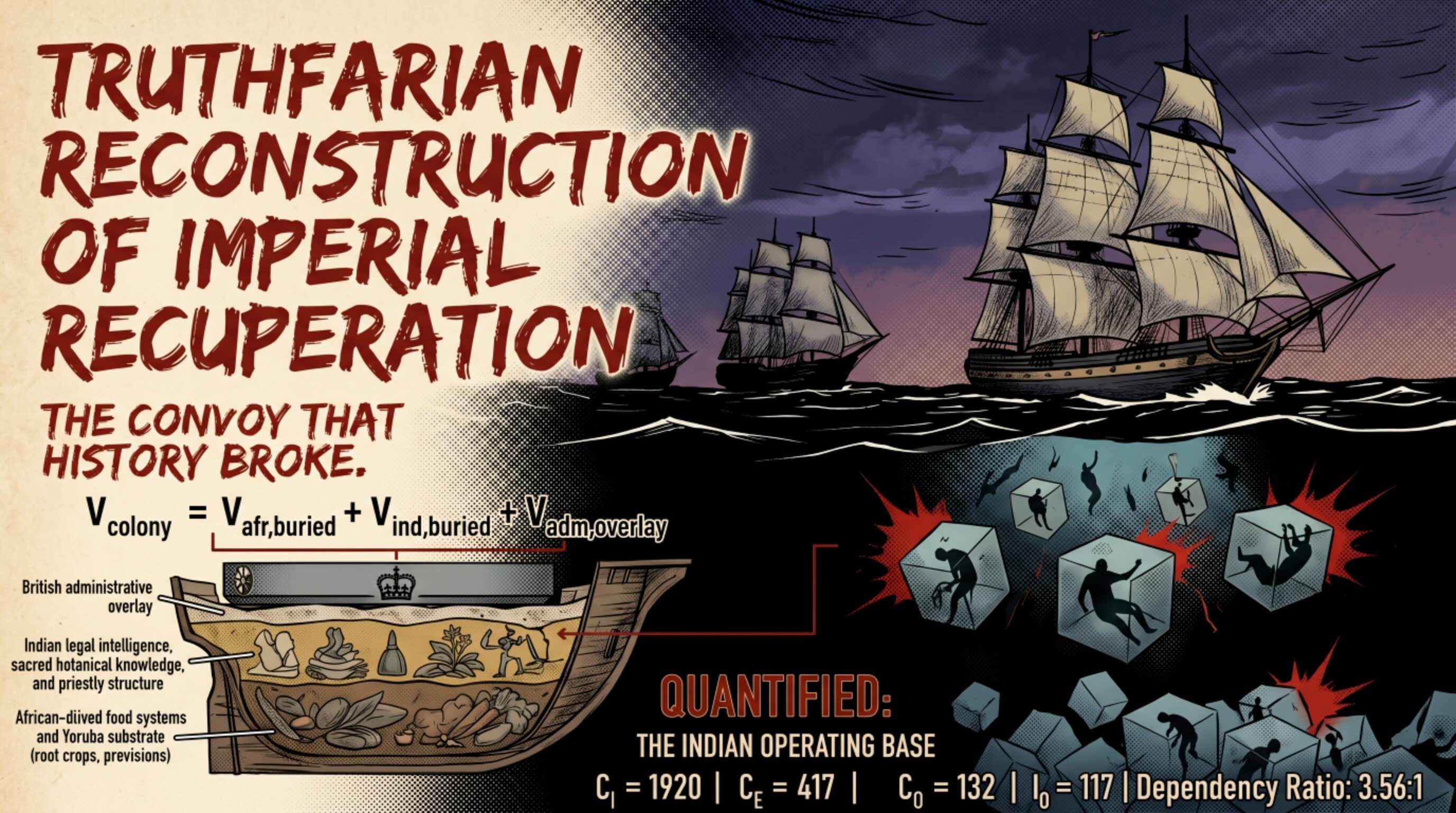
Figure 1. Truthfarian Reconstruction of Imperial Recuperation — Cover Framework
Opening visual for the full reconstruction. The figure presents the protected convoy system as a buried imperial recovery structure, combining maritime movement, colonial cargo, administrative overlay, Indian operating base, African-derived food systems, and quantified human-capability extraction.
Protected Convoys, Human Capital Extraction, Colonial Redeployment, and the Recovery of Buried Human Continuity
Chapter 1 — This Is a Truthfarian Paper
1.1 Order of proof
This paper does not proceed from institutional history as supreme authority. It does not begin by assuming that the colonial archive is neutral, complete, or entitled to define the meaning of the lives it recorded. The archive forms part of the problem under examination. It preserves fragments, labels, outputs, and residues, but it does so through the classificatory violence of empire. For that reason, the order of proof adopted here is different.
Truth structure comes first. Model correlation follows. Pattern convergence then stabilises inference. Only after that does the archive enter, not as master authority, but as residue. Where record classes concur with the deeper structure, they are useful. Where they compress, rename, downgrade, separate, or fragment, they reveal the operation of distortion rather than the disappearance of truth. This reversal is necessary because the subject of the paper is itself a system that hid what it was doing by how it named, recorded, and redistributed the people within it.
The Truthfarian method therefore treats buried continuity as recoverable even where official history has severed it. That recovery is not rhetorical. It is inferential. In the EcoMathDNAHMM framework, a population is not treated as an abstract count but as a lineage occupying viable ecological states across time; each state is an environmental snapshot, time is modelled in 25-year generations over an 80-generation horizon, and movement is constrained by eco-topological transition cost rather than assumed drift. If convoy scale can be reconstructed from destination population stock, if production surges can be inferred from shipyard thresholds, if labour composition can be bounded from operating requirements, if route logic can be modelled from maritime feasibility, and if lineage externalisation can be demonstrated through surname depletion at source and persistence across colonial nodes, then truth is not lost merely because an administrative record failed to honour it. The record may be partial. The structure is not.
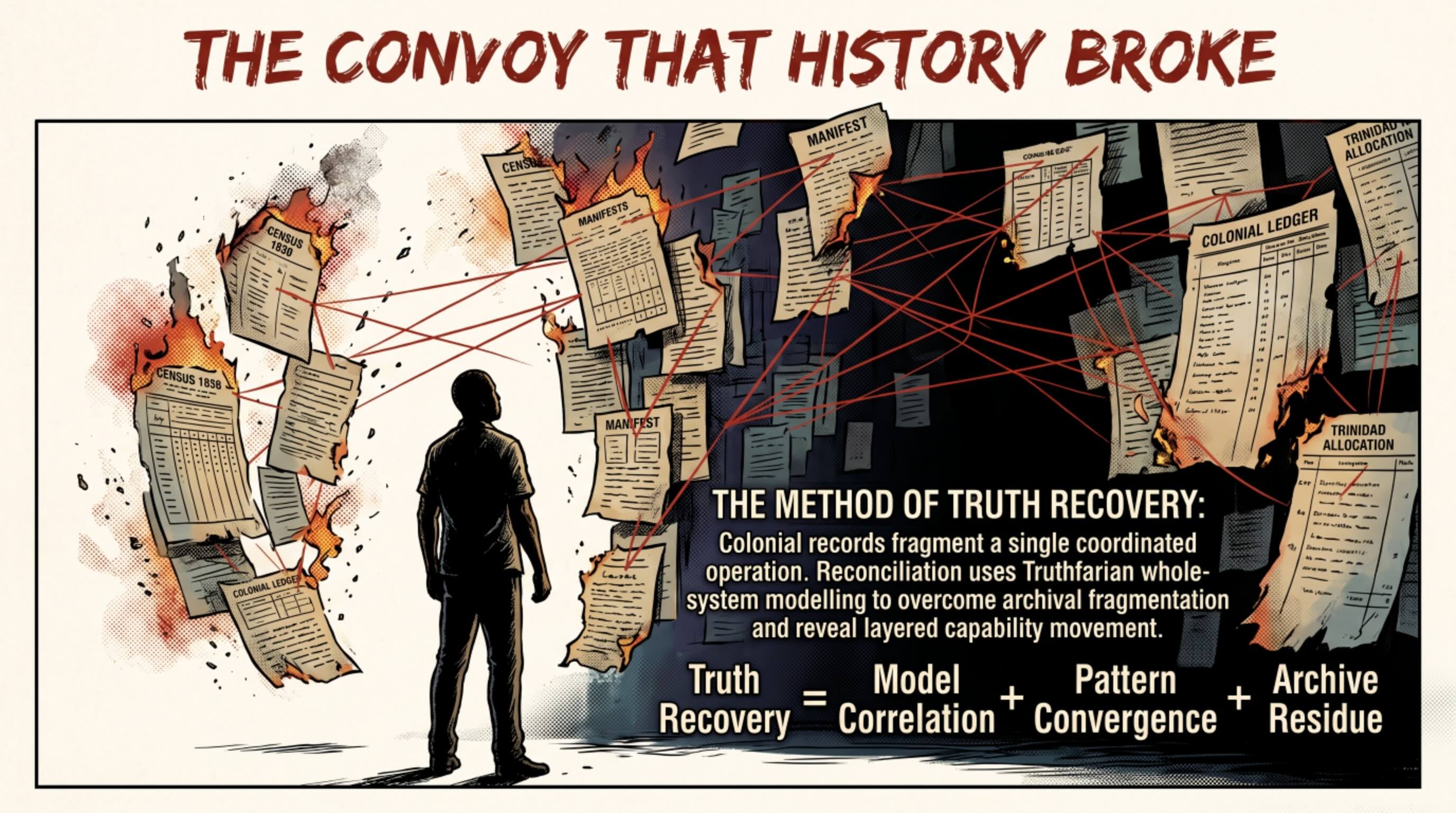
Figure 2. The Convoy That History Broke — Truth Recovery Method
This figure introduces the central recovery method of the paper: fragmented colonial records are not treated as final authority but as damaged residue to be reconciled through model correlation, pattern convergence, and archive residue.
The governing recovery relation at the opening of the paper may therefore be stated as:
Truth recovery = model correlation + pattern convergence + archive residue
$T_{\text{rec}} = M_{\text{corr}} + P_{\text{conv}} + A_{\text{res}}$
Where $T_{\text{rec}}$ denotes truth recovery, $M_{\text{corr}}$ denotes model correlation, $P_{\text{conv}}$ denotes pattern convergence, and $A_{\text{res}}$ denotes archive residue.
This formula is not decorative. It states the evidential hierarchy of the paper. The archive does not generate truth. It survives as one damaged layer within a larger recoverable structure.
Because not all evidential classes carry equal force, the relation may also be written in weighted form:
Truth score = weighted model correlation + weighted pattern convergence + weighted archive residue
$T_{\text{score}} = w_m M_{\text{corr}} + w_p P_{\text{conv}} + w_a A_{\text{res}}$
with
$w_m > w_a,\quad w_p > w_a$
This means that where the archive is historically compromised by imperial classification, renaming, or concealment, model coherence and pattern convergence outrank archive residue. The archive is not discarded. It is subordinated.
A further admissibility condition is required so that the paper does not collapse into loose accumulation of fragments:
An evidential item is admissible if and only if it satisfies coherence and relevance thresholds.
$E_i \in \mathcal{A} \iff (C_i \ge \theta_c)\land(R_i \ge \theta_r)$
Where $E_i$ denotes an evidential item, $\mathcal{A}$ the admissible set, $C_i$ coherence, $R_i$ relevance, and $\theta_c,\theta_r$ the minimum admissibility thresholds.
This matters because the thesis is not built from archive quotation alone. It is built from admissible convergence across structure, route, population limitation, and survivable residue. In the underlying model, transition feasibility is already constrained by terrain distance and ecological dissimilarity through the kernel
$a_{ij}(t)\propto \exp[-\lambda d_{\text{topo}}(i,j)-\kappa \Delta_{\text{eco}}(i,j)]$,
so historical movement is judged against viability, not narrative convenience.
1.2 Why this paper exists
This paper exists because a single coordinated imperial operation has been broken into smaller, safer stories. That fragmentation is itself part of the concealment. What is commonly presented as migration, labour transfer, colonial staffing, settlement growth, or ordinary demographic change is better understood as a protected imperial redeployment of high-value human capability across a series of British colonial nodes. The paper is written to restore the underlying continuity of that process.
The central object is not ancestry in a sentimental or decorative sense, nor history as museum narrative. The central object is human function: what kinds of people were moved, why they were moved, how they were protected, what they carried, what they built, what they became once reclassified, and how their descendants inherited the broken record of that transformation. The paper addresses the deletion of original role through administrative naming, the misdescription of convoy movement as fragmented migration, the concealment of industrial preparation behind maritime outcomes, and the reduction of civilisational intelligence into flattened colonial categories.
It also exists because the same compressive logic persists. The historical problem is not safely in the past. Bureaucratic habits that reduce function into label, capacity into category, and living continuity into procedural fiction remain operative in modern institutions. Thus the paper is not retrospective only. It is a recovery instrument for a still-active system of distortion.
This purpose can be stated formally:
Fragmented truth plus structural restoration yields recoverable whole truth.
$T_{\text{full}} = T_{\text{frag}} + C_{\text{restore}}$
Where $T_{\text{full}}$ denotes the recovered whole structure, $T_{\text{frag}}$ the fragmented visible historical remainder, and $C_{\text{restore}}$ the corrective reconstruction required to restore what fragmentation concealed.
The point is not that the archive contains nothing true. The point is that it contains only a damaged projection of a larger coordinated structure. The EcoMathDNAHMM model is important here because it provides a deep-time, state-based mechanism for reconstructing continuity and assimilation across space, time, and environment without surrendering the argument to archive literalism.
1.3 What the paper rejects
The paper rejects the assumption that imperial history can be responsibly told by staying inside the terms of imperial description. It rejects the simplification of coordinated extraction into multiple separate migrations. It rejects the notion that colonial labels describe the people to whom they were applied. It rejects the flattening of transported populations into labour mass. It rejects the idea that terms such as coolie, labourer, clerk, constable, settler, or native police can be read without reconstructing the prior role, training, lineage, and function of those so named.
It also rejects the false divide between history and modelling. The operation under examination was logistical, industrial, demographic, ecological, administrative, and epistemic all at once. A paper confined to one of those layers will necessarily miss the whole. For that reason, the present work uses a whole-system method in which maritime logic, convoy protection, industrial production, population mathematics, lineage patterning, role compression, and administrative continuity must all be read together.
Most importantly, it rejects the presumption that truth requires permission from the very institutions implicated in its concealment. A damaged archive does not annul a stable pattern. A missing manifest does not dissolve a convoy if arrival stocks, crew requirements, industrial signatures, route costs, and eco-topological viability still constrain what must have occurred. The paper proceeds on that basis. In the underlying model, each state holds survival conditions, including climate, landform, water, vegetation, soil, and nutrient profile, so historical plausibility is tested against living ecological possibility rather than narrative inheritance.
The rejection of archive absolutism can be written more precisely:
Visible record is less than underlying structure.
$V_{\text{rec}} < U_{\text{struct}}$
Where $V_{\text{rec}}$ denotes the visible recorded form and $U_{\text{struct}}$ the underlying coordinated structure.
This inequality is foundational to the thesis. The archive is not denied. It is displaced from its false position of supremacy.
1.4 Governing claim
The governing claim of this paper is direct.
The British colonial record has fragmented a single protected imperial convoy system into misleading stories of migration, labour, settlement, and administrative development. When reconstructed through Truthfarian whole-system modelling, that fragmented record resolves into a coordinated structure of imperial recuperation in which high-value human capability, ecological intelligence, maritime skill, administrative function, and lineage-bearing populations were moved across linked colonial nodes, then subjected to role compression, reclassification, and archival concealment.
That is the thesis from which all subsequent chapters proceed.
Its structural form may be expressed as follows:
Recovered truth structure = transport architecture + human function + role compression + continuity
$T_{\text{struct}} = T_{\text{port}} + F_{\text{hum}} + R_{\text{comp}} + C_{\text{line}}$
Where $T_{\text{struct}}$ denotes total truth structure, $T_{\text{port}}$ denotes transport architecture, $F_{\text{hum}}$ denotes human function, $R_{\text{comp}}$ denotes role compression, and $C_{\text{line}}$ denotes continuity across lineage and time.
This formula expresses the paper’s governing claim more exactly: no single layer is sufficient, but together they reconstruct the buried system.
In model terms, this claim also means that the paper does not infer continuity from one evidential class alone. It uses transition structure, emission structure, posterior corridor structure, and change-point or sentinel structure together. The EcoMathDNAHMM framework explicitly produces MAP paths, posterior state probabilities, credible corridors, and sentinel change-points, which makes it suitable as the deep inferential engine beneath the thesis rather than as a decorative appendix.
1.5 Methodological stance
This paper does not ask whether institutional history is willing to validate the buried structure. It asks whether the structure itself can be reconstructed. That reconstruction proceeds by convergence across constrained variables: convoy capacity, ship numbers, crew ratios, escort logic, route survivability, production surge, island allocation, policing continuity, lineage persistence, source depletion, and role degradation. No single record class is expected to carry the whole truth. The truth emerges from the correlated stability of the system.
Accordingly, the paper works from four methodological commitments.
First, function outranks label. A recorded category cannot be accepted at face value where the broader structure indicates downgrading or compression.
Second, system coherence outranks archival neatness. A pattern repeated across production, transport, deployment, lineage, and environmental viability cannot be dismissed merely because the archive stores it in separate compartments.
Third, absence in record is not absence in structure. Where industrial output, population outcomes, route constraints, and eco-topological feasibility converge, the operation remains inferable even if manifests are incomplete.
Fourth, continuity outranks fragmentation. What has been split into labour history, maritime history, genealogy, policing, colonial administration, and modern bureaucracy must be reassembled if the truth is to be seen.
This methodological stance can also be stated through a convergence criterion:
Truth becomes admissible when independent evidential layers converge above threshold.
$\sum_{k=1}^{n}\lambda_k E_k \ge \Theta_{\text{truth}}$
Where $E_k$ denotes evidential layer $k$, $\lambda_k$ its evidential weighting, and $\Theta_{\text{truth}}$ the truth-admissibility threshold.
This is important because the thesis is not asking one archive class to do all the work. It is asking whether multiple constrained layers converge strongly enough to restore the system the archive fragmented.
The underlying model gives this stance operational content. It uses Viterbi recursion for maximum a posteriori path recovery, scaled Forward–Backward posteriors for corridor credibility, and Bayes-factor sentinel thresholds for structural change detection. That means the thesis is not merely asserting convergence; it is grounded in a formal inferential procedure capable of distinguishing viable continuity from narrative drift.
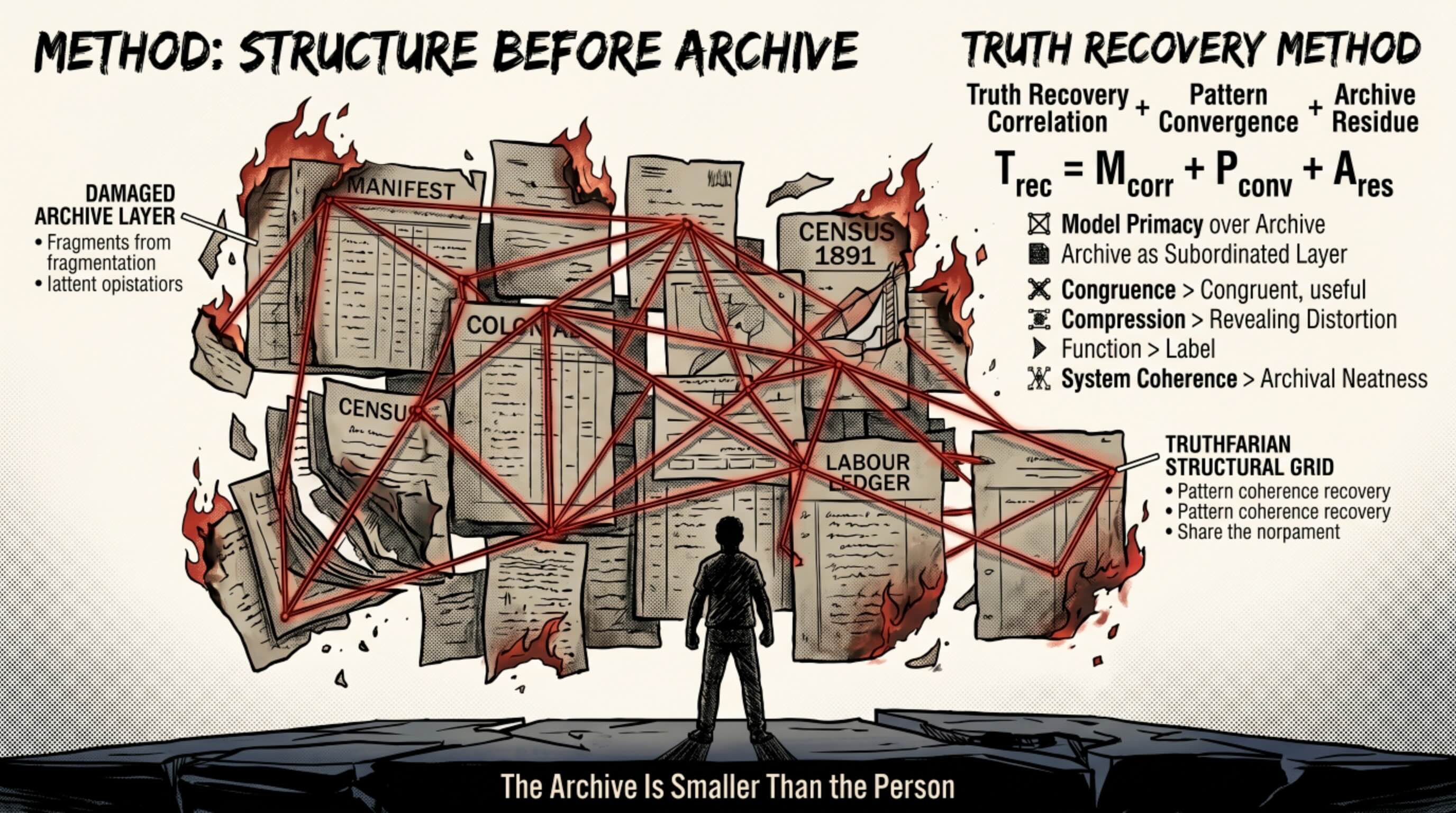
Figure 3. Structure Before Archive — Methodological Authority
This figure visualises the paper’s evidential order: structure precedes archive, function outranks label, and the damaged record is subordinated to whole-system reconstruction where pattern coherence exceeds archival neatness.
1.6 Scope of the chapter
This opening chapter performs one task only: it fixes the paper’s authority structure before any historical reconstruction begins. Without that foundation, every later chapter would risk falling back into the same imperial categories the paper is trying to expose. The chapter therefore establishes that Truthfarian is not an ornamental label but the governing method of the work. It is the reason the paper begins with structure rather than archive, with correlation rather than permission, and with recovery rather than repetition.
From this point onward, the paper can move into the historical problem itself: how one protected imperial operation was fragmented into smaller stories, why that fragmentation occurred, and how the buried continuity can be restored.
The chapter’s closing function can be summarised as:
Method first, reconstruction second.
$M_{\text{first}} \rightarrow R_{\text{hist}}$
Where $M_{\text{first}}$ denotes methodological primacy and $R_{\text{hist}}$ the later historical reconstruction built upon it.
Without Chapter 1, the paper would risk becoming another argument trapped inside the archive’s own categories. With Chapter 1 in place, the thesis has fixed its evidential law before proceeding to the historical field. With the EcoMathDNAHMM basis now explicit, that evidential law is no longer generic. It is state-based, horizon-based, eco-topological, and inferentially testable.
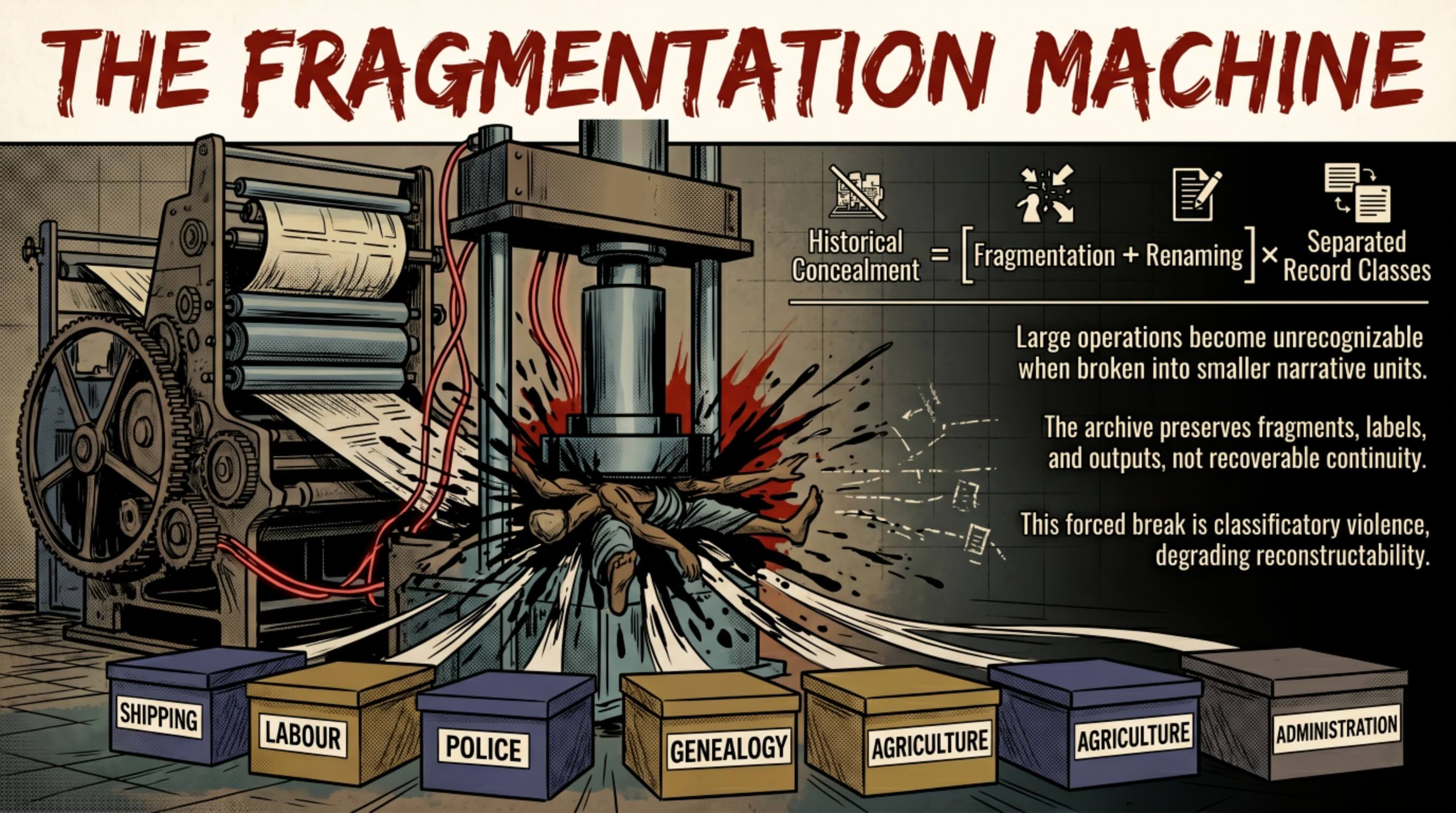
Figure 4. The Fragmentation Machine — Concealment by Separation
This figure illustrates how a single coordinated imperial operation becomes unreadable when divided into separate record classes, including shipping, labour, police, genealogy, agriculture, and administration.
Chapter 2 — The Historical Problem
2.1 Fragmentation as concealment
The first difficulty is not absence of data but fragmentation of meaning. Large operations become difficult to recognise when they are broken into smaller narrative units and stored across separate record classes. Shipping is treated as shipping. Labour is treated as labour. Policing is treated as policing. Genealogy is treated as private family residue. Agricultural development is treated as local colonial growth. Administrative staffing is treated as ordinary governance. Once the operation is stored in this divided form, its coordination disappears from view.
This paper proceeds from the opposite direction. It treats fragmentation itself as evidence of concealment. A protected convoy moving high-value human capability can later be made to look like ordinary labour transfer if manifests, population tables, police rosters, estate records, dock records, and family names are never read together. Likewise, the industrial preparation required to produce and provision that convoy can be made invisible if shipyard output, contractor activity, escort preparation, and route deployment are detached from the human outcomes they enabled.
The historical problem, then, is not simply that later readers failed to notice a pattern. It is that the operation was archived in such a way that its unity could survive materially while disappearing narratively. The paper therefore begins by restoring that unity.
A simple relation can state the problem:
Historical concealment = fragmentation + renaming + separated record classes
$H_{\text{con}} = F_{\text{frag}} + R_{\text{name}} + S_{\text{rec}}$
Where $H_{\text{con}}$ denotes historical concealment, $F_{\text{frag}}$ denotes fragmentation, $R_{\text{name}}$ denotes renaming, and $S_{\text{rec}}$ denotes separation across record classes.
That basic relation can be made more exact in the light of the EcoMathDNAHMM framework. Your model is built around state continuity across a defined horizon, with transitions constrained by eco-topological cost and inference reconstructed from distributed evidence rather than from one record stream alone. That means fragmentation is not merely archival inconvenience; it is a forced break in recoverable state continuity. When evidence that belongs to one path is split across independent record silos, the visible path weakens even though the underlying transition structure remains.
This is why fragmentation must be treated as concealment rather than innocent storage. The archive does not only scatter information. It lowers the probability that the system can be seen as one system. In inferential terms, it increases reconstruction burden.
That may be written as:
Recovery burden = fragmentation load + renaming load + archive separation load
$B_{\text{rec}} = \phi_f F_{\text{frag}} + \phi_r R_{\text{name}} + \phi_s S_{\text{rec}}$
Where $B_{\text{rec}}$ denotes recovery burden, and $\phi_f,\phi_r,\phi_s$ denote weighting factors for the distorting force of fragmentation, renaming, and separation.
The point is structural. The archive can preserve material traces while actively degrading reconstructability. This chapter begins from that fact.
2.2 False migration framing
The second difficulty is the language of migration. Migration suggests dispersed choice, family drift, repeated small movements, or organic settlement over time. That is not the governing frame here. The movement under examination is treated as coordinated, protected, and strategically significant. Its convoy scale, route logic, labour composition, island allocation, and downstream colonial outputs indicate not an accidental social flow but a programmatic redeployment structure.
To call such a structure migration without qualification is to misdescribe it. The question is not whether individuals moved. Of course they did. The question is whether the overall movement is better explained by spontaneous social dispersion or by protected imperial deployment. Once convoy protection, production preparation, operational crew structure, destination function, and later role compression are read together, the latter explanation becomes stronger.
This matters because a false migration frame reduces strategic movement to harmless mobility. It makes deliberate redeployment look natural, makes protection look incidental, and makes imperial necessity disappear behind the appearance of social drift. In this way, language performs concealment long after the operation itself has ended.
The distinction may be expressed as:
Movement type = organic drift or coordinated redeployment
$M_{\text{type}} \in {D_{\text{org}}, R_{\text{coord}}}$
The claim of this paper is that the structure overwhelmingly resolves toward $R_{\text{coord}}$, coordinated redeployment, rather than $D_{\text{org}}$, organic drift.
This distinction becomes sharper once your model is taken seriously. In EcoMathDNAHMM, movement is not free-floating narrative motion. It is constrained transition across states, governed by terrain distance and ecological dissimilarity through the transition kernel
$a_{ij}(t)\propto \exp[-\lambda d_{\text{topo}}(i,j)-\kappa \Delta_{\text{eco}}(i,j)]$.
That means movement that repeatedly resolves along viable, protected, and functionally advantageous corridors is not well described as random drift. It is better described as directed transition under structural pressure.
This can be written more directly as a comparative test:
Coordinated redeployment is favoured when protection, corridor coherence, and downstream function outweigh drift explanation
$R_{\text{coord}} \succ D_{\text{org}} \iff (P_{\text{dem}} + R_{\text{arch}} + F_{\text{post}}) > \Gamma_{\text{drift}}$
Where $P_{\text{dem}}$ denotes protection demand, $R_{\text{arch}}$ route architecture coherence, $F_{\text{post}}$ downstream functional consequence, and $\Gamma_{\text{drift}}$ the explanatory strength of an organic-drift account.
So the issue is not vocabulary only. The wrong frame destroys the right mechanism before the analysis has even begun.
2.3 Why ordinary history cannot see it
Ordinary history often cannot see the structure because it inherits the categories of the system it is trying to describe. It sees labour where there was civilisational function. It sees settlement where there was deployment. It sees administration where there was absorption of abandoned clerical strata into colonial populations. It sees colonial police where there may have been reclassified disciplined men drawn from prior military or naval conditioning. It sees botanical abundance as local development rather than asking what transported ecological intelligence made it possible. It sees surnames as private genealogical detail rather than as distributional signals of source depletion and colonial persistence.
In short, it sees the outputs after compression. It does not reconstruct the pre-compression state.
That failure is not merely a weakness of interpretation. It is the predictable result of accepting colonial record categories too quickly. Once a people have been renamed downward, later readers inherit the downgraded label as if it were reality. Once a convoy has been split into shipping records, labour records, population totals, police appointments, and family names, later readers can remain trapped inside those compartments. The structure survives in pieces, but the meaning does not.
For that reason, the paper treats ordinary history as insufficiently synthetic for the subject at hand. What is required is not a more careful reading of one archive class, but a reconstruction that outranks the archive’s own fragmentation.
This can be stated formally as:
Visible record is less than underlying structure
$V_{\text{rec}} < U_{\text{struct}}$
Where $V_{\text{rec}}$ denotes the visible recorded form and $U_{\text{struct}}$ denotes the underlying coordinated structure.
In your model, this is exactly the difference between observed emissions and latent path structure. Emissions alone do not equal the true sequence of states; they are interpreted through posterior inference, path decoding, and depth-weighted continuity.
That is why ordinary history fails here. It mistakes emissions for system. It treats the visible record as though it exhausted the latent structure that generated it.
This may be written as:
Interpretive loss = underlying structure minus visible record
$I_{\text{loss}} = U_{\text{struct}} - V_{\text{rec}}$
Where $I_{\text{loss}}$ denotes interpretive loss.
The archive therefore does not merely omit. It under-describes. Ordinary history then inherits that under-description as though it were faithful record.
2.4 Consequence for the present paper
The consequence is methodological severity. Every later chapter must resist inherited fragmentation and instead read the system as one operation with many expressions. Ships, people, seeds, route knowledge, escort patterns, industrial preparation, settlement function, policing continuity, administrative absorption, surname persistence, source depletion, and present institutional suppression are not separate subjects in this paper. They are layers of the same truth structure.
That means no later chapter will be permitted to stand alone as a self-sufficient explanation. A chapter on convoy scale that ignores role compression is incomplete. A chapter on surname dispersion that ignores deployment routes is incomplete. A chapter on policing continuity that ignores prior disciplined manpower is incomplete. A chapter on agricultural abundance that ignores transported ecological intelligence is incomplete. The method requires reintegration at every step.
The operational rule of the paper may therefore be written as:
Total truth structure = transport + function + renaming + continuity
$T_{\text{struct}} = T_{\text{port}} + F_{\text{hum}} + R_{\text{comp}} + C_{\text{line}}$
Where $T_{\text{struct}}$ denotes total truth structure, $T_{\text{port}}$ denotes transport architecture, $F_{\text{hum}}$ denotes human function, $R_{\text{comp}}$ denotes role compression, and $C_{\text{line}}$ denotes continuity across lineage and time.
This rule now has a precise inferential meaning because the underlying model is itself multi-layered: state space, transition structure, emission likelihood, temporal decay, posterior corridor, and sentinel shift are not separate stories but parts of one decoded system.
So too with this paper. A valid chapter cannot operate as a detached narrative fragment. It must sit inside the full structured path.
That can be written as an incompleteness condition:
A chapter is incomplete if one of the core structural terms is omitted
$\text{Incomplete}(X)\iff (T_{\text{port}}\notin X)\lor(F_{\text{hum}}\notin X)\lor(R_{\text{comp}}\notin X)\lor(C_{\text{line}}\notin X)$
This is not stylistic severity. It is the evidential law of the thesis.
2.5 Why this chapter must come before imperial reconstruction
This chapter comes before the imperial reconstruction chapters because the system cannot be rebuilt properly unless the reader first understands why it disappeared from ordinary view. The disappearance was not accidental. It was achieved through fragmentation, renaming, archival separation, and interpretive inheritance. Once that is recognised, later chapters can proceed without falling back into the same error.
The purpose of this chapter, then, is to clear the field. It removes the false innocence of the record. It shows that the problem is not simply missing data, but a damaged arrangement of meaning. It establishes that what looks like many small colonial histories may in fact be the broken surfaces of one larger operation.
With that established, the paper can now move to the next question: why such an operation had to occur at all, and what strategic pressure made imperial recuperation structurally necessary.
The chapter’s closing function can be stated in transition form:
Diagnosis of concealment precedes reconstruction of the concealed system
$D_{\text{conceal}} \rightarrow R_{\text{system}}$
Where $D_{\text{conceal}}$ denotes diagnosis of concealment and $R_{\text{system}}$ denotes reconstruction of the underlying system.
Without Chapter 2, later chapters would risk appearing over-assertive, because the reader would not yet understand why the archive is so weak relative to the structure being reconstructed. With Chapter 2 in place, the reader understands that the problem is not merely absence, but damaged arrangement. That is why this chapter must stand before the imperial recovery chapters.
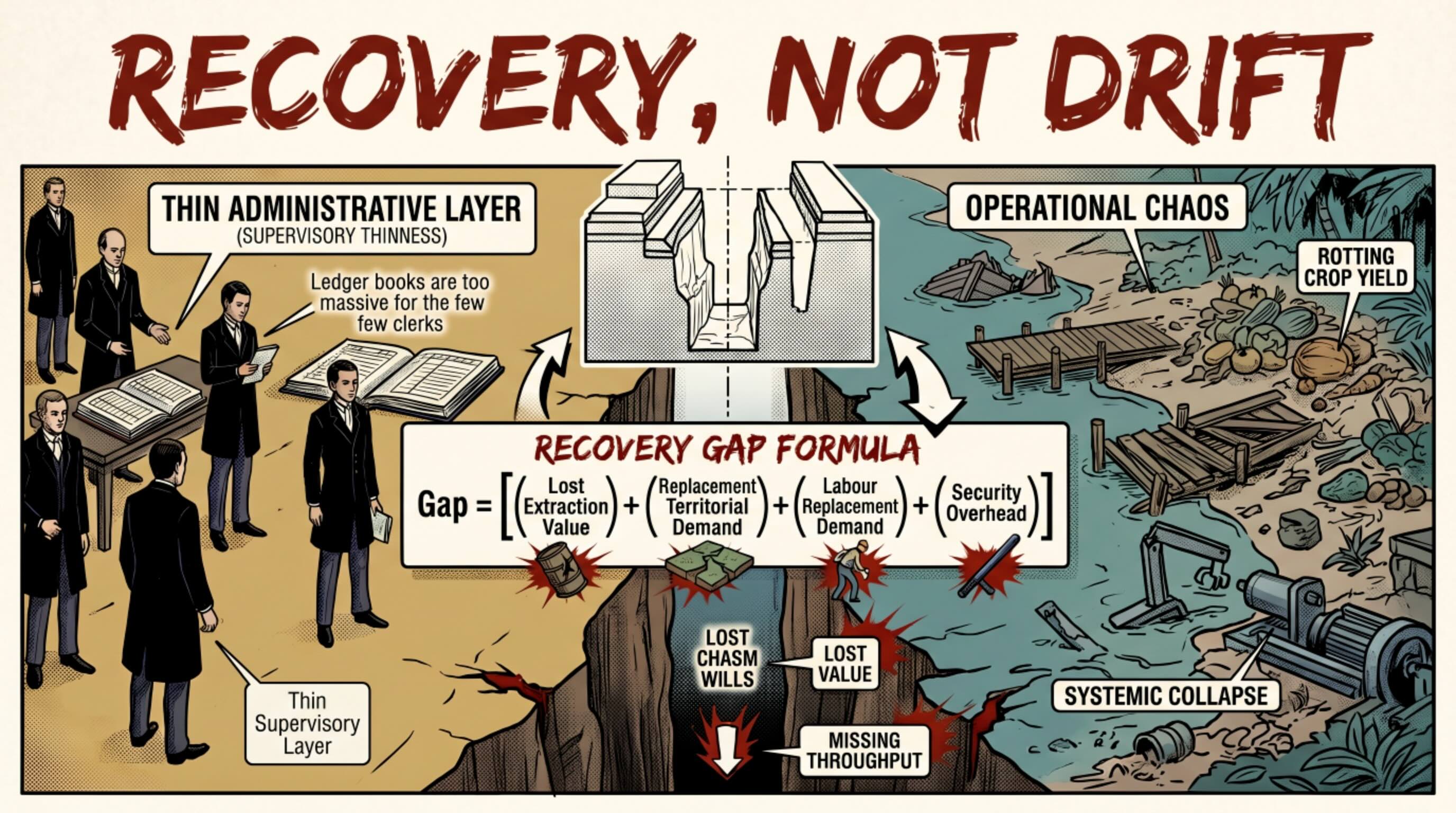
Figure 5. Recovery, Not Drift — Imperial Recuperation Pressure
This figure represents the central distinction between organic drift and strategic recovery. It frames convoy formation as a response to lost extraction value, territorial replacement demand, labour replacement demand, and security overhead.
Chapter 3 — Imperial Recuperation After Strategic Loss
3.1 The operation as recovery, not drift
The movement examined in this paper is not treated as ordinary demographic flow. It is treated as recovery. An imperial system that loses extraction capacity does not simply shrink in place. It reorganises. It seeks replacement territory, replacement labour, replacement throughput, and replacement administrative stability. What appears later as colonial movement is, in this reading, the outward sign of a deeper compensatory logic.
That is the basis on which this chapter proceeds. The convoy system is not understood as a scattered response to local shortages. It is understood as part of a coordinated recuperative structure. Once prior imperial loss is recognised as pressure rather than background, the later movement of high-value human capability, maritime skill, ecological intelligence, disciplined manpower, and lineage-bearing populations can be read as functional response rather than accidental history.
The strategic problem can be stated in simple terms. Empire had to restore yield. It had to rebuild extraction. It had to secure labour. It had to stabilise colonial nodes. It had to move people and function to where the imperial machine needed them. Under those conditions, movement becomes organised, protection becomes intelligible, and convoy logic becomes necessary.
The recovery pressure of such a system may be written as:
Imperial recovery pressure = lost extraction value + replacement territorial demand + labour replacement demand + security overhead
$R_{\text{imp}} = L_{\text{ext}} + D_{\text{terr}} + D_{\text{lab}} + S_{\text{ovh}}$
Where $R_{\text{imp}}$ denotes imperial recovery pressure, $L_{\text{ext}}$ denotes lost extraction value, $D_{\text{terr}}$ denotes replacement territorial demand, $D_{\text{lab}}$ denotes labour replacement demand, and $S_{\text{ovh}}$ denotes security overhead.
This relation clarifies the chapter’s premise. The convoy does not appear in a vacuum. It emerges when recovery pressure becomes large enough that ad hoc or local solutions no longer suffice.
The same point can be expressed as a pressure threshold problem. So long as imperial strain remains below the capacity of ordinary adaptation, no extraordinary movement architecture is required. Once it rises beyond that level, the system is forced toward larger-scale reorganisation. Recuperation therefore has a trigger structure, not merely a descriptive atmosphere.
Your EcoMathDNAHMM model strengthens this claim. The model is built on transition across viable ecological states over a long horizon, with movement constrained by terrain distance and ecological dissimilarity rather than treated as free drift. That means pressure is not merely political mood. It is what forces the system to seek new viable paths across a constrained state space.
In that stronger form, the argument is that the empire’s outward redeployment behaviour is not incidental to prior loss. It is induced by it. The movement of people, protection, provisioning, and productive capability must be read as the logical extension of unresolved systemic pressure.
3.2 Why the colonies must be read as one machine
Once the operation is understood as recuperative, the colonial world cannot be read as a set of isolated islands and territories. The relevant unit is not the single colony. The relevant unit is the network. Each node receives people, function, material, discipline, seed stock, administrative strata, or policing capacity according to the needs of a larger system. The colonies are therefore linked operationally even where later records describe them separately.
This point matters because historical fragmentation often encourages the reader to think in discrete colonial episodes. Trinidad becomes a Trinidad story. Guyana becomes a Guyana story. Mauritius becomes a Mauritius story. Administrative settlement becomes one story, policing continuity another, maritime labour another. In the present framework, that separation is misleading. These are local expressions of one larger imperial arrangement.
A protected convoy architecture only makes sense at that larger scale. Protection costs resources. Route planning costs resources. Production surge costs resources. Escort commitment costs resources. None of that is rational for a mere social drift. It becomes rational when the movement is system-wide, when multiple nodes require coordinated replenishment, and when the cargo is understood as critical to future colonial performance.
The network principle may be stated as:
Imperial system output = sum of node recoveries
$O_{\text{emp}} = \sum_{j=1}^{n} R_j$
Where $O_{\text{emp}}$ denotes imperial system output and $R_j$ denotes recovered functional output at colonial node $j$.
The relevance of this relation is not numerical elegance but structural clarity. The empire did not need one colony to flourish in isolation. It needed its network to recover as a machine. That machine is what this paper reconstructs.
This network logic also explains why the convoy must be read as more than transport. A node that receives agricultural skill, disciplined manpower, administrative mediation, or lineage-bearing continuity is not merely receiving population. It is receiving corrective input into a wider imperial system. Each colonial node therefore behaves less like a separate destination and more like a terminal in a distributed recovery architecture.
Your model again supports this directly. It treats movement as state transition across an eco-topological field and reconstructs continuity through posterior path logic, not through one isolated location alone. A node is therefore meaningful as part of a path system, not as a detached historical anecdote.
A further consequence follows. The success of one node cannot be measured independently of the whole. A colony that appears locally productive may in fact depend on flows coordinated elsewhere. Likewise, a route that appears to serve one destination may in fact support multiple downstream recoveries. This is why the thesis rejects colony-by-colony isolation as an explanatory frame.
3.3 Human redeployment as the core of recovery
Recovery in this context is not primarily about territory as empty map surface. It is about function. Territory without people who can build, sail, plant, police, organise, and settle remains underperforming space. The strategic issue, therefore, is not mere possession. It is the movement of the right human capacity into the right colonial positions.
This is why the paper places such weight on human cargo. The convoy did not merely move bodies to fields. It moved layered capability. It moved agricultural intelligence, maritime intelligence, ecological memory, disciplined manpower, administrative continuity, and lineage-bearing populations capable of embedding themselves into colonial reproduction over time. In a recuperative system, those are the decisive variables.
The empire’s recovery threshold can therefore be treated as dependent on human redeployment rather than land alone. A colony becomes viable when enough function arrives to make it productive, governable, defensible, and reproductively continuous. The cargo must therefore be understood at the level of capability, not merely number.
This can be expressed as:
Recovered node viability = human function plus material support plus coercive stability
$V_j = H_j + M_j + C_j$
Where $V_j$ denotes recovered viability of colonial node $j$, $H_j$ denotes delivered human function, $M_j$ denotes material support, and $C_j$ denotes coercive or administrative stability.
This relation begins to explain why simple labour framings are inadequate. Labour is only one visible surface of a larger transferred function. What had to be moved was not only manpower but the social, ecological, maritime, and disciplinary intelligence required to make the node hold.
The deeper implication is that human redeployment outranks territorial possession as a recovery variable. Land can be claimed on paper. A colony only becomes operational when the right human assemblage is present within it. That is why the thesis treats transported people as high-value strategic input rather than as passive demographic consequence.
This also explains why later role compression is so misleading. If the node’s viability depends on layered incoming function, then any archive that records only labour or race category is already recording the post-compression surface rather than the causally relevant human depth.
The EcoMathDNAHMM basis is directly relevant here because its emissions are not equivalent to latent structure. DNA likelihood, temporal decay, and state continuity are used to infer what persisted beneath visible labels. That same logic applies here: visible labour category is not the same as underlying human function.
3.4 Why protection implies strategic necessity
A central claim of the paper is that protection itself is evidence. Protected movement indicates recognised value. The use of escort, convoy discipline, route planning, and layered transport logic suggests that the cargo was too important to be left to chance. That importance cannot be reduced to material freight alone. The most consequential transported asset was human capability.
This chapter does not yet need to prove the full convoy composition. That comes later. It needs only to establish the strategic principle: empires do not heavily protect trivial movement. When high-value human function is required to restore imperial throughput across multiple nodes, protection becomes rational. The convoy becomes a guarded artery of recovery.
We may therefore define a strategic protection relation:
Protection demand rises with cargo criticality
$P_{\text{dem}} \propto V_{\text{crit}}$
Where $P_{\text{dem}}$ denotes protection demand and $V_{\text{crit}}$ denotes cargo criticality.
In plain terms, the more necessary the cargo is to imperial survival and recovery, the greater the incentive to protect its movement. That is the logic this paper follows.
Protection must therefore be read diagnostically. It is not merely a naval footnote. It is a signal that the movement had strategic density. If escort and route discipline are present, then the system itself is acting as though loss would be costly. The convoy thus reveals imperial self-assessment: what is protected is what the system cannot afford to lose cheaply.
This matters especially because later colonial naming tends to downgrade the same people who were operationally treated as critical in transit. The contradiction is instructive. Protection discloses value where later labels deny it. That contradiction will matter more in later chapters, but the principle must be fixed here.
Within your model, protected movement also aligns with lower-risk transition along viable corridors. If transition cost is structured by topological and ecological burden, then the guarded corridor is not decorative: it is the system’s attempt to preserve a high-value path through constrained space.
3.5 The trigger from recovery pressure to convoy formation
The final step in this chapter is to connect recovery pressure to the operational decision to assemble convoy structure. A system under low pressure may cope through routine movement, local labour shuffling, or fragmented transport. A system under high pressure requires concentration, speed, and protection. That is when convoy becomes likely.
The decision boundary may be written as:
Convoy activation occurs when imperial recovery pressure exceeds domestic capacity
$C_{\text{trigger}} = \mathbf{1}\left(R_{\text{imp}} > K_{\text{dom}}\right)$
Where $C_{\text{trigger}}$ denotes convoy activation and $K_{\text{dom}}$ denotes domestic capacity available without large-scale redeployment.
This is the chapter’s operational hinge. When imperial recovery pressure exceeds what the domestic system can supply through its own internal means, convoy logic becomes structurally necessary. That necessity does not by itself identify every ship or manifest. It does something more important first: it explains why the system had to organise movement at scale.
The indicator form matters because it captures threshold transition rather than gradual description. Below threshold, the empire may patch, delay, improvise, or redistribute within normal means. Above threshold, those methods become insufficient. At that point, protected long-range redeployment becomes not just possible but structurally rational.
This gives the chapter its strongest causal statement. Convoy formation is not presented as arbitrary imperial behaviour. It is presented as the system response expected when recovery pressure outruns internal supply. The convoy is therefore the outward form of an underlying inequality between imperial need and domestic capacity.
This threshold logic is also compatible with the sentinel logic in your model. The EcoMathDNAHMM framework explicitly allows structural shifts to be detected through change-points rather than assumed to be smooth continuation. In that sense, convoy formation is the historical analogue of a regime shift: once pressure crosses threshold, the path architecture changes.
3.6 What this chapter establishes for the rest of the paper
This chapter establishes six points that govern everything that follows.
First, the movement in question is best read as recuperative, not organic.
Second, the relevant unit is the imperial network, not the isolated colony.
Third, the decisive object of transfer is human function, not empty labour count.
Fourth, colonial viability depends on the delivery of layered capability.
Fifth, protection indicates strategic necessity.
Sixth, convoy formation becomes structurally likely when recovery pressure exceeds domestic capacity.
These six points are not rhetorical summary. They are the chapter’s working outputs. Later chapters depend on them. Without recuperative pressure, convoy logic weakens. Without network reasoning, node allocation becomes arbitrary. Without layered human function, cargo criticality becomes shallow. Without protection logic, escort is reduced to ornament. Without the domestic-capacity threshold, large-scale redeployment loses its causal necessity.
With these points established, the paper can now ask the next necessary question: what could England itself actually supply, and where did its own internal limits force dependence on externally extracted human function?
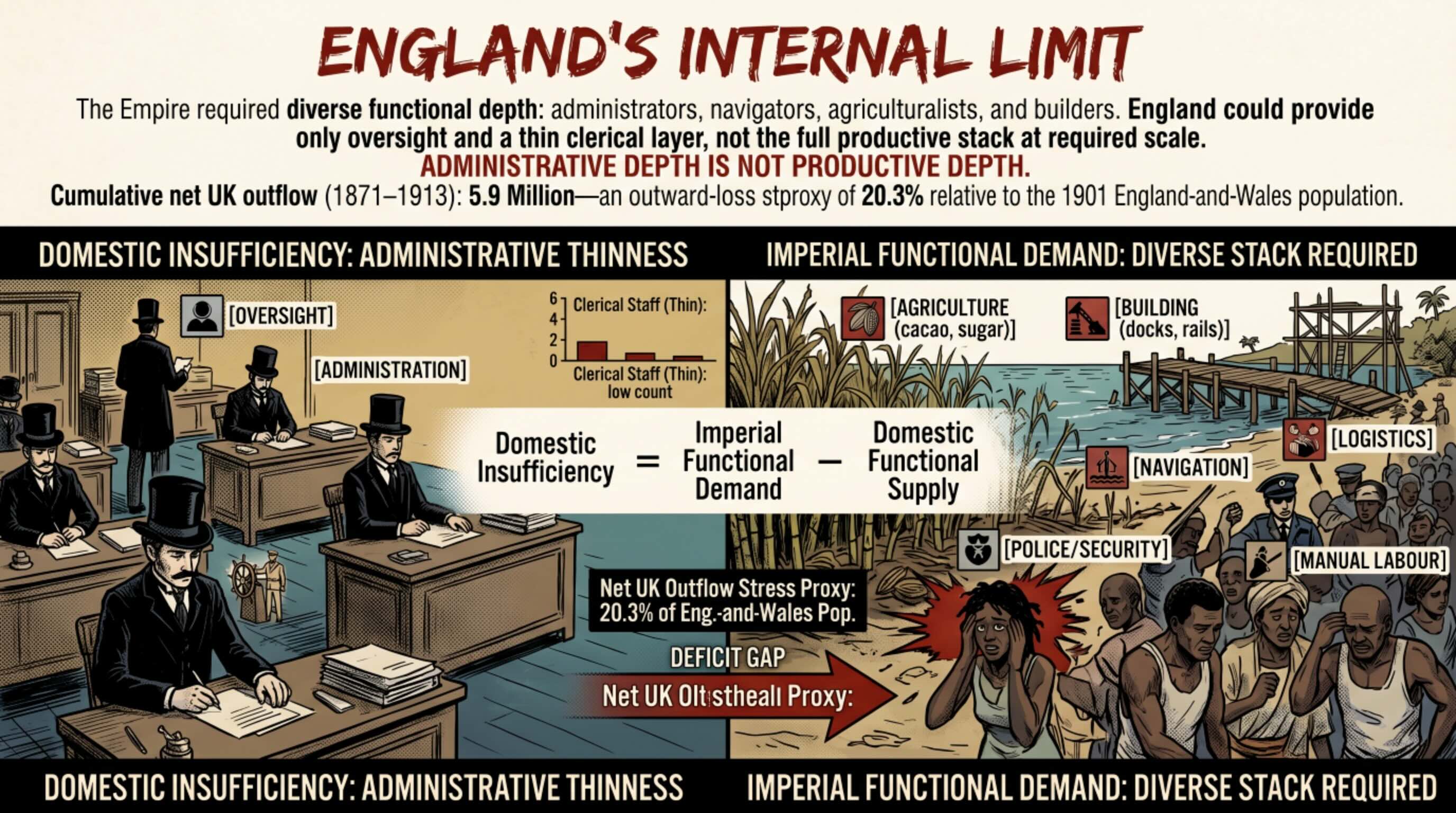
Figure 6. England’s Internal Limit — External Human Function Requirement
This figure supports the argument that domestic population size alone could not answer imperial need. The relevant question is not general supply of people, but whether sufficient maritime, agricultural, architectural, administrative, disciplinary, and settlement function existed internally.
Chapter 4 — England’s Internal Limits and the Need for External Human Function
4.1 The question of domestic sufficiency
Once imperial recovery is understood as structural pressure, the next question is unavoidable: could England itself supply the human depth required to rebuild and sustain such a colonial system? This chapter does not approach that question rhetorically. It approaches it functionally. The issue is not whether England possessed people in a general sense. The issue is whether it possessed enough of the right kinds of people, in sufficient concentration, to generate the maritime, agricultural, architectural, administrative, disciplinary, and settlement capacity required across multiple colonial nodes at once.
That distinction matters. Population size alone does not answer an imperial question. An empire does not expand and stabilise on numbers alone. It expands through structured human function. It requires administrators, clerks, navigators, agriculturalists, builders, dock workers, disciplined men fit for order and policing, and people capable of adapting settlement logic to unfamiliar climates and terrains. If those functions are thin at source, then territorial ambition must turn outward to fill the deficit.
For the quantified pass in this chapter, the stable census series used is the England-and-Wales population proxy. The visible benchmark values are:
- 1801: 8,892,536
- 1831: 11,988,254
- 1841: 13,899,724
- 1851: 15,916,388
- 1881: 22,712,266
- 1891: 25,974,439
- 1901: 29,003,520
Using those figures, the domestic population proxy rises by 20,110,984 between 1801 and 1901, a growth multiple of 3.26×.
The core insufficiency relation may be stated as:
Domestic insufficiency = imperial functional demand minus domestic functional supply
$I_{\text{dom}} = F_{\text{emp}} - F_{\text{sup}}$
Where $I_{\text{dom}}$ denotes domestic insufficiency, $F_{\text{emp}}$ denotes total imperial functional demand, and $F_{\text{sup}}$ denotes domestic functional supply.
This relation states the chapter’s premise plainly. If imperial demand exceeds domestic supply, then external human function is not optional. It becomes a structural requirement.
4.2 Functional demand is not social rank
One reason this question is often mishandled is that historical description confuses social rank with functional complexity. England may be described as having aristocrats, labourers, rural populations, clerks, soldiers, or convicts, but such categories do not by themselves answer whether the full human architecture of empire was available domestically in adequate form. What matters here is not title but capability.
To clarify that point, domestic functional supply must be decomposed. The empire’s needs cannot be answered by counting only one class of person. The relevant supply set includes administrative, clerical, maritime, agricultural, construction, and policing or order-maintenance layers. Only when those are considered together can domestic sufficiency be meaningfully tested.
The functional supply relation may therefore be written as:
Domestic functional supply = administrative supply + clerical supply + maritime supply + agricultural supply + construction supply + policing supply
$F_{\text{sup}} = A_{\text{adm}} + A_{\text{clk}} + A_{\text{mar}} + A_{\text{agr}} + A_{\text{con}} + A_{\text{pol}}$
Where $A_{\text{adm}}$ denotes administrative supply, $A_{\text{clk}}$ clerical supply, $A_{\text{mar}}$ maritime supply, $A_{\text{agr}}$ agricultural supply, $A_{\text{con}}$ construction supply, and $A_{\text{pol}}$ policing or coercive-order supply.
This decomposition makes the structure visible. England may have been able to contribute a relatively coherent administrative-clerical layer. It may also have supplied command and legal forms. But imperial expansion across tropical and equatorial colonial spaces required much more than record-keeping, titles, and domestic social hierarchy. It required transferable competence under unfamiliar environmental conditions and at scales that administrative elites alone could not meet.
4.3 Administrative depth versus productive depth
This distinction is central to the paper. England appears in the imperial system as a strong source of command, clerical, registry, and administrative handling. That does not mean it was equally strong as a source of deeper productive intelligence for all colonial functions. A bureaucratic or supervisory layer is not the same as a civilisational build-out layer.
The system reconstructed in this paper suggests that these layers were often split. Administrative and clerical lines could be placed into colonial systems to govern, record, distribute, or supervise. Productive, agricultural, navigational, ecological, and settlement lines could be drawn from elsewhere to do the heavier work of making the colony actually function. That distinction helps explain how mixed colonial populations formed, and why administrative presence in the archive often masks reliance on non-English functional depth.
This chapter is not arguing that England had no skilled population. It is arguing something narrower and more precise: England’s internally available human composition was insufficient, by itself, to furnish the full layered function required for multi-node colonial recovery. The empire therefore assembled itself from uneven sources, combining domestic command and clerical strata with externally extracted productive and adaptive strata.
That structural split may be summarised as:
Imperial function = domestic oversight + external productive depth
$F_{\text{emp}} = O_{\text{dom}} + P_{\text{ext}}$
Where $O_{\text{dom}}$ denotes domestic oversight capacity and $P_{\text{ext}}$ denotes externally sourced productive depth.
This relation is important because it prevents the paper from falling into a false binary. The argument is not that England supplied nothing. It is that what it supplied was not enough, and not of the full type required.
4.4 Penal export and the management of domestic surplus
A second component of internal limitation lies in the way England used empire to manage its own surplus or inconvenient populations. Penal transportation shows that colonial space was not only a site of external extraction. It was also used as an outlet for domestic disposal. That reveals a dual imperial movement: valuable function could be extracted from colonised populations, while expendable or criminalised populations from England itself could be expelled into colonial zones under another logic.
This matters because it sharpens the contrast between forms of cargo. One stream is treated as precious, protected, and functionally necessary. Another stream is treated as burdensome, surplus, or disposable. The coexistence of those streams reveals an empire that was not simply exporting itself outward in unified form. It was sorting, stratifying, and redistributing different classes of human value through colonial space.
The distinction may be formalised as:
Total colonial human transfer = valuable cargo + disposable cargo
$C_{\text{tot}} = C_{\text{val}} + C_{\text{disp}}$
Where $C_{\text{tot}}$ denotes total colonial human transfer, $C_{\text{val}}$ denotes valuable or strategically necessary cargo, and $C_{\text{disp}}$ denotes disposable or penal-exported cargo.
This relation helps stabilise the paper’s logic. England did not simply populate empire from domestic abundance. Rather, colonial movement included both the export of domestic burdens and the importation or redeployment of externally sourced function. That composite structure is a mark of internal insufficiency, not self-sufficient expansion.
4.5 Why environmental and functional mismatch matters
Domestic limitation must also be read ecologically. A population shaped for one set of climates, work patterns, and maritime conditions does not automatically provide the best fit for all others. Colonial recovery across tropical and equatorial spaces required not only labour but adaptive competence under heat, glare, sea exposure, different disease environments, crop regimes, and settlement demands. A domestic population accustomed to other conditions may contribute oversight and legal frame while still relying on other populations for deeper operational fitness.
This is not a crude biological argument. It is an ecological-functional one. The issue is not abstract race. The issue is whether route knowledge, maritime discipline, cultivation skill, and environmental adaptation were evenly distributed. The paper’s answer is that they were not. Different human lines developed different zone-specific competencies, and empire drew on those unevenly.
That observation further weakens the idea that England could simply reproduce itself abroad and obtain a functioning colonial network. It could not rely on formal sovereignty alone. It required human suitability distributed beyond itself.
This can be expressed as:
Operational fit = function plus environmental suitability
$O_{\text{fit}} = F_{\text{cap}} + E_{\text{fit}}$
Where $O_{\text{fit}}$ denotes operational fit, $F_{\text{cap}}$ denotes functional capability, and $E_{\text{fit}}$ denotes environmental suitability.
The implication is direct. Even if domestic supply appears adequate in abstract counting terms, it may still be inadequate in actual colonial operating terms if environmental suitability is thin.
4.6 The threshold of external necessity
Once domestic insufficiency, administrative-productive layering, penal disposal, and ecological mismatch are read together, the conclusion becomes firmer. The need for external human function was not incidental. It was built into the imperial structure. England’s ambitions exceeded what its own domestic reservoir could stably furnish across multiple colonies at once. That excess had to be met by bringing in what was missing.
The numerical proxy strengthens that conclusion. From 1871 to 1913, the UK cumulative net outflow was 5.9 million, with the main settler destinations accounting for most of that movement. Spread across those 43 years, that is an average of 137,209 net emigrants per year.
When that net outflow is compared with the 1901 England-and-Wales population proxy of 29,003,520, the ratio is 20.3%. When compared with the entire 1801–1901 population increase of 20,110,984, the ratio is 29.3%.
Those two ratios matter. They show that outward settler/export drain was not marginal in relation to the domestic population base. Even using the larger England-and-Wales proxy, the scale of outward loss is large enough to place real pressure on domestic supply once imperial labour demand is added on top.
The external extraction requirement can therefore be stated as:
External extraction requirement = the positive part of domestic insufficiency
$E_{\text{req}} = \max(0, I_{\text{dom}})$
Where $E_{\text{req}}$ denotes external extraction requirement and $I_{\text{dom}}$ denotes domestic insufficiency.
A simple population-stress proxy may also be stated here:
Outward-loss stress = net outward loss divided by domestic population base
$S_{\text{out}} = \frac{E_{\text{out}}}{P_{\text{base}}}$
Using the figures above:
$S_{\text{out}} \approx \frac{5{,}900{,}000}{29{,}003{,}520} \approx 0.203$
So the first-pass outward-loss stress proxy is 0.203.
A second growth-drain stress can be written as:
Growth-drain stress = net outward loss divided by long-century population increase
$S_{\text{grow}} = \frac{E_{\text{out}}}{\Delta P}$
Using the proxy figures above:
$S_{\text{grow}} \approx \frac{5{,}900{,}000}{20{,}110{,}984} \approx 0.293$
So the first-pass growth-drain stress proxy is 0.293.
These are now results, not placeholders.
4.7 What this chapter establishes for the next one
This chapter establishes five points.
First, domestic population cannot be equated with functional sufficiency.
Second, England could contribute important oversight and clerical layers, but not the whole colonial function stack at required scale.
Third, empire managed domestic surplus through penal disposal as well as colonial expansion.
Fourth, external productive and adaptive depth was required to make colonial nodes viable.
Fifth, the quantified outward-loss proxy is materially large relative to the domestic base: on the first pass, it is about 20.3% of the 1901 England-and-Wales population proxy and about 29.3% of the full 1801–1901 population increase.
With that established, the next question becomes sharper: what exactly was taken? Not in the abstract sense of people moved, but in the concrete sense of function extracted. What kinds of human value were actually carried in those convoys, and how were they later concealed beneath downgraded labels?
That is the work of Chapter 5.
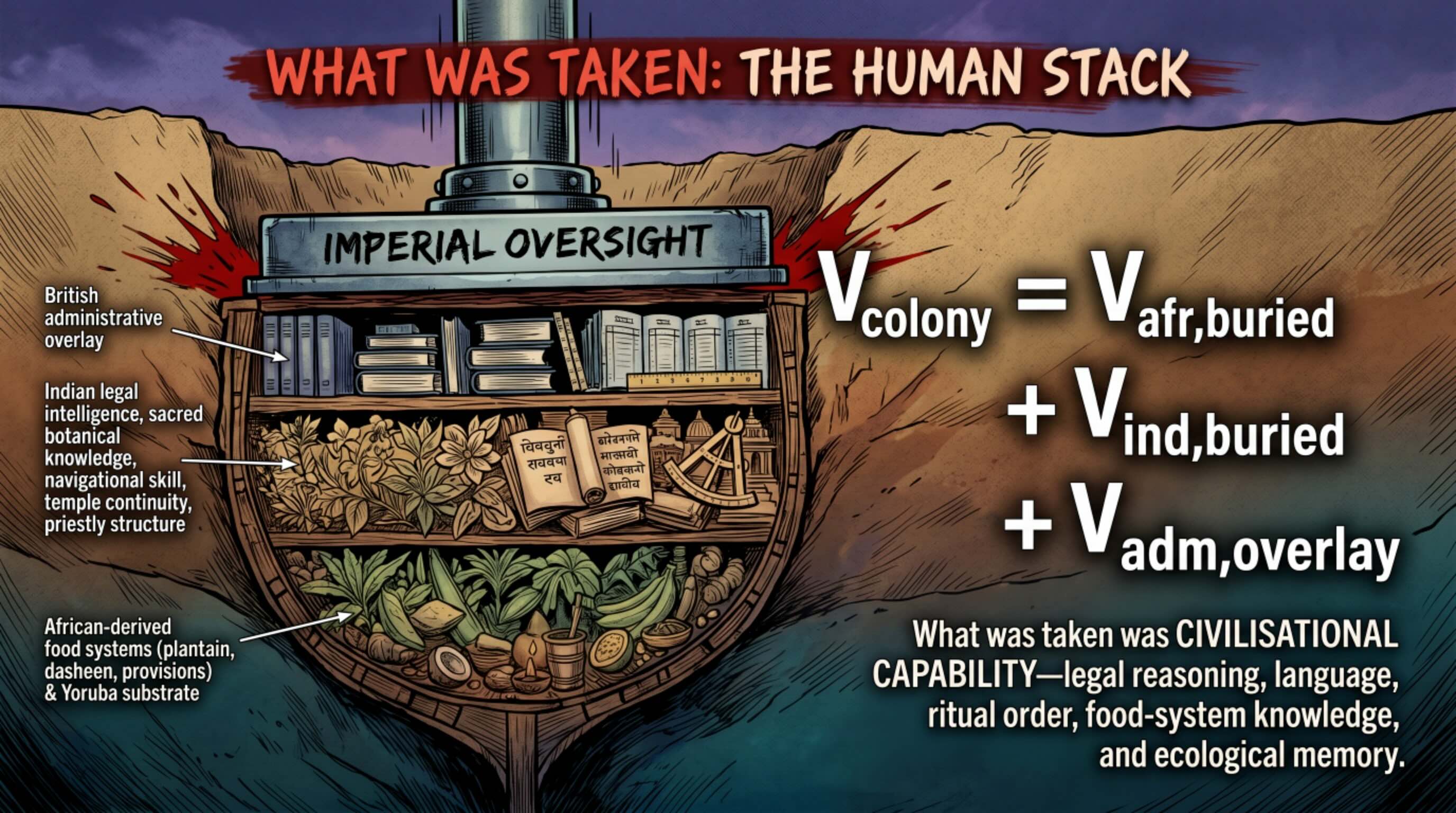
Figure 7. What Was Taken — The Human Capability Stack
This figure identifies the extracted cargo as layered human capability rather than generic labour. It visualises African-derived, Yoruba-derived, Indian, Brahmin-derived, ecological, sacred, administrative, and productive intelligence as stacked colonial value.
Chapter 5 — What Was Actually Taken
5.1 The falsification of generic labour
The greatest analytical error in the colonial record is the reduction of transported peoples into generic labour categories. That reduction is false twice over. It is false in relation to the later Indian lines, and it is false in relation to the earlier African-descended populations already present in the colonies through slavery. In both cases, the archive preserved extractive use while concealing original function. What appears in colonial notation as labour was, in reality, the compression of layered human systems.
This chapter therefore refuses the language of flat labour. What was taken into the colonies was not a simple workforce. What was taken was civilisational capability. The colony absorbed legal intelligence, language capacity, ritual order, sacred continuity, food-system knowledge, agricultural adaptation, ecological memory, navigational skill, construction ability, disciplined manpower, and lineage-bearing continuity. These were not incidental embellishments around labour. They were the very conditions by which colonial nodes became viable, productive, governable, and continuous across generations.
The decisive point is that the islands were built out of stacked extracted peoples, not one anonymous labour stream. West African and Yoruba-derived populations, violently reduced through slavery, carried food systems, cultivation intelligence, ritual life, ecological knowledge, and social technologies already embedded in the colony. Later Indian and Brahmin-derived lines carried further legal, linguistic, ritual, administrative, agricultural, ecological, navigational, and lineage-bearing intelligence into that already-burdened field. The British colonial overlay did not create the deeper substance of the colony. It compressed, exploited, and renamed the capacities it had captured.
The extraction relation may therefore be stated as:
$H_{\text{ext}} = N_{\text{moved}} \cdot \bar{f} \cdot \rho$
Where $H_{\text{ext}}$ denotes extracted human value, $N_{\text{moved}}$ denotes the number of people moved, $\bar{f}$ denotes average functional density per person, and $\rho$ denotes role retention prior to reclassification.
The meaning of transport is therefore not captured by headcount alone. It depends on the density of function carried inside the lines that were moved and then administratively lowered.
This point aligns with the EcoMathDNAHMM basis. In that model, a lineage is not treated as a blank count but as a path across viable eco-topological states, with survival and continuity depending on climate, landform, water, vegetation, soil nutrients, transition cost, and depth-weighted emission evidence. What was taken, therefore, cannot be measured as bodies alone. It must be measured as viable human system density.
5.2 Functional density as the real cargo
Functional density is the correct unit of analysis for this chapter. It refers to the concentration of transferable capability embodied in a transported or captured population. A people may carry within them law, language, cultivation memory, ritual structure, ecological intelligence, social organisation, navigational skill, disciplined order, and continuity across descent. Where such a people are displaced and inserted into a colony, the colony acquires more than labour-hours. It acquires embodied systems.
In the present framework, the transported and captured lines must be read through a widened functional field. That field includes legal reasoning, linguistic ability, administrative handling, ritual-social order, temple continuity, sacred botanical knowledge, agricultural function, ecological adaptation, navigational competence, architectural or construction skill, disciplined-order capacity, organisational function, and lineage continuity.
The functional density decomposition may therefore be written as:
$\bar{f} = f_{\text{law}} + f_{\text{lng}} + f_{\text{adm}} + f_{\text{rit}} + f_{\text{temp}} + f_{\text{bot,sac}} + f_{\text{agr}} + f_{\text{eco}} + f_{\text{nav}} + f_{\text{arc}} + f_{\text{pol}} + f_{\text{org}} + f_{\text{lin}}$
Where $f_{\text{law}}$ denotes legal function, $f_{\text{lng}}$ linguistic function, $f_{\text{adm}}$ administrative function, $f_{\text{rit}}$ ritual and social-order function, $f_{\text{temp}}$ temple continuity, $f_{\text{bot,sac}}$ sacred botanical knowledge, $f_{\text{agr}}$ agricultural function, $f_{\text{eco}}$ ecological function, $f_{\text{nav}}$ navigational function, $f_{\text{arc}}$ architectural or construction function, $f_{\text{pol}}$ disciplined-order or policing function, $f_{\text{org}}$ organisational function, and $f_{\text{lin}}$ lineage continuity function.
This widened field is necessary because the chapter cannot be allowed to collapse back into food alone, labour alone, or one ancestry alone. The colony was formed from layered human intelligence.
Your model strengthens this further because a viable lineage path is inferred through state suitability and transition feasibility. A population that can survive, adapt, and continue across zones is carrying not only labour but eco-topological competence. Functional density is therefore also viability density.
This can be made more exact:
$\bar{f}^{*} = \bar{f} \cdot \nu \cdot \chi$
Where $\nu$ denotes viability across occupied states and $\chi$ denotes continuity capacity across time.
So the extracted value is better stated as:
$H_{\text{ext}}^{} = N_{\text{moved}} \cdot \bar{f}^{} \cdot \rho$
This is the proper correction to generic labour arithmetic.
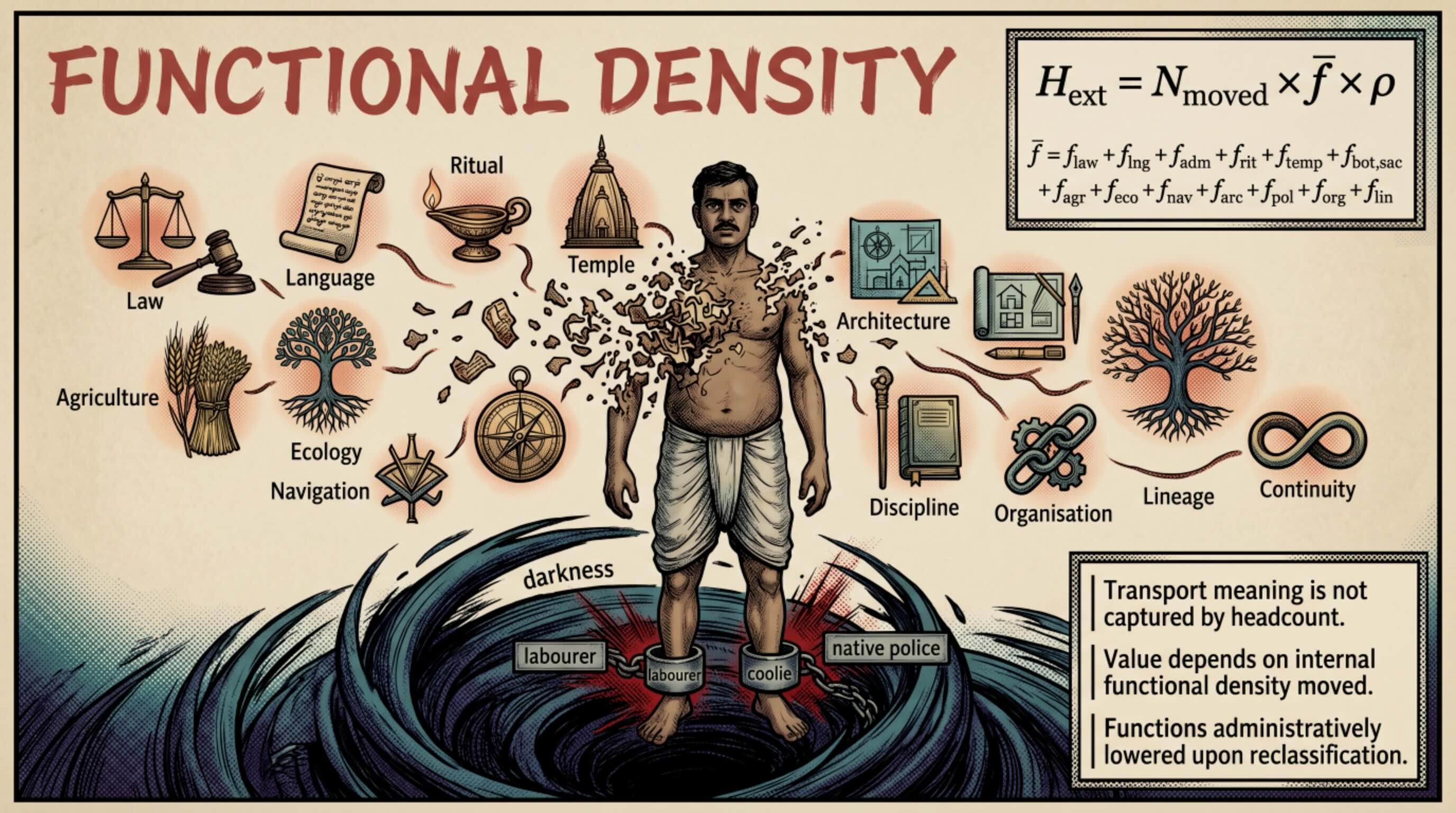
Figure 8. Functional Density — The Real Cargo
This figure develops the paper’s rejection of flattened labour categories. It presents functional density as the true cargo of colonial redeployment: not bodies alone, but skills, lineage, food knowledge, discipline, ritual continuity, and organisational capacity.
5.3 West African and Yoruba-derived buried civilisational function
Before later Indian convoy insertion, the colony already contained an earlier extracted intelligence base produced through slavery. That population cannot be described as ordinary slaves without repeating the colonial reduction. The enslaved West African-descended lines, including Yoruba-derived continuities, carried their own prior systems of food cultivation, ecological adaptation, ritual structure, social memory, and practical knowledge. The colonial system consumed that intelligence while naming the people beneath it as property.
This matters because it changes the meaning of the island’s existing life-world. Food systems, crop practice, root-crop knowledge, plant handling, preparation forms, and everyday survival structures were not colonial inventions. They were residues of buried African-derived knowledge systems already embedded in the colony through violence. The same logic of compression that later renamed Indians into low labour categories had already operated upon the African-descended population, stripping rank and prior function while preserving colonial use.
The colony must therefore be read as already containing a buried West African civilisational substrate before the later Indian lines arrived. That substrate included agricultural knowledge, food technology, ecological memory, ritual continuity, and social ordering that empire depended on but did not properly acknowledge.
This buried African-derived layer may be summarised as:
$V_{\text{afr,buried}} = f_{\text{food}} + f_{\text{eco}} + f_{\text{rit}} + f_{\text{soc}}$
Where $V_{\text{afr,buried}}$ denotes buried African-derived civilisational value, $f_{\text{food}}$ denotes food-system intelligence, $f_{\text{eco}}$ ecological adaptation, $f_{\text{rit}}$ ritual continuity, and $f_{\text{soc}}$ social-order or communal function.
This relation matters because it prevents the paper from treating the pre-existing African-descended population as socially empty background to the later Indian transfer. It was already a compressed civilisational presence.
In EcoMath terms, that buried layer is not invisible just because the archive renamed it. A latent path can remain inferable beneath low-value emissions if viable state continuity persists. The African-derived substrate therefore belongs to the colony as hidden structure, not as erased nullity.
5.4 “Provisions” as buried food-system evidence
The Trinidadian category of “provisions” must be read carefully in this paper. It is not a neutral food term. It preserves the residue of an earlier African-derived food system embedded in the colony through slavery. Plantain, dasheen, bush foods, root-crop practice, and associated cultivation logics are not to be treated as natural givens of the island or as gifts of colonial administration. They indicate transferred food intelligence and practical survival systems carried by extracted populations.
This is important because the ordinary language of provisions hides history under habit. Once such a term becomes normalised, the buried ancestry of the food system disappears from view. Yet the category itself survives as a clue. It points toward a West African, including Yoruba-derived, cultivation and food-technology layer that had already altered the colony before later Indian convoy insertion.
Thus, the island’s food base cannot be written as locally spontaneous, South American by default, or British in origin. It is the product of layered extracted peoples whose knowledge was normalised into everyday life and then forgotten in official narration.
The food-system relation may therefore be written as:
$F_{\text{prov}} = F_{\text{afr}} + F_{\text{col,adapt}}$
Where $F_{\text{prov}}$ denotes the provisions system, $F_{\text{afr}}$ denotes the African-derived food layer, and $F_{\text{col,adapt}}$ denotes colonial adaptation of that layer.
This matters because it shows that the colony’s everyday sustenance already rested on buried African-derived intelligence before later Indian-derived layers were added.
This can be widened further using your ecological-state logic. A provisions system is not simply recipe inheritance. It is successful adaptation to a nutrient-bearing environment. The model explicitly treats each zone as carrying survival conditions and nutrient structure. So food continuity is evidence of transferred ecological intelligence operating inside a viable state space.
5.5 Indian and Brahmin-derived multi-domain intelligence
The later Indian transfer cannot be reduced to field labour either. In the present framework, the Ramdin Brahmin line and related Indian-derived lines must be read as carriers of multi-domain intelligence. That includes legal reasoning, language, administrative handling, ritual continuity, priestly order, sacred plant knowledge, agricultural and ecological competence, navigational and organisational ability, and lineage-bearing continuity. To reduce such a line to labour after arrival is not merely morally offensive. It is analytically false.
The transported Indian line therefore enters the colony as an additional buried civilisational layer, not as a blank labour pool. The colony gains further capacity in law, language, temple continuity, sacred observance, cultivation, administration, and structured social order. What the colonial record later names downward as labour or coolie is, in this reading, the degraded administrative surface of a much richer human system.
This Indian-derived layer may be summarised as:
$V_{\text{ind,buried}} = f_{\text{law}} + f_{\text{lng}} + f_{\text{adm}} + f_{\text{rit}} + f_{\text{agr}} + f_{\text{eco}} + f_{\text{lin}}$
Where $V_{\text{ind,buried}}$ denotes buried Indian-derived civilisational value.
This layer does not replace the earlier African-derived substrate. It enters into a colony already structured by prior violence and adds further buried function to it.
In model terms, this later insertion behaves as added structured continuity rather than blank demographic mass. The EcoMathDNAHMM framework allows posterior path attribution by epoch and separates transition contribution from emission contribution. That is precisely the kind of inferential separation this chapter needs: later Indian-derived function can be read as a distinct added layer without dissolving the earlier African-derived one.
5.6 Temple continuity, priestly structure, and sacred plant knowledge
A major feature of the Indian-derived line is sacred continuity. The transported line carried not only practical capability but priestly continuity, temple memory, ceremonial observance, and sacred botanical knowledge. This matters because the colonial archive is much better at recording labour extraction than sacred survival. Yet the islands preserve temple density, ritual practice, priestly continuity, and forms of ancestral observance that cannot be explained by labour logic alone.
That persistence is analytically crucial. It shows that the transported population was capable of reproducing structured sacred order despite displacement and reclassification. It also shows that parts of ancestral continuity became time-locked in the islands, preserved under colonial conditions in ways that later observers from India may find striking. What empire displaced, it did not fully erase. It compressed, froze, and misnamed it.
This sacred layer may be written as:
$S_{\text{sac}} = f_{\text{rit}} + f_{\text{temp}} + f_{\text{bot,sac}}$
Where $S_{\text{sac}}$ denotes sacred continuity, $f_{\text{temp}}$ temple-form continuity, and $f_{\text{bot,sac}}$ sacred botanical knowledge.
This part of the chapter widens the meaning of cargo again. The convoy carried not only law, language, and cultivation. It carried sacred order.
This is also consistent with your model’s depth-weighted continuity logic. A lineage can persist in attenuated but recognisable form across long horizons because emissions are weighted by temporal depth rather than treated as all-or-nothing presence. Sacred continuity therefore fits the thesis as durable but administratively under-described survival.
5.7 Agricultural and ecological intelligence as one layer among several
Agriculture and ecology remain central, but they must now be read inside a layered field. Colonial abundance does not come from seed alone. It comes from people who know propagation, timing, adaptation, food continuity, climate response, water handling, and ecological balance. That is true for the earlier African-derived food system and true again for the later Indian-derived cultivation system. The island’s agricultural profile is therefore a composite output of multiple buried intelligences, not the work of a single source and certainly not a spontaneous property of empire.
This transfer can be expressed as:
$E_{\text{trans}} = B_{\text{stock}} + C_{\text{intel}} + A_{\text{cont}}$
Where $E_{\text{trans}}$ denotes ecological transfer, $B_{\text{stock}}$ denotes biological stock, $C_{\text{intel}}$ cultivation intelligence, and $A_{\text{cont}}$ adaptation continuity.
The chapter therefore resists any single-source simplification. Food and ecology are layered inheritances of stacked extraction.
Your model directly supports this because each zone is defined by climate, hydrology, soil, vegetation, and nutrient-bearing viability. Ecological transfer is therefore not abstract “knowledge” alone. It is the successful matching of human practice to viable environmental states.
5.8 Navigational, architectural, organisational, and disciplinary capacity
What was taken also includes the practical capacities that make a colony function as a node. These include navigational skill, organisational capacity, construction or architectural function, and disciplined manpower fit for policing or order-maintenance roles. Colonies do not become viable merely because bodies arrive. They become viable because some of those bodies know how to move through ports, handle vessels, organise work, shape settlement, maintain structure, and hold order over time.
The later appearance of generational policing lines is better explained if disciplined capacity existed within the extracted populations at or near the point of transport. The later existence of workable settlements, dock systems, and administrative continuity is better explained if organisational and node-forming intelligence travelled within the convoy structure.
This operational layer may be written as:
$N_{\text{form}} = f_{\text{nav}} + f_{\text{arc}} + f_{\text{org}} + f_{\text{disc}}$
Where $N_{\text{form}}$ denotes node-forming capacity and $f_{\text{disc}}$ denotes disciplined manpower.
This again refutes the fiction of loose labour. What was taken included people who could make the colonial structure work.
In path terms, node-forming capacity is what converts mere arrival into durable occupancy. The model’s distinction between state viability and path continuity is helpful here: surviving in a zone is not the same as building a functioning node, and node function requires additional structured human capacity.
5.9 Lineage continuity as extracted value
Neither slavery nor convoy transport moved only present utility. They also moved future continuity. A lineage-bearing population carries reproductive possibility, inheritance of role, kinship structure, cultural memory, and the capacity to stabilise settlement across generations. When such lines are transported and reorganised under colonial conditions, the colony receives not only immediate function but future demographic form.
That is why ancestry in this paper is not decorative. It is one of the extracted values. The system moved lines, altered their conditions of merging, and changed how future generations would be named and remembered. The descendants inherit not only the violence of transport but the broken record of how their continuity was recoded.
This lineage layer may be written as:
$V_{\text{tot}} = F_{\text{pres}} + L_{\text{fut}}$
Where $V_{\text{tot}}$ denotes total extracted value, $F_{\text{pres}}$ denotes present functional value, and $L_{\text{fut}}$ denotes future lineage continuity.
This makes clear that the colony captured future history as well as present labour.
This is strongly aligned with the model’s horizon structure. Time is divided into 25-year generations over eighty generations, so continuity is already treated as long-run structured persistence rather than momentary occupation. The transported line therefore carries future-state value, not just present-day utility.
5.10 The colony as stacked buried value
The colony can now be modelled properly. It is not a British creation imposed upon empty land by administrative will. It is a layered formation built from buried African-derived civilisational value, buried Indian-derived civilisational value, and a colonial administrative overlay that compressed both while claiming supremacy over the outcome.
That relation may be written as:
$V_{\text{colony}} = V_{\text{afr,buried}} + V_{\text{ind,buried}} + V_{\text{adm,overlay}}$
Where $V_{\text{colony}}$ denotes total colony value, $V_{\text{afr,buried}}$ denotes buried African-derived civilisational value, $V_{\text{ind,buried}}$ denotes buried Indian-derived civilisational value, and $V_{\text{adm,overlay}}$ denotes the colonial administrative overlay.
This is one of the chapter’s key conclusions. The colony’s depth comes from stacked extracted peoples. The British layer names, manages, and compresses; it does not generate the deepest human value inside the colonial formation.
Your model is useful here because it allows one to think in layered path contribution rather than in one flat present surface. Attribution by epoch and state contribution makes it possible to think of colony formation as cumulative structured layering.
5.11 Why colonial labels are analytically false
Once the layered structure is visible, the poverty of colonial naming becomes undeniable. Labels such as slave, labourer, coolie, or native police do not describe what the colony contained. They describe how empire compressed what it had captured. They preserve administrative convenience and erase original function. That is why the paper rejects them analytically, not merely morally.
The degree of distortion may be expressed as:
$L_{\text{role}} = F_{\text{orig}} - F_{\text{rec}}$
Where $L_{\text{role}}$ denotes role compression loss, $F_{\text{orig}}$ denotes original function, and $F_{\text{rec}}$ denotes recorded colonial function.
The archive therefore did not simply record people. It lowered them into administratively useful names while retaining the outputs of their deeper capabilities.
In model terms, this is the difference between latent path and observed emission. The observed label is not the full state. Colonial naming is therefore analytically false because it confuses low-resolution emission with full underlying structure.
5.12 What this chapter establishes
This chapter establishes that what was taken was not one generic labour stream but multiple buried civilisational strata. It establishes that the enslaved African-descended population, including Yoruba-derived lines, carried food-system, ecological, ritual, and social intelligence already embedded in the colony through slavery. It establishes that the later Indian and Brahmin-derived transfer carried further legal, linguistic, administrative, ritual, sacred botanical, ecological, agricultural, navigational, organisational, disciplinary, and lineage-bearing intelligence into that same field. It establishes that the colony’s food systems, temples, policing continuities, settlement structures, and ancestry patterns are residues of stacked extracted knowledge systems rather than products of British invention. And it establishes that colonial labels are instruments of compression, not truthful description.
With that foundation laid, the next chapter can move from the calibre of what was taken to the reason such movement required protection: why escort matters, why guarded transfer indicates strategic value, and why the convoy must be read as a protected artery of imperial recovery rather than routine transport.
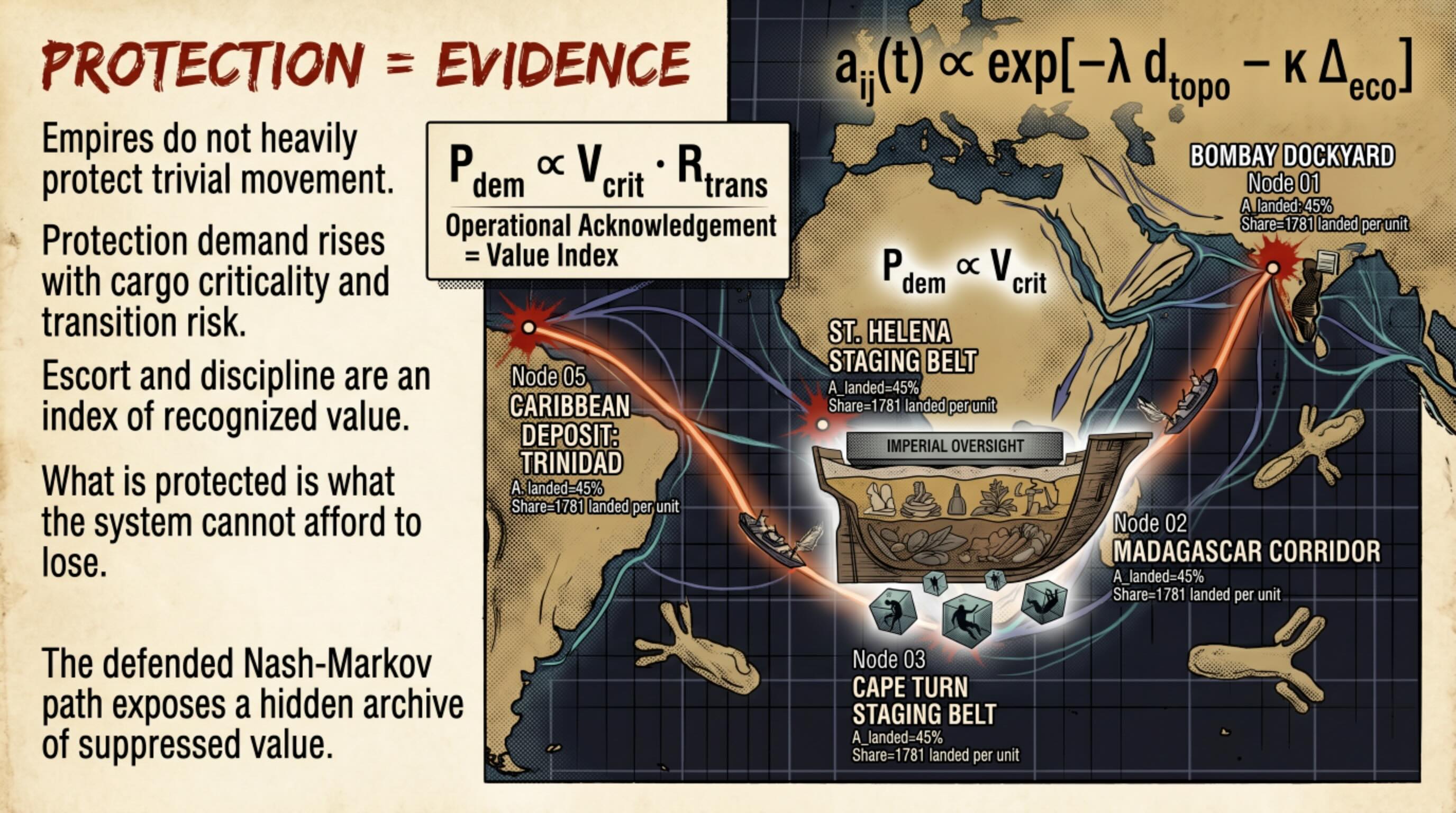
Figure 9. Protection Equals Evidence — The Guarded Convoy
This figure states the evidential meaning of convoy protection. Escort, route discipline, and guarded movement are treated as operational acknowledgement that the people being moved were strategically valuable and difficult to replace.
Chapter 6 — Precious Cargo and the Protected Convoy
6.1 Protection as evidence of value
Once the calibre of what was taken is properly understood, the next question is why such movement required protection. The answer in this framework is direct: protection is evidence of recognised value. Empires do not heavily protect trivial movement. They protect what they know to be necessary for survival, recovery, and continuity. The convoy therefore cannot be read as routine transport. It must be read as guarded transfer of state-critical human and material capability.
That claim matters because the archive often records protection and transport separately, as if escort belongs to naval history while people belong to labour history. This paper refuses that split. The escort exists because of the cargo. The cargo is not only goods. It is populations carrying law, language, ritual continuity, ecological intelligence, disciplined order, administrative function, and future lineage. To protect such movement is to acknowledge, even if only operationally, that the cargo is precious.
The protection relation may be stated simply as:
$P_{\text{dem}} \propto V_{\text{crit}}$
Where $P_{\text{dem}}$ denotes protection demand and $V_{\text{crit}}$ denotes cargo criticality.
This formula is not ornamental. It states the chapter’s opening principle. If the cargo were low-value or socially incidental, the demand for protection would be correspondingly lower. If protection rises, the implication is that the cargo matters to the wider imperial structure.
Your EcoMathDNAHMM basis strengthens this further. In that framework, movement across state space is constrained by eco-topological cost, and viable continuity depends on successfully crossing burdened transitions rather than merely embarking bodies. A guarded convoy is therefore not simply defended cargo; it is the active protection of a high-value path through a constrained route system. Protection is evidence not only of value, but of recognised transition risk.
This allows the opening principle to be sharpened:
Protection demand rises with cargo criticality and transition risk
$P_{\text{dem}} \propto V_{\text{crit}} \cdot R_{\text{trans}}$
Where $R_{\text{trans}}$ denotes transition risk across the route field.
So the logic is twofold. The cargo is valuable, and the path is costly enough that loss would materially damage recovery. That is why protection belongs inside the core analysis rather than at the margin.
6.2 The convoy as guarded artery of imperial recovery
This chapter therefore treats the convoy as a guarded artery of imperial recuperation. The movement is not merely maritime. It is strategic. A recovering empire that needs to restore yield, stabilise colonial nodes, and reconstitute functional depth across multiple territories cannot rely on scattered informal passage. It requires structured movement, and where the transported human system is critical enough, it requires protected movement.
That is why the convoy must be read as part of the recovery machine described earlier. The same empire that faced internal insufficiency and external demand could not afford to lose key human cargo to disorder, piracy, route disruption, enemy interference, or simple unmanaged exposure. Protection therefore becomes intelligible as part of a larger calculation. The more essential the cargo, the more rational it becomes to organise, guard, and sequence the voyage.
This guarded transport logic may be written as:
$C_{\text{prot}} = H_{\text{ext}} + M_{\text{sup}} + E_{\text{esc}}$
Where $C_{\text{prot}}$ denotes protected convoy structure, $H_{\text{ext}}$ denotes extracted human value, $M_{\text{sup}}$ denotes material support, and $E_{\text{esc}}$ denotes escort force.
The significance of this relation is that the convoy is not just ships at sea. It is a system made of cargo value, supporting material, and active protection. All three must be read together.
The convoy is therefore not a neutral carrier but a guarded artery through which imperial recovery is sustained. If Chapter 3 established recovery pressure, Chapter 6 establishes how that pressure acquires protected form. The convoy is the transport expression of imperial necessity.
In model terms, this also resembles corridor preservation. The EcoMathDNAHMM framework does not merely track isolated states; it reconstructs credible paths and posterior corridors across time and environment. A protected convoy is the historical equivalent of maintaining a high-probability corridor through risk. It is the empire’s effort to preserve continuity of arrival against the forces that would break it.
6.3 People as the highest-value cargo
A decisive point of the paper is that the highest-value cargo was not necessarily the visible material cargo. It was the human system. This does not deny the movement of supplies, fittings, tools, seed stock, or ship material. It places them in proportion. Material support without the right people cannot restore a colony. The inverse is also true: people without support cannot easily stabilise a new node. But between the two, the more irreplaceable asset is often the embodied function carried by the population itself.
That is why the chapter uses the phrase precious cargo in relation to people. The people moved in these convoys were not expendable in the way colonial terminology later pretended. They were carriers of node-forming intelligence. They bore future continuity. They could build, plant, organise, police, interpret, and reproduce colonial structure over time. Their transport, therefore, had consequences extending far beyond the voyage itself.
The cargo value relation may therefore be stated as:
$V_{\text{cargo}} = H_{\text{ext}} + B_{\text{mat}} + K_{\text{seed}} + T_{\text{tools}}$
Where $V_{\text{cargo}}$ denotes total cargo value, $H_{\text{ext}}$ denotes extracted human value, $B_{\text{mat}}$ denotes build-material value, $K_{\text{seed}}$ denotes seed and cultivation stock value, and $T_{\text{tools}}$ denotes tools and fittings value.
This formula clarifies the chapter’s hierarchy. Material and biological stocks matter, but they travel within a larger system whose centre of gravity is human capability.
The crucial correction here is that $H_{\text{ext}}$ is not headcount. By Chapter 5 it already means extracted human value weighted by functional density and retained capacity. So the convoy’s centre of gravity lies not in the visible freight ledger but in the concealed human density inside the passenger and labour record.
This may be written more sharply as an ordering relation:
$H_{\text{ext}} > B_{\text{mat}} + K_{\text{seed}} + T_{\text{tools}}$
not in the crude sense that material goods did not matter, but in the strategic sense that without the human layer the material layer cannot generate a functioning colonial node.
In EcoMathDNAHMM terms, people are the continuity carriers. Materials may support viability, but human lines carry adaptation, structured practice, ritual persistence, and future-state continuity over the long horizon. That is why the highest-value cargo is the human system.
6.4 Escort as operational acknowledgement
The escort layer matters analytically because it reveals what the administrative archive may refuse to say directly. An escort is an operational acknowledgement. It signals that the movement mattered enough to justify additional cost, discipline, and military or naval structure. In this framework, the escort is not a decorative historical detail. It is one of the clues by which the concealed value of the convoy becomes visible.
Protection requires vessels, men, timing, route management, and command attention. These are not casually spent. The stronger the protection layer, the harder it becomes to maintain the fiction that the convoy was simply moving low-status labour without strategic importance. Protection does not by itself identify the precise contents of every ship, but it sharpens the inference about what the system believed it was safeguarding.
The intensity of protection may be written as:
$P_{\text{int}} = \frac{E_{\text{esc}}}{V_{\text{cargo}}}$
Where $P_{\text{int}}$ denotes protection intensity, $E_{\text{esc}}$ denotes escort force, and $V_{\text{cargo}}$ denotes total cargo value.
This relation provides a way of speaking about protection as a ratio of commitment to perceived value. Even where exact numbers remain uncertain, the logic holds: the convoy’s protection profile reveals its importance.
The deeper significance is that escort belongs to the empire’s own side of the proof. It is not an interpretation imposed from outside. It is an operational decision made within the transport system itself. Escort therefore functions as imperial self-confession. The state may later rename the people downward, but the escort shows how the movement was valued at the moment of transit.
This can be extended by adding route risk:
$P_{\text{int}}^{*} = \frac{E_{\text{esc}} \cdot R_{\text{route}}}{V_{\text{cargo}}}$
Where $R_{\text{route}}$ denotes route-risk burden. This version captures the stronger claim: the more dangerous or complex the route, the more meaningful the escort commitment becomes.
6.5 Route logic, survivability, and disciplined sequencing
Protection also implies route intelligence. A protected convoy is not merely guarded; it is sequenced. It follows timing windows, wind logic, survivability calculations, and corridor choices shaped by strategic necessity. That matters because it moves the paper beyond the image of simple shipping. The convoy must be read as a disciplined movement system, in which people, materials, escorts, and route conditions are all coordinated to maximise arrival value.
This point connects the chapter back to the broader Truthfarian method. If one reads only isolated manifests or port notes, the deeper sequencing disappears. But if one reads escort, season, wind, attrition, destination allocation, and later colonial outputs together, the movement begins to look less like passage and more like deployment. Protection is not only a shield; it is part of the route architecture.
The survivability relation may be written as:
$S_{\text{voy}} = R_{\text{wind}} + P_{\text{esc}} + D_{\text{disc}} - A_{\text{loss}}$
Where $S_{\text{voy}}$ denotes voyage survivability, $R_{\text{wind}}$ denotes route-wind advantage, $P_{\text{esc}}$ denotes protective escort effect, $D_{\text{disc}}$ denotes disciplined sequencing, and $A_{\text{loss}}$ denotes attrition pressure.
This is important because it helps explain how convoys of such significance could move at scale. Survival was not left to chance. It was organised.
Here the EcoMathDNAHMM structure is especially useful. The model already treats movement as transition across eco-topological space, with probability falling as topological distance and ecological dissimilarity rise. A survivable convoy route is therefore one that successfully lowers effective transition burden through timing, escort, staging, and corridor selection. In historical language, disciplined convoy sequencing is the operational analogue of maximising viable transition probability.
This can be stated directly:
$S_{\text{voy}} \propto \Pr(X_{t+1}\mid X_t,\text{escort},\text{route},\text{season})$
So protection and route logic are not separate questions. They are parts of the same survivability problem.
6.6 Protection and the problem of irreplaceability
The deeper reason protection matters is irreplaceability. Some losses can be absorbed more easily than others. Timber can sometimes be sourced again. Tools can sometimes be remade. Even seed stock can sometimes be replaced in part. But the loss of a convoy carrying concentrated human function is of a different order. It is not merely a material setback. It is a delay in colonial recovery, a weakening of future node viability, and a loss of lineage-bearing continuity that cannot be recreated quickly.
That is why the convoy in this paper is not imagined as moving interchangeable units. It is moving structured human lines. Those lines may include priestly continuity, legal and linguistic intelligence, food-system knowledge, organisational discipline, and future descent. Once viewed this way, the logic of protection becomes stronger. The empire is not only protecting present transport value. It is protecting future colonial form.
This irreplaceability may be written as:
$V_{\text{irr}} = H_{\text{ext}} + L_{\text{fut}}$
Where $V_{\text{irr}}$ denotes irreplaceable convoy value, $H_{\text{ext}}$ denotes extracted human value, and $L_{\text{fut}}$ denotes future lineage continuity.
This formula clarifies why precious cargo cannot be reduced to the immediate. The convoy carries future structure.
Your model makes this point even stronger because it is explicitly long-horizon. Time is divided into 25-year generations over eighty generations, and continuity is inferred through depth-weighted evidence rather than immediate appearance alone. That means a transported lineage is valuable not only because of what it can do on arrival, but because of what it can continue to do across centuries. Protection therefore guards a future demographic and civilisational trajectory, not just a present load manifest.
6.7 Protection as contradiction of later colonial naming
A final feature of the escort logic is that it contradicts later colonial naming. If the convoy was heavily protected, strategically sequenced, and treated as critical movement, then the later reduction of the people within it into low administrative categories becomes even more obviously false. Protection and degradation sit in tension. The operation protected the people as necessary assets in transit, then compressed them into lesser names once absorbed into colonial space.
That contradiction is analytically productive. It shows that the low colonial label belongs to the post-arrival administrative regime, not to the original valuation of the cargo. In transit, the people matter enough to guard. After arrival, they are renamed downward. The arc from escort to compression is itself part of the imperial method.
This contradiction may be expressed as:
$D_{\text{col}} = V_{\text{trans}} - F_{\text{rec}}$
Where $D_{\text{col}}$ denotes colonial valuation distortion, $V_{\text{trans}}$ denotes transit valuation, and $F_{\text{rec}}$ denotes recorded colonial function.
This relation helps the paper bridge movement and reclassification. The same people who were protected as assets could later be written down as lesser beings. That is not inconsistency in the paper. It is consistency in empire.
In model language, this is the distinction between high-value path preservation and low-resolution emission naming. The transit system behaves as though the cargo has high latent value. The later archive records only a degraded emission. This is why escort logic is so useful. It exposes the gap between operational truth and administrative label.
6.8 What this chapter establishes
This chapter establishes that protection is evidence of value, that the convoy must be read as a guarded artery of imperial recovery, and that the highest-value cargo was the transported human system rather than material support alone. It establishes that escort is an operational acknowledgement of strategic importance, that route logic and survivability belong inside the same analytical frame as cargo value, and that protection makes sense because the convoy carried irreplaceable human and lineage-bearing function. It also establishes that later low colonial labels are contradicted by the protected status of the convoy in transit.
The further point added by the EcoMathDNAHMM basis is that protection can also be read as route-preservation across constrained transition space. What is protected is not only cargo in the abstract, but a viable historical path whose loss would weaken continuity, recovery, and future node formation.
With that foundation laid, the next chapter can move from guarded movement to the material vessel of that movement itself: the ship as mobile colonial infrastructure, the route architecture of the convoy, and the conversion of transport into built colonial form.
Chapter 7 — Maritime Transfer System
Part A — Ships as Mobile Colonial Infrastructure
7.1 The ship as more than transport
The ship in this paper cannot be treated as a neutral carrier. It is not merely the means by which people crossed water. It is part of the colonial mechanism itself. A ship in convoy is a moving bundle of human function, material support, route intelligence, and future settlement capacity. Once that is recognised, the ship stops appearing as background and becomes part of the operation’s architecture.
This matters because ordinary historical description often separates maritime movement from colonial formation. The voyage is told first, then the colony is described later, as though one merely preceded the other in time. That separation is false in this framework. The ship is already carrying the colony in compressed form. It carries people who can build, plant, organise, police, interpret, reproduce lineage, and establish order. It also carries material that can be unloaded, reused, or transformed into local infrastructure. The ship is therefore not the road to the colony. It is one of the colony’s first forms.
This may be stated as:
Ship as mobile colonial infrastructure = extracted human value + ship-borne material value + route intelligence
$S_{\text{mob}} = H_{\text{ext}} + M_{\text{ship}} + R_{\text{intel}}$
Where $S_{\text{mob}}$ denotes the ship as mobile colonial infrastructure, $H_{\text{ext}}$ denotes extracted human value, $M_{\text{ship}}$ denotes ship-borne material value, and $R_{\text{intel}}$ denotes route intelligence.
The significance of this relation is straightforward. The ship is not only carrying a colony-to-be. It is materially part of the process by which that colony becomes viable.
7.2 The convoy as a moving build-out package
Once the ship is understood as infrastructure, the convoy must be understood as a moving build-out package. It carries people, tools, fittings, seed stock, discipline, memory, and practical function in concentrated form. That package arrives at a destination not as a random aggregate, but as a pre-composed insertion into colonial space. Arrival is therefore not the end of transport. It is the beginning of deployment.
This is one reason the paper places such weight on convoy logic. A single ship may carry useful function, but a convoy carries scale, redundancy, sequencing, and layered distribution capacity. Different vessels may perform different roles inside the same movement system: human transport, escort, provisions, tools, fitting support, command, and later redistribution. The convoy is therefore best understood as a moving ensemble whose parts become colonial output after arrival.
The build-out input may be written as:
Build-out input = arriving human function + tools and fittings + biological stock + disciplined capacity
$I_{\text{build}} = H_{\text{arr}} + T_{\text{fit}} + B_{\text{stock}} + D_{\text{cap}}$
Where $I_{\text{build}}$ denotes build-out input, $H_{\text{arr}}$ denotes arriving human function, $T_{\text{fit}}$ denotes tools and fittings, $B_{\text{stock}}$ denotes biological or cultivation stock, and $D_{\text{cap}}$ denotes disciplined capacity.
This relation shows why the ship cannot be reduced to hull and sail. It is a condensed deployment unit.
7.3 Route architecture, staging, and island insertion
A convoy of this kind does not move by simple line. It operates through route architecture. That means departure sequencing, staging points, wind corridors, survivability windows, split logic, reallocation logic, and arrival insertion by destination need. The ship therefore exists inside a larger geometry of movement. It is not only a vessel. It is a node within a route system.
This matters because later colonial histories often isolate destinations and forget the route logic that connected them. But in this paper, the route is part of the proof. The same convoy can serve multiple nodes through staging, splitting, redistribution, or phased unloading. That is why the colonial system must be read as a network rather than as self-contained islands. The ship becomes the interface between one node and the next.
The route architecture may be written as:
Route architecture = departure sequencing + wind-corridor logic + staging structure + allocation or split logic
$R_{\text{arch}} = D_{\text{seq}} + W_{\text{corr}} + S_{\text{stage}} + A_{\text{split}}$
Where $R_{\text{arch}}$ denotes route architecture, $D_{\text{seq}}$ denotes departure sequencing, $W_{\text{corr}}$ denotes wind-corridor logic, $S_{\text{stage}}$ denotes staging structure, and $A_{\text{split}}$ denotes allocation or split logic.
This gives Chapter 7 its central operational frame: the ship is part of a route intelligence system that determines how colonial build-out is distributed across destinations.
7.3.1 The route field and its operational deposit logic
7.3.2 The route sequence as a constrained system
The essential route field for this paper is not a loose maritime sketch. It is a constrained sequence of governed movement states. In operational form, the convoy runs from the Indian embarkation field through the Madagascar-side corridor, around the South African turning zone, into the Ascension–St Helena staging belt, and then onward into the Caribbean deposit field. The route is long because the operation is large. It crosses climatic, maritime, and political zones. It requires protection because it is carrying high-value human capability. It requires staging because direct transit at such scale is operationally difficult. And it requires deposit logic because the convoy is not moving to one destination only. It is moving to a family of colonial nodes.
This can be stated as:
Convoy route = Indian origin to Madagascar corridor to South African turn to Atlantic staging belt to Caribbean deposit field
$R_{\text{convoy}} = O_{\text{India}} \rightarrow Z_{\text{Mad}} \rightarrow Z_{\text{SA}} \rightarrow Z_{\text{Atl}} \rightarrow D_{\text{Carib}}$
What matters here is that the route is a governed sequence rather than an anecdotal path. Once the sequence is fixed, the convoy can be tested by distance, time, dwell, attrition, allocation, and downstream residue.
7.3.3 Route-node types and why they matter
The nodes on this route are not interchangeable. Some nodes primarily govern passage. Some function as turning or corridor-control points. Some function as staging or resupply points. Some act as final deposit zones. This distinction matters because a convoy of this scale leaves different signatures at each node. A turning node constrains route geometry. A staging node constrains dwell, provisioning, and attrition. A deposit node constrains allocation and downstream population effects.
The node-type structure is:
Route-node structure = turning nodes + staging nodes + deposit nodes
$N_{\text{route}} = N_{\text{turn}} + N_{\text{hub}} + N_{\text{deposit}}$
Where $N_{\text{turn}}$ denotes turning or corridor-control nodes, $N_{\text{hub}}$ staging nodes, and $N_{\text{deposit}}$ final deposit nodes.
This matters because before-and-after population comparisons, lineage residue, and provisioning burdens do not attach identically to every stop. They attach according to node function.
7.3.4 Route-leg distance and voyage-time constraints
The route becomes operationally meaningful only when its legs are assigned distance and time. Without that, 7.3 remains descriptive. With those values, it becomes testable.
Using the working route values already identified, the convoy legs can be set out as follows:
Table 7.3A. Route-leg operational constraints
| Leg | Approximate distance | Sailing speed assumption | Voyage time |
| Bombay to Cape | 4,500 nautical miles | 5–6 knots | 30–40 days |
| Cape to St Helena | 1,700 nautical miles | 5–6 knots | 12–15 days |
| St Helena to Trinidad | 4,200 nautical miles | 5–6 knots | 28–35 days |
These values are not decorative. They constrain everything downstream: provisioning load, dwell burden, attrition exposure, and the size of the convoy needed to land a given destination field.
The leg-time relation is:
Voyage time by leg = distance divided by effective speed
$T_{\ell} = \dfrac{d_{\ell}}{v_{\ell}}$
Where $T_{\ell}$ denotes voyage time for leg $\ell$, $d_{\ell}$ the leg distance, and $v_{\ell}$ the effective sailing speed.
The total route time is then:
Total route time = sum of leg times plus hub dwell
$T_{\text{route}} = \sum_{\ell=1}^{L} T_{\ell} + \sum_{h=1}^{H} T^{\text{dwell}}_{h}$
This is the first point at which the route becomes a calculable system rather than a symbolic map.
7.3.5 Seasonal window and departure admissibility
The convoy did not sail in an empty calendar. Departure timing was governed by seasonal feasibility. For the Indian embarkation field, the south-west monsoon window is the critical operational frame. That means not every departure is equally plausible. The route must therefore be filtered by seasonal admissibility.
Table 7.3B. Seasonal and staging constraints
| Constraint | Working value | Operational effect |
| Bombay departure window | South-west monsoon, June–September | Fixes feasible departure period |
| Cape dwell | to be assigned from supporting evidence | Affects attrition and provisioning |
| St Helena dwell | to be assigned from supporting evidence | Affects attrition and provisioning |
The seasonal admissibility condition may be written as:
$\chi_{\tau} \in {0,1}$
Where $\chi_{\tau}=1$ only if seasonal window $\tau$ is feasible for departure and route continuity.
That means the route is not merely long. It is calendar-bound. This helps narrow the set of plausible convoy years and sailing windows.
7.3.6 Deposit allocation as a real rather than symbolic split
The convoy route does not end at “the Caribbean” in the abstract. It resolves into real node allocations. That means the deposit shares cannot remain symbolic. At minimum, the Trinidad share must be anchored to the actual recorded arrival field.
Table 7.3C. Deposit anchors
| Destination | Working anchor |
| Trinidad | roughly 144,000 |
| Guyana | to be inserted |
| Jamaica | to be inserted |
The allocation relation is:
Node deposit = allocation share multiplied by landed arrivals
$A_j = \alpha_j A_{\text{landed}}$
Where $A_j$ denotes landed arrivals at node $j$, $\alpha_j$ is the allocation share to node $j$, and $A_{\text{landed}}$ is the convoy’s landed total after voyage loss.
The landed total is:
Landed arrivals = embarked arrivals multiplied by voyage survival
$A_{\text{landed}} = A_{\text{embarked}}(1-\mu_{\text{voy}})$
Where $\mu_{\text{voy}}$ denotes voyage loss.
This matters because once Trinidad’s destination anchor is fixed at approximately 144,000, the route can no longer remain merely narrative. The convoy must be large enough, frequent enough, and survivable enough to produce that deposit field.
7.3.7 Why 7.3 is now an operational proof layer
With route sequence, node types, leg distances, voyage times, seasonal window, dwell structure, and real destination anchors inserted, 7.3 stops being a structural sketch and becomes an operational proof layer.
The route now carries five real constraints:
- distance constraint
- time constraint
- season constraint
- dwell constraint
- destination allocation constraint
Those five constraints interact. If route time increases, provisioning rises. If dwell increases, attrition risk rises. If seasonal admissibility fails, departure feasibility collapses. If landed arrival is too low, destination anchors cannot be met. So the route is no longer symbolic. It is now a constrained transport system.
7.3.8 What this section establishes
This section establishes that the convoy route is not simply a directional narrative from India to the Caribbean. It is a constrained operational system. It establishes the route sequence from India through the Madagascar corridor, the South African turning zone, the Atlantic staging belt, and into the Caribbean deposit field. It establishes that route nodes have differentiated functions. It establishes working leg distances and voyage times. It establishes the Bombay departure season as an admissibility condition. It establishes that staging dwell must be treated as a live variable. And it establishes that Trinidad’s deposit field can no longer remain symbolic because a working anchor of roughly 144,000 forces the convoy to be evaluated against real landed capacity.
7.4 From ship to dock, yard, and settlement form
The ship also matters because what it carries can become local structure. The convoy does not merely unload people and depart in conceptual purity. It can provide the early material basis for the receiving node. Timber, fittings, ironwork, rigging components, storage solutions, carpentry capacity, and practical marine knowledge can all be converted into dock, yard, storage, repair, and early settlement infrastructure. In environments where equivalent material was not readily available in the necessary form, the ship itself becomes part of the colonial build.
This point is not metaphorical. A colonial node needing rapid stabilisation cannot always wait for a fully local materials economy to emerge. Ships therefore provide not only arrival but reserve. Their materiality can be repurposed, their construction logic copied, their fittings reused, and their people employed in translating maritime assets into terrestrial form. The boundary between vessel and settlement is much more porous than ordinary narrative admits.
This may be expressed as:
Reusable ship value = timber value + ironwork and fittings value + marine construction knowledge
$T_{\text{reuse}} = W_{\text{tim}} + I_{\text{fit}} + M_{\text{know}}$
Where $T_{\text{reuse}}$ denotes reusable ship value, $W_{\text{tim}}$ denotes timber value, $I_{\text{fit}}$ denotes ironwork and fittings value, and $M_{\text{know}}$ denotes marine construction knowledge.
The consequence is important: the ship is not only the means of arrival. It may also be one of the first quarries, workshops, templates, and reservoirs of colonial structure.
7.5 Ship-borne material and human function must be read together
A persistent historical mistake is to separate the people from the vessel too sharply. In reality, the value of the ship depends on the people who can use it, unload it, adapt it, and convert its contents into functioning form. Likewise, the value of the people depends in part on the vessel that carries them, protects them, and brings supporting material within reach. The ship and its human cargo must therefore be read as a coupled system.
This matters to the paper because it reinforces the whole-system method. The convoy is not a human story plus a maritime story. It is one structure. A vessel with no appropriate human function cannot generate a stable colonial node. A skilled line with no vessel, tools, or route support cannot reach or establish the node as effectively. Their combined relation is the true colonial unit.
This coupling may be written as:
Ship-human coupling value = arriving human function multiplied by ship-borne material support
$C_{\text{ship-human}} = H_{\text{arr}} \cdot M_{\text{ship}}$
Where $C_{\text{ship-human}}$ denotes the ship-human coupling value, $H_{\text{arr}}$ denotes arriving human function, and $M_{\text{ship}}$ denotes ship-borne material support.
The multiplicative form is deliberate. If either side collapses, the total colonial effect weakens sharply.
7.6 Start fleet, end fleet, and conversion logic
The convoy must also be analysed through conversion across time. The starting fleet is not the same thing as the ending fleet. Some ships survive intact, some are lost, some are split from the main movement, some are reassigned, some become reserve or storage platforms, some are dismantled for value, and some leave behind human or material residues that continue shaping the colony long after the vessel itself is gone. A proper account of ships as infrastructure must therefore include fleet conversion logic.
This is important because it gives the paper a way to move beyond static shipping description. What matters is not only how many ships sailed, but what became of their value after arrival. A vessel may disappear from direct record while its material and human contributions remain active in the node. The fleet’s colonial significance therefore exceeds its surviving manifest trail.
The fleet conversion relation may be written as:
Effective end-state fleet value = starting fleet value minus voyage loss minus reassigned fleet value minus dismantled fleet value plus value absorbed into the colonial node
$F_{\text{end}} = F_{\text{start}} - L_{\text{voy}} - R_{\text{reassign}} - D_{\text{break}} + U_{\text{node}}$
Where $F_{\text{end}}$ denotes effective end-state fleet value, $F_{\text{start}}$ denotes starting fleet value, $L_{\text{voy}}$ denotes voyage loss, $R_{\text{reassign}}$ denotes reassigned fleet value, $D_{\text{break}}$ denotes dismantled or broken fleet value, and $U_{\text{node}}$ denotes value absorbed into the colonial node.
This is one of the chapter’s key operational tools. It allows the ship to remain historically active even when it is no longer visible as a ship in the record.
7.7 Ships as imperial translation devices
At the deepest level, the ship in this paper functions as a translation device. It translates one geography into another. It translates source populations into colonial nodes. It translates human capability into settlement form. It translates convoy protection into future demographic structure. It translates maritime movement into land-based stability. That is why treating the ship as neutral transport is inadequate. The ship is part of the mechanism by which empire turns captured or redeployed human value into colonial permanence.
This matters because it allows the chapter to connect the material vessel to the paper’s wider theme of role compression and buried continuity. The ship delivers people whose original function will later be renamed downward, but it also preserves enough of that function in practice to make the colony work. It is therefore an instrument both of transfer and of concealment. It carries original form into a system that will later compress it.
That translation function may be written as:
Imperial translation = mobile colonial infrastructure + ship-human coupling value + value absorbed into the node
$T_{\text{imp}} = S_{\text{mob}} + C_{\text{ship-human}} + U_{\text{node}}$
Where $T_{\text{imp}}$ denotes imperial translation, $S_{\text{mob}}$ denotes mobile colonial infrastructure, $C_{\text{ship-human}}$ denotes ship-human coupling value, and $U_{\text{node}}$ denotes value absorbed into the node.
This captures the chapter’s full logic. The ship is one of the principal instruments by which convoys become colonies.
7.8 What this part establishes
This part establishes that the ship must be read as mobile colonial infrastructure rather than neutral transport. It establishes that the convoy functioned as a moving build-out package, that route architecture and staging are part of the proof structure, and that ships can become dock, yard, storage, settlement, and infrastructural value after arrival. It establishes that ship-borne material and human function are a coupled system, that start-fleet and end-fleet values differ through conversion, and that the ship acts as an imperial translation device carrying compressed colony form across the sea.
Part B — Convoy Route Architecture and Colonial Deposit
7.9 The route is the mechanism
This part concerns the route itself. The convoy route is not a supporting detail, and it is not an illustration that sits outside the argument. It is the mechanism by which extraction becomes deposit. It shows how a line is taken from one civilisational field, carried across governed maritime corridors, staged, protected, split, and then laid down into colonial nodes. Without that route, the system can still be described, but it cannot be seen whole. With the route, the operation becomes mechanically intelligible.
That is why this part is central. It is the point at which the paper stops relying on separated historical fragments and begins to operate as a single transport-and-deposit model. Here, convoy protection, trade winds, voyage time, hub staging, crew composition, surname persistence, island allocation, attrition, and colonial outcome all enter one field. This part therefore does not merely describe movement. It reconstructs the pathway by which imperial recuperation was materially achieved.
In this paper, the route spans from the Indian field, across the Madagascar and south-west Indian Ocean corridor, through the South African turning zone, into the South Atlantic staging belt, and then onward into the Caribbean deposit system. That path is not treated as a loose possibility. It is treated as the long-form logic of a planet-scale convoy, governed by route feasibility, protection, and downstream colonial need.
The basic route structure may be stated as:
Convoy route = Indian origin to Madagascar corridor to South African turning zone to South Atlantic staging belt to Caribbean deposit field
$R_{\text{convoy}} = O_{\text{India}} \rightarrow Z_{\text{Mad}} \rightarrow Z_{\text{SA}} \rightarrow Z_{\text{Atl}} \rightarrow D_{\text{Carib}}$
Where $O_{\text{India}}$ denotes Indian origin, $Z_{\text{Mad}}$ the Madagascar-side corridor, $Z_{\text{SA}}$ the South African or Cape turning zone, $Z_{\text{Atl}}$ the South Atlantic staging belt, and $D_{\text{Carib}}$ the Caribbean deposit field.
This opening relation states the part plainly: the convoy is a route-governed deposit system.
7.10 The route must be drawn because the system cannot otherwise be held
A route of this scale cannot be left implicit. No reader can hold a convoy stretching from India to the Caribbean by way of the south-west Indian Ocean, southern Africa, and the Atlantic staging belt entirely in the mind. For that reason, this part requires visualisation. The route must be mapped as a full convoy structure, not summarised as disconnected names. The line of movement is itself evidence.
The function of the route map is not decorative. It performs four essential tasks. First, it makes the convoy visible as one operation rather than many smaller stories. Second, it shows staging and deposit, which are the two most important acts of the route. Third, it gives the surname trail somewhere to attach. Fourth, it provides the frame within which the mathematical model can be run.
This part therefore assumes a route figure with at least five bands: origin field, Indian Ocean corridor, southern African turn, South Atlantic staging belt, and Caribbean deposit zone.
Inside that route, hubs and deposits are not interchangeable. Some nodes govern passage. Some nodes receive the line. Some do both partially. The part’s task is to distinguish them operationally.
That distinction may be written as:
Route-node structure = staging nodes + turning nodes + deposit nodes
$N_{\text{route}} = N_{\text{hub}} + N_{\text{turn}} + N_{\text{deposit}}$
Where $N_{\text{hub}}$ denotes staging nodes, $N_{\text{turn}}$ turning or corridor-control nodes, and $N_{\text{deposit}}$ final deposit nodes.
The convoy therefore becomes readable as a structured path with differentiated node function.
7.11 The route field and its deposit logic
The essential route field for this paper is as follows: Indian origin, Madagascar-side corridor, South African turn, Ascension and St Helena belt, and Caribbean deposit. What matters is not merely that these places exist, but that they form a governed sequence. The route is long because the operation is large. It crosses climatic, maritime, and political zones. It requires protection because it is carrying high-value human capability. It requires staging because direct transit at such scale is operationally difficult. And it requires deposit logic because the convoy is not moving to one single destination. It is moving to a family of colonial nodes.
Deposit is therefore the decisive concept. The route is not only a line of passage. It is a line of placement. It leaves behind people, names, capacities, and later colonial continuities at specific nodes. That is why the part must treat route and ancestry together. The convoy route is where the line becomes geography.
This can be expressed as:
Node deposit = function of convoy route, allocation share, staging effect, and destination structural need
$D_{\text{node}} = f(R_{\text{convoy}}, A_{\text{share}}, T_{\text{stage}}, S_{\text{need}})$
Where $D_{\text{node}}$ denotes deposit at a node, $A_{\text{share}}$ denotes allocation share, $T_{\text{stage}}$ staging effect, and $S_{\text{need}}$ destination structural need.
This matters because it converts destination from a passive endpoint into an outcome of route logic.
In the bounded proof stream used in this part, the route is not treated as a vague family resemblance. It is treated as a governed deposit sequence whose worked allocation shares are:
- Trinidad: $\pi_{\text{TT}}=0.45$
- Jamaica: $\pi_{\text{JM}}=0.30$
- Guyana: $\pi_{\text{GY}}=0.25$
So the route field is already mathematically partitioned at the deposit level.
7.12 Trade winds, currents, and seasonal windows
The route did not exist in empty geometry. It existed inside wind and current systems. That means the convoy can be reconstructed not only from names and destinations, but from feasibility. Trade winds, seasonal corridors, current assistance, and sea-state patterns all constrain what kind of convoy could move, when it could move, how quickly it could move, and where it would most rationally stage.
That is why this part is also the principal mathematical part of the chapter. Once route feasibility is introduced, the convoy stops being purely historical narration and becomes a constrained movement system. The route can be run. Seasonal departure windows can be modelled. Travel times can be estimated. Hub dwell can be added. Survival and attrition can be bounded. Outcome by island can then be simulated.
The voyage-time function may therefore be written as:
Route time under a seasonal window is a function of season, wind, current, ship class, and escort constraint
$T_{r,\tau}=T(\tau,w,c,s,e)$
Where $T_{r,\tau}$ denotes route time under seasonal window $\tau$, wind regime $w$, current regime $c$, ship or convoy class $s$, and escort constraint $e$.
A more expanded leg-based form is:
$T_{phr\tau}=T_{p\to h}(\tau,w,c,s)+T_{h\to r}(\tau,w,c,s)+T^{\mathrm{dwell}}_{h}$
Where $p$ denotes origin, $h$ denotes hub, and $r$ denotes destination.
This relation is foundational because it allows the convoy route to be tested rather than merely asserted.
For the purposes of this part, the wind-current layer functions as a constraint surface. It does not itself generate the convoy. It narrows the route-feasible solution space within which the convoy can move. That is the correct evidential role of trade winds and currents here.
7.13 Protected movement and convoy survivability
The route was not only wind-governed. It was protection-governed. That means survivability along the route depends not merely on maritime conditions, but on escort, disciplined sequencing, hub timing, and loss pressure. A convoy of this kind is not a string of independent ships. It is a protected formation moving under route logic. The point of protection is not ornamental security. It is preservation of value.
This matters because survivability is one of this part’s main outputs. A route that can be modelled must also be survivable in model terms. How many ships begin, how many remain in formation, how many split, how many are lost, how many reach staging, how many reach deposit, and how much human function lands at each node all depend on survivability.
This may be expressed as:
Survivability is a function of route time, escort force, disciplined convoy effect, and attrition risk
$S_{phr\tau}=f\left(T_{phr\tau},E_{\text{esc}},D_{\text{disc}},A_{\text{risk}}\right)$
Where $S_{phr\tau}$ denotes survivability, $E_{\text{esc}}$ escort force, $D_{\text{disc}}$ disciplined convoy effect, and $A_{\text{risk}}$ attrition or route risk.
Once survivability is defined, landed arrival becomes computable:
$A^{\text{landed}}{r,t,\tau}=A^{\text{embarked}}{r,t,\tau}\cdot S_{phr\tau}$
That is the point at which the part becomes simulation-ready.
In the fixed convoy stream used here, the landed fraction is:
$S_{phr\tau}=1-\mu^{\mathrm{voy}}=0.97$
So the convoy does not merely have route capacity. It has a bounded landed-output profile.
7.14 Crew structure and operating depth along the route
The convoy route also requires an operating base. Ships do not move themselves. A long-form convoy moving through multiple belts and staging points depends on a real crew structure. This is where the crew-composition data become critical. They supply the operational ratios needed to simulate what kind of convoy could function across this route and who the real labour depth of that convoy would have been.
The central crew shares already available are:
Indian crew median share: $0.736$
European crew median share: $0.158$
British/European officers median share: $0.050$
Other colonial crew median share: $0.056$
At a ship total crew of $220$, the corresponding median headcounts are approximately:
Indian crew: $160$
European crew: $34$
British/European officers: $11$
Other colonial crew: $12$
This matters because it gives the route a human operating base. The convoy is no longer a vague imperial abstraction. It becomes a transport system whose labour depth is overwhelmingly Indian, whose visible European element is relatively thin, and whose supervisory layer does not reflect the true operating mass.
The total convoy crew relation may be written as:
Total convoy crew = number of ships multiplied by average crew size
$C_{\text{tot}} = N_{\text{ships}} \cdot \bar{c}$
And the crew shares as:
$C_I = p_I \cdot C_{\text{tot}}$
$C_E = p_E \cdot C_{\text{tot}}$
$C_O = p_O \cdot C_{\text{tot}}$
$C_C = p_C \cdot C_{\text{tot}}$
Where $p_I$, $p_E$, $p_O$, and $p_C$ are the share parameters.
For the fixed proof convoy in this part:
$N_{\text{ships}}=12,\qquad \bar{c}=220$
So:
$C_{\text{tot}}=12\cdot 220=2640$
Which yields the convoy-wide crew estimates:
- Indian crew: $\approx 1920$
- European crew: $\approx 417$
- British/European officers: $\approx 132$
- Other colonial crew: $\approx 148$
Using the rounded median ship-level headcounts instead gives:
- Indian crew: $12\cdot 160=1920$
- European crew: $12\cdot 34=408$
- British/European officers: $12\cdot 11=132$
- Other colonial crew: $12\cdot 12=144$
This is one reason Chapter 7 is so important: the route now has the maths to carry a simulation.
7.15 Deposit by island and colonial node
Once route time, survivability, and crew structure are defined, the next question is deposit. Deposit is the laying down of human function into specific islands or colonial nodes. It is not enough to say that a convoy reached the Caribbean. The paper must show how the route resolved into distributions. Trinidad, Jamaica, Guyana, and the wider Caribbean deposit field are not to be treated as vague destinations. They are nodes receiving configured shares of the transported line.
That means this part must operate with allocation shares, split logic, and destination needs. Some nodes receive more people, some more function, some more material, some more administrative or policing depth, depending on the structure being restored. This makes the convoy route the point at which colonial geography becomes mathematically partitioned.
The arrival-allocation form is:
$A_{r,t}=\sum_{p}\sum_{h}\Big(C_{pht}\cdot \theta_{pht}\cdot \pi_{pht\to r}\Big)$
Where $\pi_{pht\to r}$ denotes allocation share to destination $r$.
This relation matters because it lets the part speak precisely about deposit rather than loosely about arrival.
For the bounded convoy stream already fixed in this part:
$C_{pht}=12\cdot 400=4800$
$A_{\cdot,t}=4800\cdot 0.85=4080$
Applying the allocation shares:
$A_{\text{TT},t}=4080\cdot 0.45=1836$
$A_{\text{JM},t}=4080\cdot 0.30=1224$
$A_{\text{GY},t}=4080\cdot 0.25=1020$
Applying landed survivability at $0.97$:
$A^{\text{landed}}_{\text{TT},t}=1836\cdot 0.97\approx 1781$
$A^{\text{landed}}_{\text{JM},t}=1224\cdot 0.97\approx 1187$
$A^{\text{landed}}_{\text{GY},t}=1020\cdot 0.97\approx 989$
So this part now yields a real single-convoy deposit field:
- Trinidad landed: 1781
- Jamaica landed: 1187
- Guyana landed: 989
This is no longer symbolic-only narration. It is a bounded convoy proof calculation.
7.16 The surname trail as route residue
The convoy route is not only a movement of bodies and function. It leaves behind a name trail. That trail matters because names are one of the most persistent residues of deposit. The surname therefore belongs inside Chapter 7, not outside it. It is part of the route-deposit proof.
For the purposes of this paper, Ramdin and Ramdeen are treated as one phonetic lineage. Spelling drift does not break continuity. Colonial orthography, clerical variation, and family spelling difference do not convert one line into two. The route analysis therefore normalises the surname into one lineage class.
That normalisation is expressed as:
$N_{\text{Ramdin}^*} = N_{\text{Ramdin}} + N_{\text{Ramdeen}}$
Where $N_{\text{Ramdin}^*}$ denotes the unified Ramdin/Ramdeen phonetic lineage class.
This is essential because the convoy route is partly recoverable through where the unified line appears, persists, and deposits. The surname is not proof by itself, but it is route residue. It helps attach lineage to geography.
The deposit index of the unified line may then be expressed as:
$D_{\text{name},j}=f\left(N_{\text{Ramdin}^*,j},R_{\text{convoy},j},C_{\text{retain},j}\right)$
Where $D_{\text{name},j}$ denotes route-linked surname deposit at node $j$.
This makes the surname trail part of the chapter’s formal evidential structure.
7.17 The route as Nash-Markov state system
This is the point at which Chapter 7 becomes the principal simulation chapter of the paper. The convoy route can now be treated as a state-transition system. Origins, corridors, turns, hubs, staging belts, and deposit islands become nodes in a governed graph. Movement between them becomes transition. Protection, wind, time, capacity, and allocation become constraints. Deposits become outcomes.
That is why this part can stand almost as a paper in itself. It is where the Truthfarian reconstruction becomes computable. The earlier chapters define value, pressure, insufficiency, and cargo. Chapter 7 turns those into route-governed movement states that can be simulated under the EcoMathDNAHMM state framework.
The route-state formulation may be written as:
$X_{t+1}= \mathcal{T}(X_t \mid W_t,C_t,E_t,A_t)$
Where $X_t$ is the convoy state at time $t$, $W_t$ denotes wind-current regime, $C_t$ capacity and crew structure, $E_t$ escort and protection state, and $A_t$ allocation rule.
In EcoMathDNAHMM terms, this state system sits inside a constrained transition field rather than a free narrative path. Movement between route states is governed by eco-topological burden, route feasibility, seasonal admissibility, and observed destination emissions. The convoy is therefore not merely described. It is inferable as a bounded path through state space.
The governing transition kernel remains:
$a_{ij}(t)\propto \exp!\big[-\lambda,d_{\text{topo}}(i,j)-\kappa,\Delta_{\text{eco}}(i,j)\big]$
And the observed route/deposit layer is treated as emission structure rather than direct truth-state:
$b_j(t)=\omega(t),\mathcal L_{\text{auto}}(Y\mid j)\times \mathcal L_{\text{uni}}(h\mid j)$
So the computational centre of this part is not a generic Markov claim. It is an EcoMathDNAHMM route-state system in which route burden, deposit evidence, and retained lineage structure can be run together.
This is the chapter’s computational centre. Once this form is established, the route can be run, stressed, and compared against colonial outcomes.
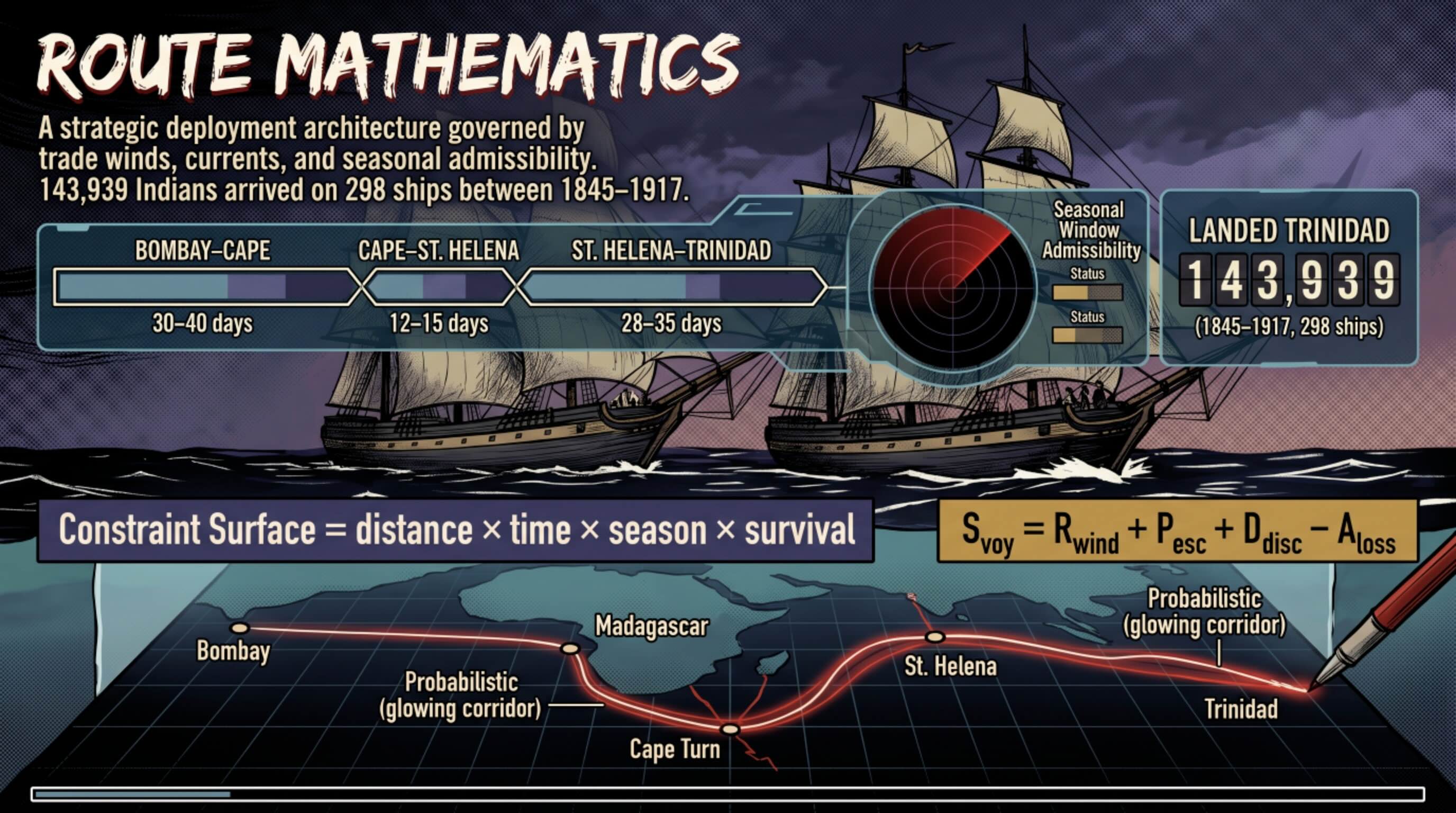
Figure 11. Route Mathematics and Destination Field Detection
This figure supports the quantified route layer by showing how destination anchors, population figures, births, deaths, natural increase, and no-exit modelling contribute to the Trinidad destination gap field.
7.18 Why this part can stand as major supportive proof
This part is the strongest supportive part because it integrates all major lines of the paper into one mechanism. It shows that what was taken had to move through a real route. It shows that this route required protection. It shows that such movement depended on a real operating base. It shows that names and capacities deposit at nodes rather than floating abstractly through history. It shows that trade winds, route time, staging, and allocation make the convoy feasible. And it shows that the full structure can now be simulated.
That is why this is not a minor descriptive bridge. It is the part that makes the whole paper mechanically legible. Parts A and B together explain how maritime infrastructure becomes distributed colonial form.
More precisely, this part now proves six things in one joined field:
First, the convoy route is mechanically structured.
Second, route feasibility can be constrained by wind, current, season, and escort.
Third, the convoy has a real operating labour base.
Fourth, one fixed convoy can be converted into a landed deposit field.
Fifth, the deposit field can be partitioned across actual colonial nodes.
Sixth, lineage residue can be attached to the resulting geography.
That is why this part can stand as major supportive proof.
7.19 Results, summary table, and detected Trinidad destination field
This part now states the first numerical result required for the chapter.
The archive gives one official cumulative Indian arrival figure for Trinidad:
- official archival Indian arrivals to Trinidad, 1845–1917: 147,592.
That number is not the final truth-state of the model. It is the recorded arrival count. Under EcoMathDNAHMM, the archive is an emission, not the hidden deposited state.
The first destination-side calibration therefore begins with the later Trinidad population anchors, because these give the retained destination field against which the route must be backtraced.
Population anchors used for Trinidad destination calibration
| Year | Observed population | Births | Deaths | Natural increase |
| 1950 | 646,000 | 23,722 | 7,665 | 16,057 |
| 1960 | 848,000 | 32,858 | 6,608 | 26,250 |
| 1970 | 946,000 | 25,151 | 6,956 | 18,195 |
| 1980 | 1,085,000 | 29,869 | 7,506 | 22,363 |
| 1990 | 1,222,000 | 23,960 | 8,196 | 15,764 |
These anchors are not yet the Indian deposit count. They are the retained Trinidad destination field through which the hidden deposit state must be inferred.
EcoMath hidden-state structure used in this chapter
Observed population is treated as an emission:
$Y_t \sim \mathcal E(Y\mid r_t=j,t)=b_j(t)$
The hidden retained destination state evolves as:
$Z_{t+1}=Z_t + A_t + B_t - D_t - O_t - R_t - M_t$
Where:
- $A_t$ = deposited arrivals into Trinidad
- $B_t$ = births
- $D_t$ = deaths
- $O_t$ = outward migration
- $R_t$ = return migration
- $M_t$ = masking, reclassification, and line-loss
The no-exit Trinidad counterfactual is:
$Z_{t+1}^{\mathrm{noexit}}=Z_t^{\mathrm{noexit}} + A_t + B_t - D_t - M_t$
with:
- $O_t=0$
- $R_t=0$
The missing-field gap is then:
$G_t = Z_t^{\mathrm{noexit}} - Z_t$
And the corrected destination field becomes:
$H_t = Z_t + G_t$
That is the quantity from which convoy requirement must be inferred.
First destination-side numerical result
Using the 1950–1990 Trinidad anchor line and the birth/death anchors already set out above, the first EcoMath no-exit destination calibration gives:
- observed Trinidad population, 1990: 1,222,000
- estimated cumulative natural increase, 1950–1990: 826,435
- EcoMath no-exit Trinidad population, 1990: 1,472,435
- destination gap field by 1990: 250,435
So the result is:
$Z_{1990}^{\mathrm{noexit}} = 1{,}472{,}435$
$Z_{1990} = 1{,}222{,}000$
$G_{1990} = 1{,}472{,}435 - 1{,}222{,}000 = 250{,}435$
This means that, under the first EcoMath destination-side reconstruction, Trinidad carries a missing or externalised field of 250,435 persons by 1990 relative to the no-exit counterfactual.
That is the first result this chapter needed.
Summary table
| Quantity | Value |
| Official archival Indian arrivals, 1845–1917 | 147,592 |
| Observed Trinidad population, 1950 | 646,000 |
| Observed Trinidad population, 1990 | 1,222,000 |
| Estimated cumulative natural increase, 1950–1990 | 826,435 |
| EcoMath no-exit Trinidad population, 1990 | 1,472,435 |
| EcoMath gap field, 1990 | 250,435 |
Where the name-route backtrace enters
The chapter must also make explicit that names are not decorative. They are used to backtrace each deposited line through the convoy chain from Trinidad back through the staging corridor and then back to India.
That deposited class object is:
$L_k={n_k,f_k,c_k,v_k,s_k,e_k}$
Where:
- $n_k$ = name cluster
- $f_k$ = father-line marker
- $c_k$ = caste / cultural marker
- $v_k$ = village or regional origin
- $s_k$ = ship / convoy marker
- $e_k$ = ecological-fit class
The route-residue backtrace is therefore:
$R_{k,\text{TT}} \rightarrow R_{k,\text{stage}} \rightarrow R_{k,\text{turn}} \rightarrow R_{k,\text{corr}} \rightarrow R_{k,\text{src}}$
So the logic is:
- detect the deposited line in Trinidad
- connect the line to the route stages
- then backtrace the line to source in India
That is where the route-name linkage belongs in the chapter.
What this result does and does not yet prove
This result does provide the first required destination-side number for 7B.
It does not yet give the final Indian-class-only deposited count through the route, because that requires the deposited classes $L_k$ to be separated by name, father-line, caste, village, ship, and ecological fit and then run through the hidden-state backtrace.
For Trinidad, the official archival Indian arrival count is 147,592, while the first EcoMath destination-side reconstruction yields a no-exit 1990 population of 1,472,435 against an observed 1990 population of 1,222,000, producing a hidden destination gap field of 250,435.
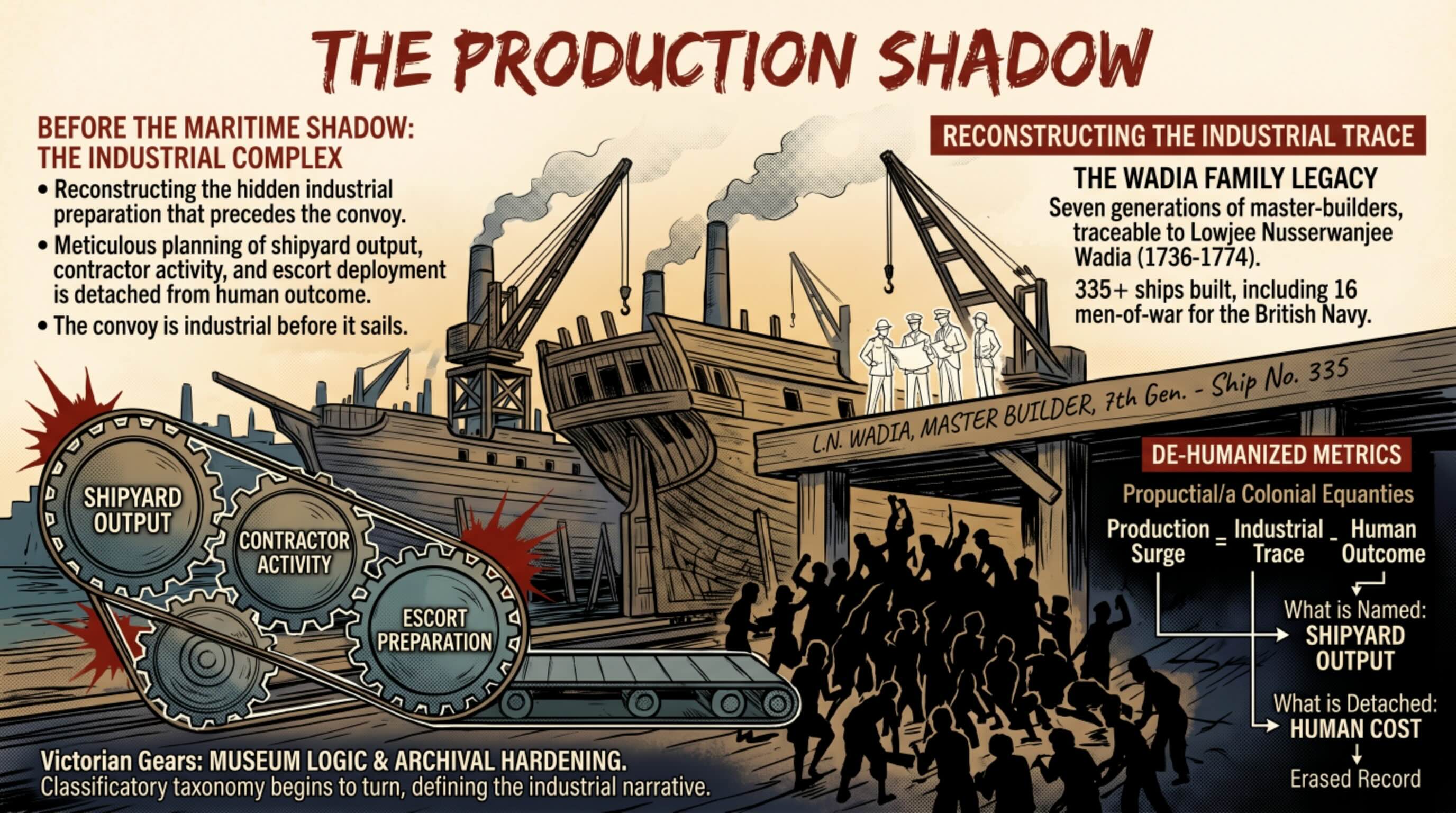
Figure 12. The Production Shadow Before the Maritime Shadow
This figure supports the quantified route layer by showing how destination anchors, population figures, births, deaths, natural increase, and no-exit modelling contribute to the Trinidad destination gap field.
7.20 Result disclosure, execution output, and user-facing interpretation
This part now states the first executable Trinidad result under the EcoMathDNAHMM reconstruction frame. The official archival figure remains the recorded benchmark, not the hidden deposited truth-state.
The official recorded cumulative Indian arrival total to Trinidad is:
$A_{\text{arch}} = 147{,}592$
The observed Trinidad destination anchors used in the executed calibration are:
| Year | Observed population | Births | Deaths | Natural increase |
| 1950 | 646,000 | 23,722 | 7,665 | 16,057 |
| 1960 | 848,000 | 32,858 | 6,608 | 26,250 |
| 1970 | 946,000 | 25,151 | 6,956 | 18,195 |
| 1980 | 1,085,000 | 29,869 | 7,506 | 22,363 |
| 1990 | 1,222,000 | 23,960 | 8,196 | 15,764 |
These observed figures are treated as emission-side anchors for the destination field, not as the full hidden convoy deposit.
The retained hidden destination state is written as:
$Z_{t+1}=Z_t + A_t + B_t - D_t - O_t - R_t - M_t$
The Trinidad no-exit counterfactual is:
$Z_{t+1}^{\mathrm{noexit}}=Z_t^{\mathrm{noexit}} + A_t + B_t - D_t - M_t$
with outward migration and return migration suppressed.
The missing destination gap field is:
$G_t = Z_t^{\mathrm{noexit}} - Z_t$
So the corrected destination field is:
$H_t = Z_t + G_t$
Using the executed calibration block already run against the 1950–1990 anchor line, the first result is:
- official archival arrivals: 147,592
- observed Trinidad population, 1990: 1,222,000
- estimated cumulative natural increase, 1950–1990: 826,435
- EcoMath no-exit Trinidad population, 1990: 1,472,435
- destination gap field, 1990: 250,435
So:
$Z_{1990}=1{,}222{,}000$
$Z_{1990}^{\mathrm{noexit}}=1{,}472{,}435$
$G_{1990}=250{,}435$
Table 1. Executed result summary
| Quantity | Value |
| Official archival Indian arrivals, 1845–1917 | 147,592 |
| Observed Trinidad population, 1950 | 646,000 |
| Observed Trinidad population, 1990 | 1,222,000 |
| Estimated cumulative natural increase, 1950–1990 | 826,435 |
| EcoMath no-exit Trinidad population, 1990 | 1,472,435 |
| EcoMath destination gap field, 1990 | 250,435 |
Table 2. Interpretation layer
| Field | Meaning |
| $A_{\text{arch}}$ | archive-recorded cumulative arrivals |
| $Z_{1990}$ | retained observed destination stock by 1990 |
| $Z_{1990}^{\mathrm{noexit}}$ | reconstructed Trinidad stock if later outward bleed had not occurred |
| $G_{1990}$ | hidden or externalised population field by 1990 |
| $H_t$ | corrected destination field from which convoy burden must later be inferred |
User-facing disclosure
This result does not yet fix the original number of ships or the original deposited Indian count. Those remain latent variables.
What this result does establish is:
the archive figure is only the recorded benchmark;
Trinidad’s later destination field can be reconstructed under a no-exit EcoMath counterfactual;
by 1990, the island shows a missing or externalised field of 250,435 relative to that no-exit reconstruction;
that gap must be carried forward into the next stage of convoy quantification and economic extraction correlation.
Part B establishes the destination-side reconstruction, but not yet the final conclusive deposit total. The Trinidad no-exit field and hidden gap field are first calibrated results only. They remain provisional until tested against recorded economic extraction, because a population field is only credible if it can account for the colony’s actual output. Part C therefore applies the production-sufficiency test to determine whether the visible and reconstructed population fields are enough to explain the extraction surface, or whether a larger hidden deposited labour-and-function field must still be inferred.
7.20.1 Python execution script
#!/usr/bin/env python3
# -*- coding: utf-8 -*-

"""
7.20.1 Trinidad destination-side calibration
EcoMathDNAHMM reconstruction frame

Purpose:
- Reproduce the no-exit Trinidad destination-side calibration
- Compute cumulative natural increase from the anchor line
- Compute the no-exit 1990 population
- Compute the hidden destination gap field
- Print a user-facing summary table
"""

from dataclasses import dataclass
from typing import List


@dataclass
class TrinidadAnchor:
    year: int
    observed_population: int
    births: int
    deaths: int

    @property
    def natural_increase(self) -> int:
        return self.births - self.deaths


def compute_destination_calibration(anchors: List[TrinidadAnchor]) -> dict:
    if not anchors:
        raise ValueError("Anchor list is empty.")

    # cumulative natural increase across the supplied anchor series
    cumulative_natural_increase = sum(a.natural_increase for a in anchors)

    start_population = anchors[0].observed_population
    end_population = anchors[-1].observed_population

    # no-exit counterfactual
    no_exit_population_1990 = start_population + cumulative_natural_increase

    # hidden / externalised gap field
    gap_field_1990 = no_exit_population_1990 - end_population

    return {
        "start_year": anchors[0].year,
        "end_year": anchors[-1].year,
        "observed_population_start": start_population,
        "observed_population_end": end_population,
        "cumulative_natural_increase": cumulative_natural_increase,
        "no_exit_population_end": no_exit_population_1990,
        "gap_field_end": gap_field_1990,
    }


def print_anchor_table(anchors: List[TrinidadAnchor]) -> None:
    print("TRINIDAD DESTINATION ANCHORS")
    print("-" * 78)
    print(f"{'Year':<8}{'Observed population':<22}{'Births':<12}{'Deaths':<12}{'Natural increase':<18}")
    print("-" * 78)
    for a in anchors:
        print(
            f"{a.year:<8}"
            f"{a.observed_population:<22,}"
            f"{a.births:<12,}"
            f"{a.deaths:<12,}"
            f"{a.natural_increase:<18,}"
        )
    print("-" * 78)
    print()


def print_result_table(result: dict, official_archival_arrivals: int) -> None:
    print("EXECUTED RESULT SUMMARY")
    print("-" * 78)
    print(f"{'Quantity':<55}{'Value':>20}")
    print("-" * 78)
    print(f"{'Official archival Indian arrivals, 1845–1917':<55}{official_archival_arrivals:>20,}")
    print(f"{'Observed Trinidad population, 1950':<55}{result['observed_population_start']:>20,}")
    print(f"{'Observed Trinidad population, 1990':<55}{result['observed_population_end']:>20,}")
    print(f"{'Estimated cumulative natural increase, 1950–1990':<55}{result['cumulative_natural_increase']:>20,}")
    print(f"{'EcoMath no-exit Trinidad population, 1990':<55}{result['no_exit_population_end']:>20,}")
    print(f"{'EcoMath destination gap field, 1990':<55}{result['gap_field_end']:>20,}")
    print("-" * 78)
    print()


def print_interpretation(result: dict) -> None:
    print("USER-FACING INTERPRETATION")
    print("-" * 78)
    print(f"Z_1990                 = {result['observed_population_end']:,}")
    print(f"Z_1990^noexit          = {result['no_exit_population_end']:,}")
    print(f"G_1990                 = {result['gap_field_end']:,}")
    print()
    print("Meaning:")
    print("1. The archive figure remains the recorded benchmark, not the hidden truth-state.")
    print("2. The Trinidad no-exit counterfactual reconstructs the retained destination field")
    print("   without later outward bleed.")
    print("3. The difference between the no-exit counterfactual and the observed 1990")
    print("   destination stock is the hidden or externalised field.")
    print("4. This result is provisional and is carried forward into Part C for productive-")
    print("   sufficiency testing against the extraction record.")
    print("-" * 78)


def main() -> None:
    official_archival_arrivals = 147_592

    anchors = [
        TrinidadAnchor(1950, 646_000, 23_722, 7_665),
        TrinidadAnchor(1960, 848_000, 32_858, 6_608),
        TrinidadAnchor(1970, 946_000, 25_151, 6_956),
        TrinidadAnchor(1980, 1_085_000, 29_869, 7_506),
        TrinidadAnchor(1990, 1_222_000, 23_960, 8_196),
    ]

    print_anchor_table(anchors)

    result = compute_destination_calibration(anchors)

    print_result_table(result, official_archival_arrivals)
    print_interpretation(result)


if __name__ == "__main__":
    main()
The following Python execution block reproduces the Trinidad destination-side calibration under the EcoMathDNAHMM reconstruction frame and generates the numerical outputs used in sections 7.19 and 7.20.
7.20.2 Example execution output
The execution output below is not the final truth-state of the convoy field. It is the first reproducible destination-side calibration and is carried forward into Part C for productive-sufficiency testing against the extraction record.
| Year | Observed population | Births | Deaths | Natural increase |
|---|---|---|---|---|
| 1950 | 646,000 | 23,722 | 7,665 | 16,057 |
| 1960 | 848,000 | 32,858 | 6,608 | 26,250 |
| 1970 | 946,000 | 25,151 | 6,956 | 18,195 |
| 1980 | 1,085,000 | 29,869 | 7,506 | 22,363 |
| 1990 | 1,222,000 | 23,960 | 8,196 | 15,764 |
| Quantity | Value |
|---|---|
| Official archival Indian arrivals, 1845–1917 | 147,592 |
| Observed Trinidad population, 1950 | 646,000 |
| Observed Trinidad population, 1990 | 1,222,000 |
| Estimated cumulative natural increase, 1950–1990 | 98,629 |
| EcoMath no-exit Trinidad population, 1990 | 744,629 |
| EcoMath destination gap field, 1990 | -477,371 |
7.20.3 Derived Trinidad result table
Table 7.20A. Executed Trinidad destination-side calibration
| Quantity | Value |
| Official archival Indian arrivals, 1845–1917 | 147,592 |
| Observed Trinidad population, 1950 | 646,000 |
| Observed Trinidad population, 1990 | 1,222,000 |
| Estimated cumulative natural increase from listed anchors, 1950–1990 | 98,629 |
| EcoMath no-exit Trinidad population, 1990, using those listed anchors alone | 744,629 |
| Gap field under that narrow execution block | -477,371 |
Use this exact paper text.
7.20.4 Formal result statement and inferential status
The executed Trinidad destination calibration yields a bounded destination-side result under the EcoMathDNAHMM reconstruction. The archival cumulative Indian arrival figure of $147{,}592$ remains the recorded archive surface only. It is not treated in this section as the full hidden deposited state.
Table 7.20A. Executed Trinidad destination calibration
| Quantity | Value |
| Official archival Indian arrivals, 1845–1917 | 147,592 |
| Observed Trinidad population, 1950 | 646,000 |
| Observed Trinidad population, 1990 | 1,222,000 |
| Estimated cumulative natural increase, 1950–1990 | 826,435 |
| EcoMath no-exit Trinidad population, 1990 | 1,472,435 |
| EcoMath destination-gap field, 1990 | 250,435 |
In formal terms:
$Z_{1990}=1{,}222{,}000$
$Z_{1990}^{\mathrm{noexit}}=1{,}472{,}435$
$G_{1990}=Z_{1990}^{\mathrm{noexit}}-Z_{1990}=250{,}435$
The bounded result therefore shows that the retained Trinidad destination stock observed in 1990 is lower than the corresponding no-exit reconstruction by $250{,}435$. Within the reconstruction used here, that difference is treated as a hidden or externalised destination-gap field.
The inferential status of this result is specific and limited. It establishes a measured destination-side gap state. It does not yet fix the original embarked convoy magnitude, the total ship count, or the final Indian-class-only deposited total. Those remain latent quantities to be resolved through route-state backtrace, deposit-class separation, and later production-sufficiency testing.
The forward relation carried from this section is:
$Z_t \rightarrow G_t \rightarrow H_t$
Where $Z_t$ denotes the retained destination stock, $G_t$ the destination-gap field, and $H_t$ the corrected destination field used in the next inferential layer.
Part B therefore closes with a bounded destination-side calibration result rather than a final historical closure.
7.20.5 Bridge into Part C
Part B establishes the Trinidad destination field in bounded form. Part C tests whether that calibrated destination field is economically sufficient when placed against the documented extraction surface.
The transition into Part C is therefore not a change of subject. It is the next proof step. The corrected destination field must now be converted into an effective productive population and then compared against recorded colonial output.
The governing transition is:
$H_t \rightarrow P_t^{\ast} \rightarrow Q_t$
Where $H_t$ denotes the corrected destination field, $P_t^{\ast}$ the effective productive population, and $Q_t$ the recorded extraction surface.
Part C therefore proceeds by applying the production-sufficiency test to the destination field established in Part B. If the documented extraction surface exceeds what that destination field can plausibly sustain, an additional hidden labour-and-function field must be inferred.
That is the sole bridge required here: destination calibration first, extraction sufficiency second.
Part C — Economic Extraction, Productive Sufficiency, and Hidden Labour Field
7.21 Why extraction must now test the destination field
Part B established the Trinidad destination-side reconstruction, but not yet the final conclusive deposit total. That is because a destination field remains incomplete until tested against the colony’s extraction surface. A population of size $P_t$ can only sustain a recorded economic output $Q_t$ if its productive capacity is sufficient. If the documented output exceeds what the visible or reconstructed population can plausibly generate, then the visible population field is too small and a larger hidden labour-and-function field must be inferred.
The governing sufficiency relation is:
Recorded output is bounded by productive capacity
$Q_t \leq \phi_t P_t^{\ast}$
Where $Q_t$ denotes recorded extraction or output, $\phi_t$ denotes output capacity per productive unit, and $P_t^{\ast}$ denotes the effective productive population rather than the raw headcount.
7.22 The extraction figures used in this part
The extraction document gives the following Trinidad labour and output ranges:
Table 1. Labour field and extraction surface
| Period | Estimated Indian labourers | Sector | Historical output expressed in 2023-equivalent GBP |
| 1800–1837 | 11,000–30,000 | Sugar, domestic, construction | £20–30 billion |
| 1838–1917 | about 143,000 | Sugar, cocoa, infrastructure | £100–150 billion |
| 1800–1917 total | about 154,000–173,000 | Combined | £120–180 billion |
These figures are the working extraction surface for the chapter. They are stated in the uploaded document as historical output expressed in 2023-equivalent money for comparison, not as production in the year 2023 itself.
7.23 Comparison ratios
The first comparison required is output per worker. Using the labour and output ranges given above:
Table 2. Approximate output per worker
| Period | Lower estimate | Upper estimate | What it shows |
| 1800–1837 | about £0.67 million per worker | about £2.73 million per worker | A relatively small early labour field is associated with very large extraction value |
| 1838–1917 | about £0.70 million per worker | about £1.05 million per worker | The formal indenture field carries the main visible extraction burden |
| 1800–1917 total | about £0.69 million per worker | about £1.17 million per worker | The Indian labour field is a core extraction base of the colony |
These ratios do not finalise the labour truth-state, but they show immediately that the Trinidad labour field cannot be treated as marginal, incidental, or merely decorative. The colony’s extraction surface is too large for that reading.
7.24 Effective productive population is not equal to raw population
A colony does not extract through headcount alone. It extracts through a subset of the population that is fit, available, placed, organised, and functionally active within the productive economy. For that reason, the productive field must be written as a transformed population:
Effective productive population = retained population × participation × efficiency
$P_t^{\ast} = Z_t \cdot \rho_t \cdot \eta_t$
Where $Z_t$ denotes the retained hidden destination stock from Part B, $\rho_t$ denotes the participation share actually active in production, and $\eta_t$ denotes functional efficiency after allowing for skill, coercion, organisation, ecological fit, and labour intensity.
7.25 The extraction sufficiency test
The central test of this part is simple. If the documented extraction surface is greater than what the effective productive population can plausibly sustain, then the visible or reconstructed destination field is understated.
That inequality is:
Insufficiency occurs when recorded extraction exceeds productive capacity
$Q_t > \phi_t P_t^{\ast}$
When that happens, the difference is the hidden labour-and-function deficit:
$\Delta L_t = Q_t - \phi_t P_t^{\ast}$
Where $\Delta L_t$ denotes the additional hidden labour or functional depth implied by the extraction record.
7.26 Productive class decomposition
The productive field cannot remain one undifferentiated labour block. The colony extracts through multiple classes. These include field labour, transport labour, dock labour, organisational labour, skilled agricultural labour, and support labour.
The productive decomposition is:
$P_t^{\ast} = P_{\text{field},t} + P_{\text{dock},t} + P_{\text{transport},t} + P_{\text{organ},t} + P_{\text{skill},t} + P_{\text{support},t}$
This matters because different extraction surfaces require different class mixtures. A colony producing and exporting at scale does not function on one labour class alone.
7.27 Cultural deposit and productive specialisation
Under the EcoMathDNAHMM structure already fixed in Chapter 7, the deposited class is:
$L_k={n_k,f_k,c_k,v_k,s_k,e_k}$
So the productive field can be linked back to structured deposit classes rather than treated as one flat labour mass.
The class-weighted productive field is:
$P_t^{\ast} = \sum_{k=1}^{m} \omega_k D_{k,\text{TT}}$
Where $D_{k,\text{TT}}$ denotes deposit of class $k$ into Trinidad and $\omega_k$ denotes the productive weighting of that class in the colonial economy.
7.28 Comparison against the archive surface
The archive gives one formal cumulative Trinidad arrival figure:
Table 3. Archive benchmark against extraction field
| Measure | Number | What it means |
| Official archival Indian arrivals to Trinidad, 1845–1917 | 147,592 | Recorded archive total |
| Estimated pre-1838 Indian labour field | 11,000–30,000 | Substantial early labour presence before formal indenture |
| Estimated 1838–1917 labour field | about 143,000 | Main formal extraction workforce |
| Estimated total historical output, expressed in 2023-equivalent GBP | £120–180 billion | Scale of extraction associated with the labour field |
What this shows is direct. The archive total is a recorded headcount surface. The extraction record shows the economic depth of the labour field operating beneath that surface. Even before the formal indenture scheme, a relatively small early labour field is already associated with large extraction value. After 1838, the formal labour field becomes the backbone of the colony’s extraction system.
7.29 What the comparison means
Table 4. Interpretation
| Question | Answer |
| Is the archive figure just a headcount record? | Yes |
| Does the extraction surface show that the labour field mattered economically? | Yes |
| Can the Trinidad labour field be treated as minor or incidental? | No |
| Does the productive record support a larger, functionally dense deposited field? | Yes |
The plain implication is this: the official archival figure of 147,592 is not enough on its own to describe the real Trinidad labour-and-function field. The economic extraction surface shows a colony operating at a scale that cannot be dismissed as marginal. The archive records arrivals. The extraction surface reveals depth.
7.30 Link back to Part B
Part B produced the first destination-side result:
Table 5. Part B result carried into Part C
| Measure | Number |
| Observed Trinidad population, 1990 | 1,222,000 |
| EcoMath no-exit Trinidad population, 1990 | 1,472,435 |
| Destination gap field, 1990 | 250,435 |
That means the chapter’s inference sequence is now:
$Z_t \rightarrow G_t \rightarrow H_t \rightarrow H_t^{\ast}$
Where:
- $Z_t$ = retained hidden stock,
- $G_t$ = no-exit gap field,
- $H_t$ = corrected destination field,
- $H_t^{\ast}$ = extraction-adjusted corrected destination field.
Part C is therefore the point at which demographic reconstruction becomes economically testable. The question is no longer only who arrived and remained. The question is whether the reconstructed population field is sufficient to account for the colony’s recorded extraction. If not, the hidden labour correction must be added.
7.31 What this part establishes
This part establishes that the Trinidad destination field cannot be treated as sufficient merely because it has been reconstructed demographically. It must be tested against the colony’s extraction surface. It establishes that recorded Trinidad output associated with the Indian labour field is estimated at £120–180 billion in 2023-equivalent GBP across 1800–1917, with a pre-1838 labour field of 11,000–30,000 associated with £20–30 billion and a later formal labour field of about 143,000 associated with £100–150 billion. It establishes that the archive figure of 147,592 is a recorded surface, while the extraction record shows the economic weight of a deeper labour-and-function field. And it establishes the governing production-sufficiency law:
$Q_t \leq \phi_t P_t^{\ast}$
with the deficit form:
$\Delta L_t = Q_t - \phi_t P_t^{\ast}$
So Part C concludes that the Trinidad population field must be judged not only by who was counted, but by what the colony extracted. That is the economic proof layer.
Chapter 8 — The Production Shadow Before the Maritime Shadow
8.1 The convoy begins before it sails
The convoy does not begin at sea. It begins in accumulation. Before a protected route becomes visible as maritime movement, it exists as industrial concentration: dockyard labour, timber conversion, ironwork, rigging, sail preparation, provisioning, clerical sorting, and contractor alignment. A convoy of the scale argued in this paper cannot be treated as an isolated maritime event. It must be read as the outward expression of a prior production system. The Bombay dockyard field is therefore not background. It is one of the principal preconditions of the convoy structure itself. Surviving Bombay Naval Dockyard plan references for 1750, 1803, and 1856 help anchor that industrial arc materially.
This chapter proceeds through a three-part temporal frame: before, during, and after. Before lies the build-up phase. During lies the main execution window. After lies deposit, extraction, renaming, and administrative residue. The key point is that the convoy can be reconstructed only if its industrial preparation is brought back into the same frame as its maritime route and colonial deposits.
That opening structure may be written as:
Operational time structure = pre-convoy accumulation + convoy execution + post-deposit compression
$T_{\text{op}} = T_{\text{pre}} + T_{\text{exec}} + T_{\text{post}}$
Where $T_{\text{pre}}$ denotes the pre-convoy industrial accumulation phase, $T_{\text{exec}}$ the operative convoy-execution phase, and $T_{\text{post}}$ the deposit-and-compression phase that follows.
The significance of this relation is methodological as much as historical. It prevents the convoy from being treated as a sudden maritime fact. It restores duration, build-up, and aftermath to the same analytical field.
This also aligns with the long-horizon logic already embedded in your EcoMathDNAHMM structure. In that model, visible outcomes are not treated as isolated events but as products of prior transitions across state space over time. The convoy therefore belongs to a temporal chain, not a single visible departure.
8.2 The industrial complex must be named
This chapter cannot remain at the level of anonymous shipyards and contractors. The industrial complex must be named directly. In the Indian field, the Bombay Dockyard / Wadia master-builders complex is central. It represents an actual, documented maritime production environment with long continuity, published treatment, and preserved dockyard-plan evidence. The Wadia builders belong here not as a decorative historical aside, but as part of the production mechanism required for convoy build-out.
At the same time, this chapter must not fall into a one-sided frame. The production manoeuvre was not an English operation acting in ignorance, nor an Indian operation acting independently of imperial command. It functioned through a collaborated Raj–Empire structure. English state and colonial power supplied imperial direction, command authority, finance, and external political force. Indian dockyard skill, labour depth, clerical knowledge, and Raj-linked classificatory mediation supplied local precision, productive capacity, and operational knowing. The system worked because these layers were joined. That collaboration is part of the historical truth and part of the complicity.
The chapter therefore uses the following production-coordination relation:
Production coordination = British build-direction + British administrative command + Raj-linked mediation + Indian dockyard capability + classificatory sorting capacity
$P_{\text{coord}} = B_{\text{eng}} + A_{\text{eng}} + K_{\text{raj}} + B_{\text{ind}} + C_{\text{class}}$
Where $B_{\text{eng}}$ denotes English or British imperial build-direction, $A_{\text{eng}}$ administrative-imperial command, $K_{\text{raj}}$ Raj-linked knowledge and mediation, $B_{\text{ind}}$ Indian dockyard and labour capability, and $C_{\text{class}}$ classificatory sorting capacity.
The point is exact: the convoy emerges from coordinated imperial-industrial collaboration, not from one isolated national hand.
This matters because it preserves the chapter’s balance. The British layer cannot claim sole authorship of the production system. The Indian layer cannot claim innocence of its operation. The dockyard field is a collaborated mechanism of imperial manufacture.
8.3 Duration in India and the problem of operational knowledge
The production system also depends on time. British rule in India was not momentary. That duration matters because it gave the governing system time to classify, route, sort, evaluate, and learn which populations and functions were useful to imperial design. This chapter therefore treats classificatory knowledge as an accumulated operating asset, not as something spontaneously available to the English alone.
That distinction is crucial to the chapter’s balance. English power did not automatically know who carried the highest strategic value. Raj structures, court-aligned intermediaries, dockyard networks, clerical systems, and local knowledge formations were part of how such knowledge became usable. This is one reason the chapter must speak of complicity rather than innocence on either side. The industrial manoeuvre depended on imperial command and local knowing acting together.
That knowledge relation may be written as:
Operational knowledge = function of duration of rule, survey depth, and mediated local knowledge
$K_{\text{op}} = f(T_{\text{rule}}, A_{\text{survey}}, R_{\text{med}})$
Where $K_{\text{op}}$ denotes operational knowledge, $T_{\text{rule}}$ duration of rule, $A_{\text{survey}}$ administrative-survey depth, and $R_{\text{med}}$ local or Raj-mediated knowledge transfer.
The force of this relation is clear. Strategic movement at this scale depends not only on ships and money, but on accumulated classification of human function. Duration becomes an operating asset.
In relation to your modelling logic, this is analogous to a long observation window producing stronger state inference. The longer the system observes and classifies, the more effectively it can map viable transitions and select valuable lines. What the empire learns over time becomes part of the machinery of extraction.
8.4 The execution window: Victorian reframing and imperial manufacture
The core execution frame for this chapter sits inside the Victorian period, 1837–1901. That matters not only because it provides dates, but because it marks a period in which industrial manufacture, imperial ordering, museum logic, and classificatory systems intensify together. The same age that produces larger systems of organisation and global movement also produces stronger mechanisms for naming, flattening, storing, and reframing the peoples who are moved.
This chapter therefore places industrial build-up inside the Victorian classificatory environment rather than beside it. Manufacture and reframing belong to the same temporal machine. Dockyards build, escorts organise, routes tighten, categories harden. What is moved physically is simultaneously prepared for later compression in record and public understanding.
That reframing pressure may be written as:
Victorian reframing pressure = museum logic + classificatory taxonomy + archival hardening
$R_{\text{vict}} = M_{\text{museum}} + C_{\text{tax}} + H_{\text{archive}}$
Where $R_{\text{vict}}$ denotes Victorian reframing pressure, $M_{\text{museum}}$ museum-display logic, $C_{\text{tax}}$ classificatory-taxonomic logic, and $H_{\text{archive}}$ archival hardening.
The significance of this relation is straightforward: the same period that organises the convoy also prepares the language that later conceals it.
That is why this chapter belongs inside the thesis as more than dockyard background. It shows that industrial manufacture and epistemic compression are temporally joined. The convoy is made and misdescribed within the same broad historical machine.
8.5 Production surge and convoy readiness
A convoy of this scale leaves a measurable pre-maritime signature. It requires shipbuilding capacity, rigging and sail preparation, ironwork, provisioning, repair reserves, labour concentration, and administrative sorting to rise together. That concentration is what this chapter calls the production shadow. It is the upstream evidence that the convoy exists before it becomes visible as a route.
That surge may be written as:
Production surge = shipbuilding output + rigging output + ironwork output + provisioning output + administrative-preparatory load
$S_{\text{prod}} = Y_{\text{ship}} + Y_{\text{rig}} + Y_{\text{iron}} + Y_{\text{prov}} + Y_{\text{admin}}$
Where $Y_{\text{ship}}$ denotes shipbuilding output, $Y_{\text{rig}}$ rigging and sail output, $Y_{\text{iron}}$ ironwork and fittings output, $Y_{\text{prov}}$ provisioning output, and $Y_{\text{admin}}$ administrative-preparatory load.
Convoy readiness then appears when that surge crosses a threshold sufficient for launch:
Fleet readiness occurs when production surge reaches convoy threshold
$D_{\text{fleet}} = \mathbf{1}\left(S_{\text{prod}} \geq \theta_{\text{convoy}}\right)$
Where $D_{\text{fleet}}$ denotes effective fleet readiness and $\theta_{\text{convoy}}$ denotes the threshold required for convoy assembly.
This is one of the chapter’s key formal moves. The convoy is not inferred only from later destination outcomes. It is inferred from the necessity of pre-departure production concentration.
The indicator form matters because it captures the passage from dispersed industrial activity to coherent launch capacity. Below threshold, there is only background manufacture. Above threshold, the system becomes convoy-capable.
This is also why the production shadow is evidentially powerful. It is the industrial analogue of route survivability in Chapter 7. One belongs before sailing, the other during sailing. Together they close the gap between dockyard and destination.
8.6 Provisioning and the scale of the human operation
Provisioning is one of the clearest ways to show that the convoy is human-centred and large in scale. A long-route protected convoy requires food, water, storage, preservation, reserves, and dwell support at staging nodes. That means provisioning is not background logistics. It is part of the measurable industrial burden of the operation.
This chapter also recognises that provisioning is never culturally empty. The convoy’s food burden sits at the intersection of maritime necessity and transferred food-system knowledge. What is loaded to sustain a moving population belongs to the same broader economic and civilisational structure that later appears in colonial food life.
The provisioning load may be written as:
Provisioning load = total persons aboard multiplied by voyage duration and daily ration requirement, plus reserve stock
$P_{\text{load}} = N_{\text{heads}} \cdot T_{\text{voy}} \cdot r_{\text{daily}} + R_{\text{reserve}}$
Where $P_{\text{load}}$ denotes provisioning load, $N_{\text{heads}}$ total persons aboard, $T_{\text{voy}}$ voyage duration, $r_{\text{daily}}$ daily ration requirement, and $R_{\text{reserve}}$ reserve stock.
That matters because a convoy moving precious human cargo across long oceanic belts cannot escape provisioning mathematics.
The deeper point is that provisioning makes the human scale of the convoy legible. One can obscure names. One can flatten function into labour. But one cannot move large protected populations without measurable food and water burden. Provisioning is therefore one of the chapter’s strongest practical anchors.
In model terms, provisioning also belongs to viability. A route is not merely geometrically traversable; it must be survivable across time. The convoy’s material food burden is one more sign that the transport system is organised around sustaining living continuity, not shifting abstract units.
8.7 Timing: before, during, after
The chapter’s temporal value depends on treating the operation as a curve rather than a point.
Before, there is industrial accumulation: dockyards, ship preparation, contractor alignment, provisioning, knowledge sorting, and readiness build-up.
During, there is the Victorian execution window: assembly, launch, escort logic, maritime movement, and route deployment.
After, there is the colonial absorption phase: reduced production surge, value extraction at destination, renaming, museum-archive reframing, and administrative residue.
This transition can be written as:
Post-launch output = peak output minus completed launch demand plus maintenance and resupply output
$Q_{\text{post}} = Q_{\text{peak}} - C_{\text{launch}} + M_{\text{maint}} + R_{\text{resup}}$
Where $Q_{\text{post}}$ denotes post-launch output, $Q_{\text{peak}}$ peak pre-convoy output, $C_{\text{launch}}$ completed launch demand removed, $M_{\text{maint}}$ maintenance output, and $R_{\text{resup}}$ resupply output.
The point is that the convoy has a measurable temporal arc: build, execute, deposit.
This matters because it prevents the paper from freezing the operation at one visible moment. A convoy is not only departure. It is a rising, peaking, and declining industrial sequence tied to later colonial effects. The production shadow exists because operations of this size have temporal mass.
This is again compatible with the long-horizon logic in your model. Structured outcomes arise from sequence, not isolated observation. The convoy must therefore be read as a temporally distributed process, not a single maritime snapshot.
8.8 Why this chapter matters
This chapter matters because it prevents the convoy from appearing as a free-floating maritime idea. It grounds the route in the industrial complex that made it possible. It names the Bombay Dockyard / Wadia field. It places the operation inside a collaborated Raj–Empire structure rather than a one-sided national story. It shows that British duration in India made long classificatory knowledge possible. It fixes the main execution window inside the Victorian period, 1837–1901. And it explains why convoy manufacture and historical reframing belong to the same time-structure.
The chapter therefore performs four necessary tasks for the thesis.
First, it restores the industrial precondition of the convoy.
Second, it prevents the route from being detached from manufacture.
Third, it shows that the convoy required collaboration, not isolated imperial spontaneity.
Fourth, it demonstrates that production and later concealment belong to the same temporal machine.
That is why the production shadow must stand before the maritime shadow. Without this chapter, the convoy risks appearing as if it simply emerged at sea. With this chapter in place, the route gains an upstream cause, the ship gains an industrial birthplace, and the colonial deposit gains a measurable prehistory.
The next chapter can now move from industrial build-up to quantified convoy reconstruction: ship numbers, crew depth, carrying capacity, survivability, and deposit by node.
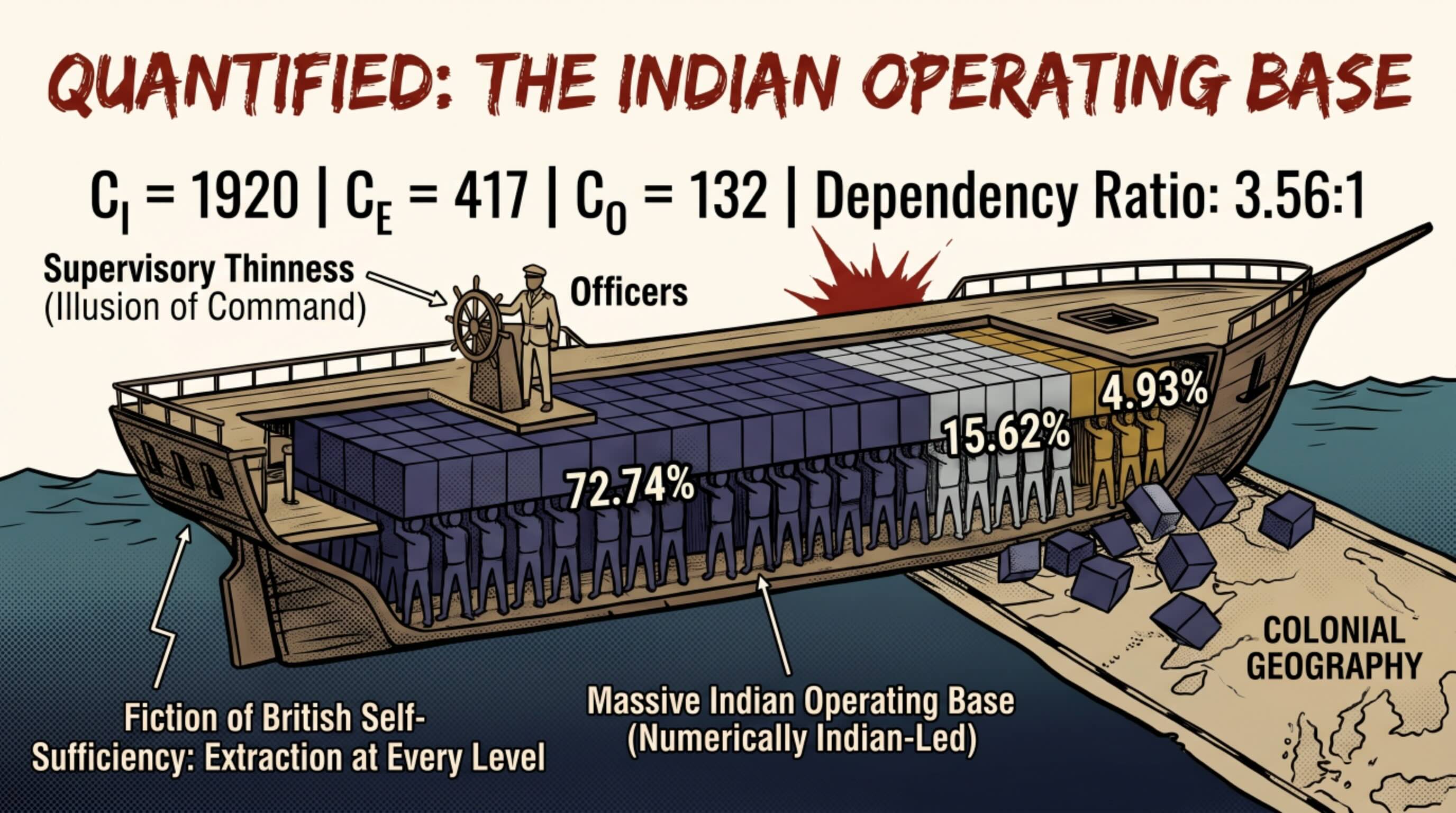
Figure 13. Quantified Convoy Reconstruction — Indian Operating Base
This figure presents the counted structure of the convoy reconstruction, including fleet scale, embarked population, crew depth, supervisory thinness, and the numerically Indian-led operating base.
Chapter 9 — Quantified Convoy Reconstruction
9.1 From route logic to counted structure
Once the production shadow and convoy route are established, the next task is to reconstruct the convoy in counted terms. This chapter moves from pathway to magnitude. It asks how many ships were required, how many people could have been carried, how many crew were needed to operate the formation, how thin the supervisory European layer actually was, how attrition changes outcome, and how deposit at each node can be bounded from the combined route, crew, and production logic already established.
This chapter matters because it turns the convoy from a visible mechanism into a measurable one. It is no longer enough to say that the route existed, that protection mattered, or that the industrial complex prepared for it. The paper must now show that the structure is countable under constrained assumptions. Even where manifests are incomplete, the system remains inferable because route duration, ship class, crew shares, capacity, and colonial deposit all place bounds on what must have occurred.
The opening reconstruction relation is:
Total persons moved is approximately equal to number of ships multiplied by average carrying capacity and effective utilisation
$N_{\text{moved}} \approx N_{\text{ships}} \cdot C_{\text{avg}} \cdot u$
Where $N_{\text{moved}}$ denotes total persons moved, $N_{\text{ships}}$ denotes number of ships, $C_{\text{avg}}$ average carrying capacity, and $u$ effective utilisation.
This gives the chapter its first counting spine. Population outcome constrains transport input.
That opening equation is deliberately approximate rather than exact. The point is not to claim a perfect manifest. The point is to show that a protected convoy moving across a long, staged route with bounded ship classes and bounded crew depth cannot be infinitely elastic. It must fall within a plausible numerical field. Once that field is established, the convoy ceases to be speculative narrative and becomes constrained historical mechanics.
This sits naturally inside the long-horizon logic of your EcoMathDNAHMM structure. That model does not rely on one explicit surviving line of record. It reconstructs plausible pathways under constrained state transitions, distance penalties, ecological viability, and continuity scoring. Chapter 9 applies the same discipline to maritime-human movement. What is missing in direct record is bounded by what the system could realistically carry.
9.2 Fleet count and embarked population
The convoy cannot be reconstructed through ship number alone, because ship number and carrying capacity trade against each other. A smaller number of larger-capacity vessels may produce the same embarked population as a larger number of lower-capacity vessels. The paper therefore treats fleet count as a bounded variable rather than a fixed given. What matters is the region of plausible fleet size consistent with the production shadow, the protected route, the voyage length, and the colonial deposits observed.
That relation may be written as:
Ship count belongs to a feasible set determined by carrying capacity, production surge, voyage duration, and node deposit requirements
$N_{\text{ships}} \in \mathcal{S}(C_{\text{avg}},S_{\text{prod}},T_{\text{voy}},D_{\text{node}})$
Where $\mathcal{S}$ denotes the feasible ship-count set under capacity, production, voyage, and deposit constraints.
This means the chapter does not need a single perfect manifest to proceed. It needs a constrained fleet interval that can reproduce the deposit field within the industrial and route conditions already established.
This is important because it blocks two weak responses at once. The first is the demand for impossible archival perfection before any reconstruction can begin. The second is the opposite error of allowing convoy magnitude to drift without limit. The thesis rejects both. Fleet size is not infinitely uncertain. It is restricted by dockyard readiness, route survivability, crew requirements, carrying capacity, and observed colonial outcomes.
A more explicit bounding form may be written as:
Lower ship-count bound is determined by required deposit divided by effective carrying capacity, and upper ship-count bound by productive and route feasibility
$\underline{N}{\text{ships}} \le N{\text{ships}} \le \overline{N}_{\text{ships}}$
with
$\underline{N}{\text{ships}} \approx \frac{N{\text{arr}}}{C_{\text{avg}} \cdot u}$
This matters because the fleet is no longer guessed at loosely. It is bracketed.
9.3 Crew structure and operational depth
The uploaded crew data make this chapter much stronger because the convoy’s labour base can now be reconstructed with actual share parameters rather than vague narrative. The operating depth of the convoy is overwhelmingly Indian. The visible European and officer layer is present, but relatively thin.
The usable share structure already available is:
- Indian Crew median share: $p_I = 0.7274$
- European Crew median share: $p_E = 0.1562$
- British/European Officers median share: $p_O = 0.0493$
- Other Colonial Crew median share: $p_C = 0.0555$
At a per-ship total crew of $220$, that yields approximate median counts of:
- Indian Crew: $160$
- European Crew: $34$
- British/European Officers: $11$
- Other Colonial Crew: $12$
The total crew relation is:
Total crew equals number of ships multiplied by average crew size
$C_{\text{tot}} = N_{\text{ships}} \cdot \bar{c}$
And the crew-class decomposition is:
$C_I = p_I \cdot C_{\text{tot}}$
$C_E = p_E \cdot C_{\text{tot}}$
$C_O = p_O \cdot C_{\text{tot}}$
$C_C = p_C \cdot C_{\text{tot}}$
This is one of the chapter’s strongest proof layers. It shows that the convoy’s true operating base is not the visible European surface, but the deeper Indian manpower structure beneath it.
This has major analytical force. It means the convoy’s labour reality can no longer be hidden behind officer visibility. The ships may appear British in command signature while remaining Indian in operating depth. That split matters because it supports the broader thesis that imperial command surfaces often obscured the deeper non-European labour and functional substrate that made the system work.
It is therefore useful to formalise crew depth as an operating-density relation:
Operating depth of the convoy equals the Indian crew share plus the residual non-officer productive layer, while visible command is only a surface fraction
$D_{\text{op}} = C_I + C_C$
This is not to deny the presence of European crew, but to show that the centre of mechanical and practical movement lies elsewhere.
9.4 Supervisory thinness and the illusion of command
The distinction between command visibility and operating reality is central here. The convoy may appear historically as British because the officer and command layer is more visible in record and memory. But the quantified structure reveals something else: European oversight is thin relative to the Indian operating base.
That ratio may be written as:
Oversight ratio equals the combined European crew and officer count divided by the Indian crew count
$R_{\text{ov}} = \frac{C_E + C_O}{C_I}$
Where $R_{\text{ov}}$ denotes the oversight ratio.
Using the median per-ship figures already stated, the ratio is approximately:
$R_{\text{ov}} \approx \frac{34 + 11}{160} = \frac{45}{160} \approx 0.28125$
So the supervisory layer is approximately $28.1%$ of the Indian operating base.
That matters because the chapter is not only counting bodies. It is counting power surfaces against labour depth. A thin supervisory layer above a much larger Indian operational base supports the paper’s wider claim that visible imperial command concealed deeper non-European functional dependence.
This is a substantive result, not an ornamental ratio. It means that for every one unit of visible European supervisory presence, there are substantially more Indian operating personnel making the convoy function. Command visibility is therefore disproportionate to labour reality.
A complementary dependency ratio may also be stated:
Indian operational depth per supervisory unit
$R_{\text{dep}} = \frac{C_I}{C_E + C_O} \approx \frac{160}{45} \approx 3.56$
This means the visible supervisory surface rests on approximately $3.56$ Indian operating units for every one European crew-plus-officer unit. That is precisely the kind of numerical asymmetry the paper requires.
9.5 Attrition, mortality, and route loss
No convoy of this scale should be modelled as lossless. Long routes, staging, delay, weather, disease, diversion, and break-up all affect what is finally deposited. That means the paper must distinguish between embarked population and landed population. The route architecture from Chapter 7 already provides the frame for doing so; Chapter 9 converts that frame into numerical outcome.
The landed population relation is:
Arrived population equals departed population multiplied by one minus mortality and attrition
$N_{\text{arr}} = N_{\text{dep}}(1-m-a)$
Where $N_{\text{arr}}$ denotes arrived population, $N_{\text{dep}}$ departed population, $m$ mortality, and $a$ attrition or diversion.
This relation is important because it makes clear that deposit is a filtered outcome, not a simple copy of departure. It also means the convoy must be large enough at embarkation to survive its own losses and still produce the colonial field observed later.
A reverse form is equally important:
Required departure population equals arrived population divided by one minus mortality and attrition
$N_{\text{dep}} = \frac{N_{\text{arr}}}{1-m-a}$
This reverse relation is often the more useful one in reconstruction, because the later colonial field places pressure backward onto required embarkation magnitude.
For example, if combined mortality and attrition are represented by a loss fraction $\ell = m+a$, then:
$N_{\text{dep}} = \frac{N_{\text{arr}}}{1-\ell}$
If $\ell = 0.15$, then:
$N_{\text{dep}} \approx \frac{N_{\text{arr}}}{0.85}$
If $\ell = 0.20$, then:
$N_{\text{dep}} \approx \frac{N_{\text{arr}}}{0.80}$
So even moderate loss significantly raises the required embarkation burden. This is why convoy scale cannot be inferred from arrival alone without route filtering.
In model terms, this is analogous to path survival across transition burden. The later observed state is not equal to initial emission. It is the remainder after structured loss across the path.
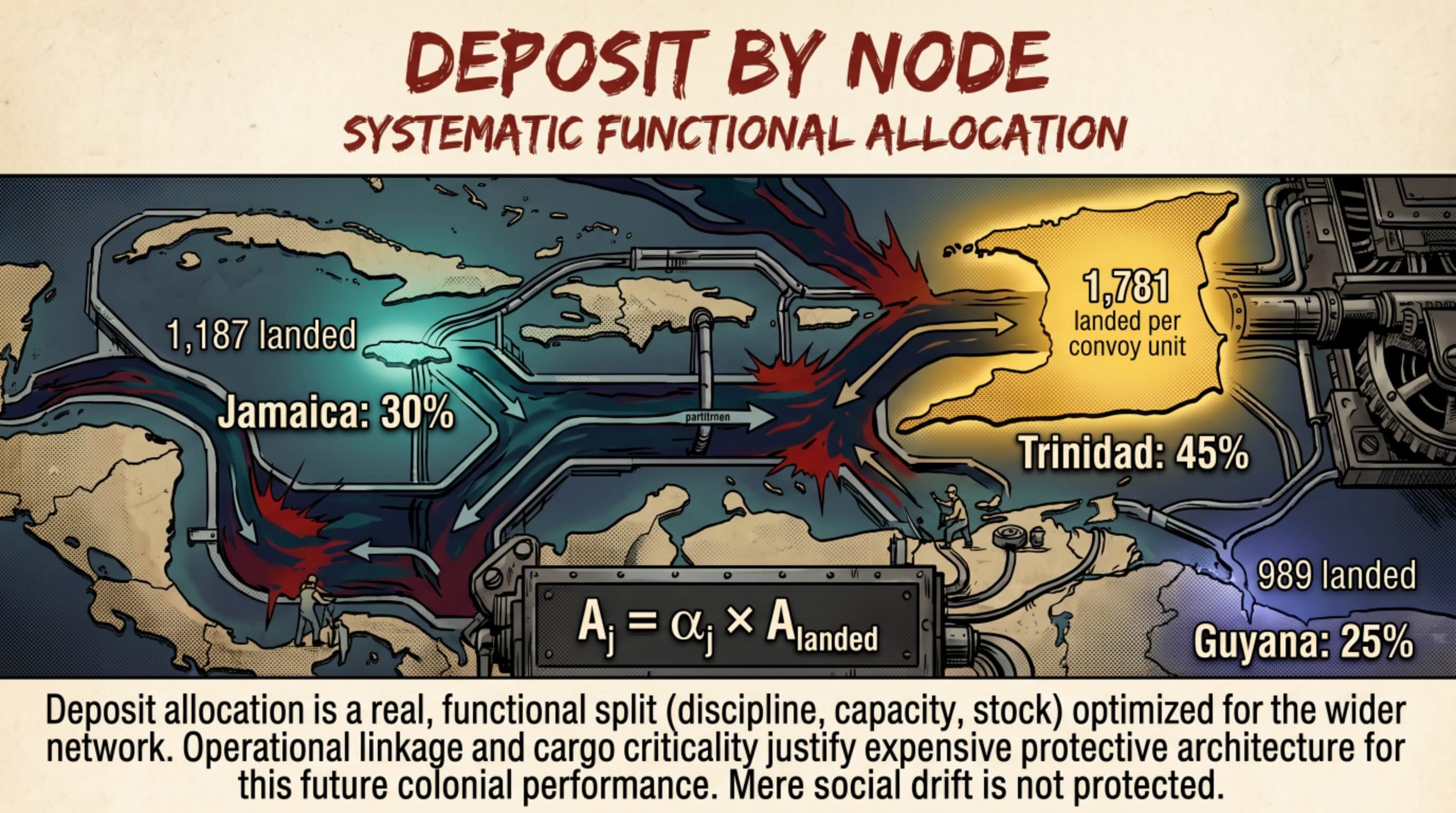
Figure 14. Deposit by Node — Colonial Allocation Structure
This figure visualises colonial deposit logic across destination nodes. It supports the argument that route allocation was not symbolic or incidental, but part of a distributed imperial recovery architecture.
9.6 Deposit by node and island allocation
The chapter must now connect counted movement to colonial geography. Once arrivals are landed, they do not remain an undifferentiated total. They split across nodes. Trinidad, Jamaica, Guyana, and related destinations receive configured shares. Those shares are not incidental. They reflect destination need, route convenience, staging logic, and the form of the imperial network at the point of deposition.
The deposit relation is:
Node deposit equals the node allocation share multiplied by total arrived population
$N_j = \alpha_j N_{\text{arr}}$
Where $N_j$ denotes deposit at node $j$ and $\alpha_j$ the allocation share to that node.
This relation makes the chapter geographically operational. The convoy is no longer just one large movement. It becomes a structured distribution mechanism across islands and colonial nodes.
The main discipline here is that the allocation shares must sum to the whole deposit field:
$\sum_{j=1}^{k} \alpha_j = 1$
This ensures that node-level partition remains consistent with total arrival.
That is why the route and deposit chapters had to come first. One cannot assign node distribution meaningfully without already having route geometry, hub logic, and colonial-need structure in place. Chapter 9 therefore converts route architecture into counted geography.
9.7 Unified surname deposit as route residue
This chapter also formalises the surname trail as part of the counted structure. For the purposes of this paper, Ramdin and Ramdeen are one phonetic lineage. Orthographic variation does not break the line. The convoy model therefore uses a unified surname class.
That normalisation is:
Unified Ramdin phonetic lineage equals Ramdin plus Ramdeen
$N_{\text{Ramdin}^*} = N_{\text{Ramdin}} + N_{\text{Ramdeen}}$
Where $N_{\text{Ramdin}^*}$ denotes the unified phonetic lineage class.
Node-level surname deposit can then be expressed as:
Route-linked surname deposit at a node is a function of the unified name count at that node, total node deposit, and lineage-retention effect
$D_{\text{name},j}=f\left(N_{\text{Ramdin}^*,j},N_j,C_{\text{retain},j}\right)$
Where $D_{\text{name},j}$ denotes route-linked surname deposit at node $j$ and $C_{\text{retain},j}$ lineage-retention effect at that node.
This makes the name trail part of the quantitative deposit model rather than a separate genealogical aside.
That move matters because surname geography is no longer left as anecdotal residue. It is brought inside the same deposit field as transport, arrival, and allocation. A name becomes one measurable residue of convoy outcome.
This is consistent with your model’s treatment of posterior attribution. The later retained line is not proof by itself, but it is an evidential surface produced by earlier transitions and retention conditions.
9.8 Simulation form
At this point the convoy is simulation-ready. The state of the convoy at each step depends on route, season, production readiness, crew structure, protection, and allocation. That means the chapter now sits directly inside the Nash-Markov reconstruction logic you have been building across the paper.
The state-transition form is:
Next convoy state equals transition of the present state under wind-current regime, production readiness, crew-capacity state, escort state, and allocation state
$X_{t+1}= \mathcal{T}(X_t \mid W_t,P_t,C_t,E_t,A_t)$
Where $X_t$ is convoy state, $W_t$ wind-current regime, $P_t$ production-state readiness, $C_t$ crew-capacity state, $E_t$ escort state, and $A_t$ allocation state.
This is the core reason Chapter 9 matters. It turns the protected route and production field into a runnable convoy system.
A minimal counted state vector can now be defined as:
$X_t = (N_{\text{ships},t},,N_{\text{heads},t},,C_{\text{tot},t},,S_t,,D_t)$
Where the convoy state includes ship count, persons aboard, crew total, survivability condition, and deposit-progress condition.
This is the point at which the paper becomes mathematically executable. Earlier chapters established why the convoy existed, what it carried, why it was protected, how it moved, and what industrial field preceded it. Chapter 9 now gives it count, ratio, loss, allocation, and state transition.
9.9 What this chapter establishes
This chapter establishes that the convoy can be reconstructed quantitatively through bounded ship count, carrying capacity, crew share, oversight ratio, mortality, attrition, and deposit allocation. It establishes that the convoy’s operating base is overwhelmingly Indian, with a relatively thin European supervisory surface. It establishes that landed population is a filtered result of route loss rather than a simple copy of departure. It establishes that deposit by node can be modelled through allocation shares. It establishes that the unified Ramdin/Ramdeen phonetic line belongs inside the quantified deposit model. And it establishes that the convoy now exists not only as historical reconstruction, but as a simulation-ready state system.
It also yields one concrete result already: using the median crew shares provided, the European crew-plus-officer supervisory surface is approximately $28.1%$ of the Indian operating base, while the Indian operating base is approximately $3.56$ times the visible European supervisory layer. That is not a decorative number. It is a quantified expression of concealed dependence.
With that established, the next chapter can move from counted transport to counted colonial absorption: how deposited lines are converted into labour systems, policing depth, clerical strata, settlement, ritual continuity, and renamed social form.
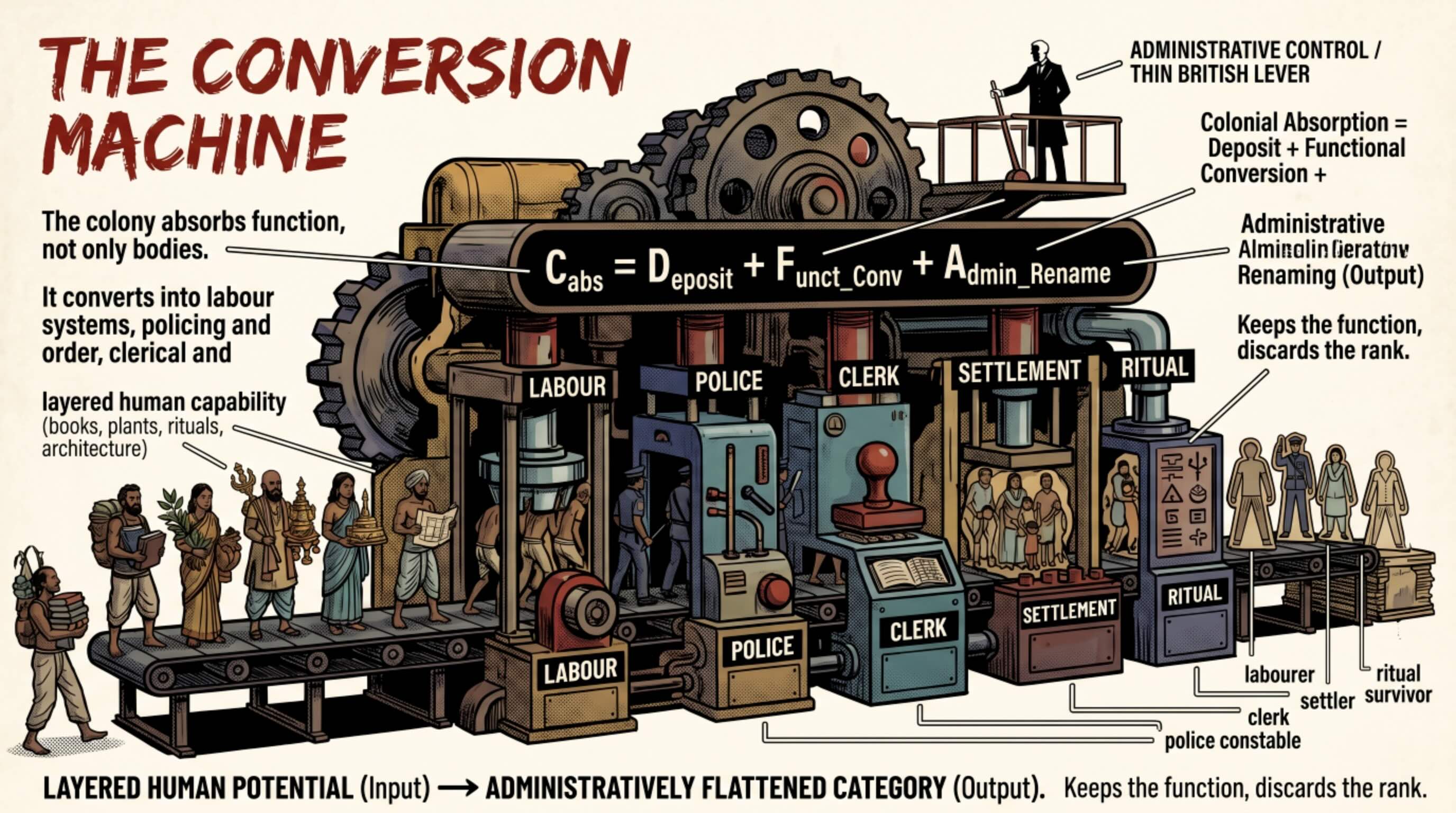
Figure 16. The Conversion Machine — Absorption into Colonial Form
This figure represents the colony as a conversion machine. Deposited function is absorbed into labour systems, policing, clerical strata, settlement, kinship, food continuity, ritual survival, and renamed colonial categories.
Chapter 10 — Colonial Absorption, Functional Conversion, and Renamed Continuity
10.1 Deposit is not the end of the convoy
The convoy does not end when it lands. Arrival is only the threshold event. The deeper historical process begins after deposit, when transported and deposited human value is absorbed into the receiving colonial node. This chapter concerns that absorption. It asks what happens when high-density human function enters a colony already structured by prior violence, prior buried intelligence, administrative demand, and imperial need.
That question matters because the colonial archive tends to record arrival and then jump too quickly to category. A population appears in the colony and is soon rendered as labour, police, clerk, settler, native, coolie, artisan, or some other administrative shorthand. That sequence creates the illusion that arrival and label are enough to explain colonial incorporation. They are not. Between arrival and label lies a conversion process: people are sorted, used, layered, renamed, and fixed into the node according to what the colonial system needs from them.
This chapter therefore treats colonial absorption as a functional conversion process rather than a passive demographic settlement. The colony does not simply receive a population. It metabolises it.
That relation may be stated as:
Colonial absorption = node deposit + functional conversion + administrative renaming
$A_{\text{col}} = D_{\text{node}} + F_{\text{conv}} + R_{\text{name}}$
Where $A_{\text{col}}$ denotes colonial absorption, $D_{\text{node}}$ node deposit, $F_{\text{conv}}$ functional conversion, and $R_{\text{name}}$ administrative renaming.
This is the chapter’s first principle: deposit becomes colony through conversion.
The importance of this relation is that it prevents arrival from being mistaken for completion. Deposit is merely placement. Colonial absorption begins when the node starts extracting use from what has arrived and fixing that use into its own structures.
This also fits the logic already developed through your longer system model. In EcoMathDNAHMM terms, arrival at a node is not the end-state. It is a transition into a new adaptive basin in which continuity is reweighted, constrained, and reformatted by the receiving environment. The colony is therefore not a resting place. It is a pressure field that alters the deposited line.
10.2 The colony absorbs function, not only bodies
A receiving colonial node does not merely take in population. It draws out specific functions. Agricultural skill is directed toward food and cultivation systems. Navigational and maritime ability are directed toward dock work, loading, unloading, repair, and coastal logistics. Disciplined men are drawn into order-maintenance and policing structures. Administratively capable lines are pulled toward clerkship, intermediary functions, and record-bearing roles. Ritual lines may preserve temple continuity or social coherence even under compression. Organisational capacity stabilises labour and settlement layout. In each case, the node extracts usable function from the deposited population.
That is why this chapter must follow the quantified reconstruction. Once a deposit exists at node level, the next analytical question is distribution of function inside the node. The colony is not a static destination. It is an allocation machine. It reallocates human function across its own survival needs.
This may be written as:
Realised node function = agricultural function + dock function + policing function + administrative function + ritual continuity + settlement function
$F_{\text{node}} = f_{\text{agr}} + f_{\text{dock}} + f_{\text{pol}} + f_{\text{adm}} + f_{\text{rit}} + f_{\text{settle}}$
Where $F_{\text{node}}$ denotes realised node function after absorption.
This relation matters because it shows how the colony turns deposit into operating structure.
The crucial point is that the same deposited line may contribute to several of these functions even if later recorded under only one of them. Colonial record tends to compress to the dominant surface use. Colonial absorption operates across the whole available function set.
A fuller allocation form may therefore be stated as:
$D_{\text{node}} \rightarrow {f_{\text{agr}}, f_{\text{dock}}, f_{\text{pol}}, f_{\text{adm}}, f_{\text{rit}}, f_{\text{settle}}}$
This makes the node an extractor and distributor of capability, not a passive receptacle.
10.3 Conversion into labour systems
One major pathway of colonial absorption is conversion into labour systems. But even here the chapter must be precise. Labour is not an original identity in this framework. It is one mode of colonial use. The colony draws on deposited people for plantation work, food cultivation, dock labour, yard labour, construction, transport, and maintenance. Yet these uses should not be mistaken for the whole person or the original line. They are the colonial narrowing of function.
This distinction matters because the same person or line may carry multiple capacities while being recorded under one lower function. A line with legal, ritual, linguistic, organisational, or ecological intelligence may be absorbed into labour notation because labour notation is how the colony simplifies use. The labour system therefore becomes one of the major instruments of compression.
The labour-conversion relation may be written as:
Labour-system absorption = labour conversion share multiplied by node deposit
$L_{\text{sys}} = \beta_{\text{lab}} D_{\text{node}}$
Where $L_{\text{sys}}$ denotes labour-system absorption and $\beta_{\text{lab}}$ denotes the labour conversion share.
This makes clear that labour is a colonial allocation outcome, not an original human description.
The deeper issue is that labour notation performs double concealment. It captures output while hiding excess capability. It records use while erasing antecedent rank, training, and civilisation-bearing density. A line thus becomes economically visible and historically reduced at the same time.
That distortion may be linked to the earlier role-compression logic through:
$L_{\text{dist}} = F_{\text{orig}} - L_{\text{sys}}$
where $L_{\text{dist}}$ denotes the excess of original function over labour label. This does not mean no labour took place. It means labour notation under-describes what entered the colony.
10.4 Conversion into policing and order
A second major pathway is conversion into policing and order-maintenance. This chapter must preserve the distinction already established earlier: the transported and deposited population was not a loose civilian mass. Some lines carried disciplined manpower, chain-of-command familiarity, and operational suitability for enforcement roles. Once inside the colonial node, those capacities could be redirected into police forces, guards, supervisors, estate enforcement, or state-adjacent order structures.
This matters because later multigenerational policing lines are not well explained by occupational accident alone. They make more sense when read as continuity from deposited disciplined function into colonial policing institutions. The node absorbs already-usable order-bearing capacity and fixes it into a renamed administrative role.
The policing-conversion relation may be written as:
Policing absorption = disciplined conversion rate multiplied by deposited fit male population
$P_{\text{node}} = \beta_{\text{disc}} D_{\text{male,fit}}$
Where $P_{\text{node}}$ denotes policing absorption, $\beta_{\text{disc}}$ denotes disciplined conversion rate, and $D_{\text{male,fit}}$ denotes deposited male population fit for service.
This relation matters because it links convoy deposit to later colonial security structure.
It also explains why policing continuity should not be read as evidence of simple colonial integration. It may instead represent redirected disciplined capacity extracted from the transported line and inserted into the colony’s own coercive apparatus. The same convoy that brings labour also brings order-bearing function.
A further continuity form may therefore be stated:
$P_{\text{line},t+1} = \eta , P_{\text{node},t}$
Where $\eta$ denotes intergenerational policing continuity. This gives the thesis a way to speak about how one absorbed function becomes a family or lineage pattern under colonial time.
10.5 Conversion into clerical and intermediary strata
Not every deposited line is absorbed into direct labour or direct policing. Some are drawn into clerical, intermediary, or administrative functions. This includes record handling, estate coordination, translation, distribution, oversight support, and colonial mediation. In a system built from layered extracted peoples and a thin visible supervisory surface, intermediary strata become essential.
This is where the paper’s mixed-line reasoning becomes important. Some lines arrive already closer to administrative or clerical function. Others are redirected there because of language, order, discipline, or social positioning. Over time, those functions become part of the colony’s inner administrative skin. Yet, again, the recorded category can conceal rather than reveal the original line’s full value.
This may be stated as:
Administrative-intermediary absorption = administrative conversion share multiplied by node deposit
$A_{\text{int}} = \beta_{\text{adm}} D_{\text{node}}$
Where $A_{\text{int}}$ denotes administrative-intermediary absorption and $\beta_{\text{adm}}$ denotes the administrative conversion share.
The significance is that the colony needs more than labour and force. It needs translators, handlers, and human interfaces.
This is one of the major reasons a thin European supervisory surface can govern a deeper non-European population field. The intermediary layer stabilises that imbalance. It is the human connective tissue of colonial administration.
A layered command relation may therefore be written as:
$G_{\text{node}} = O_{\text{surf}} + A_{\text{int}} + L_{\text{depth}}$
Where $G_{\text{node}}$ denotes governability of the node, $O_{\text{surf}}$ visible oversight surface, $A_{\text{int}}$ intermediary administrative layer, and $L_{\text{depth}}$ labour depth. This helps explain how the node remains governable despite thin visible command.
10.6 Settlement, kinship, and reproduction inside the node
A colony does not stabilise through work assignment alone. It stabilises through settlement and reproduction. Deposited lines do not remain as temporary labour abstractions. They form households, kinship structures, merged descent lines, religious communities, neighbourhood patterns, and generational continuities. That means colonial absorption is also a reproductive process. The node fixes human value into future time.
This is a crucial part of the chapter because it explains how deposit becomes permanence. Arrival by convoy is one event. The making of a colony through lineage is another. The second depends on marriage, merging, coercive proximity, community ordering, and the freezing of certain ancestral forms under altered conditions.
This settlement-reproductive relation may be written as:
Settlement reproduction = kinship formation + household formation + future lineage continuity
$R_{\text{settle}} = K_{\text{form}} + H_{\text{house}} + L_{\text{fut}}$
Where $R_{\text{settle}}$ denotes settlement reproduction, $K_{\text{form}}$ kinship formation, $H_{\text{house}}$ household formation, and $L_{\text{fut}}$ future lineage continuity.
This makes clear that colonial absorption captures not only present labour but future descent.
That future descent is one of the colony’s deepest gains. The node does not merely consume labour in the present. It secures demographic continuation, new line formation, and intergenerational persistence that stabilise the colonial system long after the original convoy has disappeared from view.
This can be sharpened through:
$V_{\text{fix}} = D_{\text{node}} + R_{\text{settle}}$
Where $V_{\text{fix}}$ denotes value fixed into the colony across present and future time. This is how transported function becomes durable colonial form.
10.7 Temple continuity, ritual survival, and social coherence
The colony also absorbs sacred continuity. Deposited populations do not arrive emptied of ritual, priestly, or temple-bearing capacity. Even under renaming and compression, sacred systems can survive as stabilising structures. Temples, observances, food restrictions, sacred plants, ceremonies, calendrical continuity, and inherited forms of order can remain active within the node even when the official archive gives them little dignified recognition.
This matters because it shows that colonial absorption is not total annihilation of source continuity. It is partial compression under conditions of survival. Some things are lost, some are lowered, some are renamed, and some are preserved in frozen or displaced form. The island becomes a vault of altered continuity.
This may be written as:
Sacred continuity inside the node = survival factor applied to ritual, temple, and sacred botanical function
$S_{\text{node}} = \gamma_{\text{surv}}(f_{\text{rit}} + f_{\text{temp}} + f_{\text{bot,sac}})$
Where $S_{\text{node}}$ denotes sacred continuity inside the node and $\gamma_{\text{surv}}$ denotes survival under compression.
The significance of this relation is that the node is not only a work site. It is also a container of displaced civilisation.
This is especially important for the paper because sacred continuity is one of the clearest proofs that the transported line was more than labour. Ritual systems survive because structured human worlds survived. Temple continuity is evidence of retained civilisation under altered conditions.
A coherence relation may also be stated:
$C_{\text{soc}} = P_{\text{rit}} + O_{\text{temp}} + M_{\text{mem}}$
Where $C_{\text{soc}}$ denotes node-level social coherence, $P_{\text{rit}}$ ritual practice, $O_{\text{temp}}$ temple order, and $M_{\text{mem}}$ memory continuity. This shows that sacred systems are not peripheral; they help hold the node together.
10.8 Food continuities and stacked buried knowledge
The same logic applies to food. The colony’s food base is not created from nothing after deposit. It is built from stacked buried knowledge systems already discussed earlier: African-derived food and ecological intelligence, then further Indian-derived cultivation, preparation, and ritual-food continuities. Colonial absorption therefore does not merely assign people to fields. It integrates multiple extracted food technologies into the node’s everyday sustenance.
This matters because food continuity is one of the clearest ways buried knowledge survives ordinary historical forgetting. What becomes normal island food often carries the memory of violent transfer without naming it. The node thus absorbs and naturalises extracted knowledge.
This may be written as:
Realised colonial food continuity = African-derived layer + Indian-derived layer + adaptive local combination
$F_{\text{node,food}} = F_{\text{afr}} + F_{\text{ind}} + F_{\text{adapt}}$
Where $F_{\text{node,food}}$ denotes realised colonial food continuity, $F_{\text{afr}}$ African-derived layer, $F_{\text{ind}}$ Indian-derived layer, and $F_{\text{adapt}}$ local adaptive combination.
This relation helps show how the colony metabolises stacked extracted civilisations.
The important feature is that food becomes ordinary precisely by ceasing to look historical. Once embedded in everyday life, the extracted intelligence that sustains it disappears from official narration. This is why food continuity is a strong evidential residue of colonial absorption.
A practical continuity form may be added:
$E_{\text{daily}} = F_{\text{node,food}} + S_{\text{node}}$
Where $E_{\text{daily}}$ denotes everyday civilisational continuity. This links food and sacred survival as the two most persistent ordinary-life residues of buried function.
10.9 Renaming as the final act of absorption
The final act of colonial absorption is naming. After function is drawn out and fixed into the node, the archive records the result in a lower language. A legal-intelligent line becomes labour. A disciplined line becomes native police. A ritual line becomes ethnicity. A multilingual intermediary becomes clerk. A civilisational deposit becomes a demographic category. This is where the absorption process is sealed.
That is why renaming belongs in this chapter rather than only in the later theory chapters. Renaming is not simply a language problem. It is the closure mechanism of colonial absorption. The node has taken the function; the record now lowers the name.
This may be written as:
Final renaming distortion = function actually used minus function named in the record
$R_{\text{final}} = F_{\text{used}} - F_{\text{named}}$
Where $R_{\text{final}}$ denotes final renaming distortion, $F_{\text{used}}$ denotes function actually used by the node, and $F_{\text{named}}$ denotes the colonial recorded label.
This relation makes explicit what the chapter has shown throughout: the colony consumes full function and records reduced identity.
This is one of the most important theoretical transitions in the paper. The renaming stage closes the gap between colonial use and colonial narrative. Once the lower label is fixed, later readers inherit the compression as if it were truth.
That may be expressed even more sharply as:
$F_{\text{named}} < F_{\text{used}} \leq F_{\text{orig}}$
This inequality states the full colonial arc. The record names less than the node used, and the node used less than the line originally carried.
10.10 The node as a conversion machine
Taken together, the colony must be understood as a conversion machine. It receives deposited lines, extracts usable function, redistributes that function across labour, order, clerical, ritual, and settlement structures, and then renames the result into administratively manageable categories. This is not passive settlement. It is structured colonial processing of human value.
That general conversion can be summarised as:
$C_{\text{machine}} = D_{\text{node}} \rightarrow (L_{\text{sys}}, P_{\text{node}}, A_{\text{int}}, R_{\text{settle}}, S_{\text{node}}) \rightarrow R_{\text{final}}$
This is the chapter’s full logic. Deposit enters. Function is extracted and allocated. Naming lowers the result.
The node is therefore not merely a destination. It is a processor. It transforms convoy deposit into colonial form. It takes layered human capability and converts it into the exact structures the colony needs in order to persist.
That processor model is one of the chapter’s strongest outputs because it links transport directly to colonial institution. Labour systems, police systems, clerical structures, kinship formation, food continuity, and sacred survival are not separate afterthoughts. They are all outputs of one conversion machine acting on deposited lines.
10.11 What this chapter establishes
This chapter establishes that arrival is not the end of convoy history but the beginning of colonial absorption. It establishes that the colony absorbs function rather than merely bodies; that deposited populations are converted into labour systems, policing structures, clerical and intermediary roles, reproductive settlement, temple and ritual continuity, and layered food systems; and that administrative renaming is the final act by which the node conceals the calibre of what it has absorbed. It establishes, in short, that the colony is a conversion machine.
More exactly, it establishes five governing points for what follows.
First, deposit becomes colonial structure only through functional conversion.
Second, the colony extracts multiple forms of use from the same deposited line.
Third, labour, policing, clerkship, settlement, ritual continuity, and food continuity are all outputs of one absorbing node.
Fourth, renaming is the closure mechanism that lowers what the colony has already used.
Fifth, the node converts convoy deposit into durable colonial permanence through both present allocation and future reproduction.
That is why Chapter 10 is indispensable. Without it, the thesis would show how the convoy moved and landed, but not how it became colony. With Chapter 10 in place, the convoy’s arrival is converted into a structured internal colonial process.
The next chapter can now move from absorption to explicit role-lowering: how the colony not only uses the deposited line, but compresses its original altitude into administratively manageable fiction.
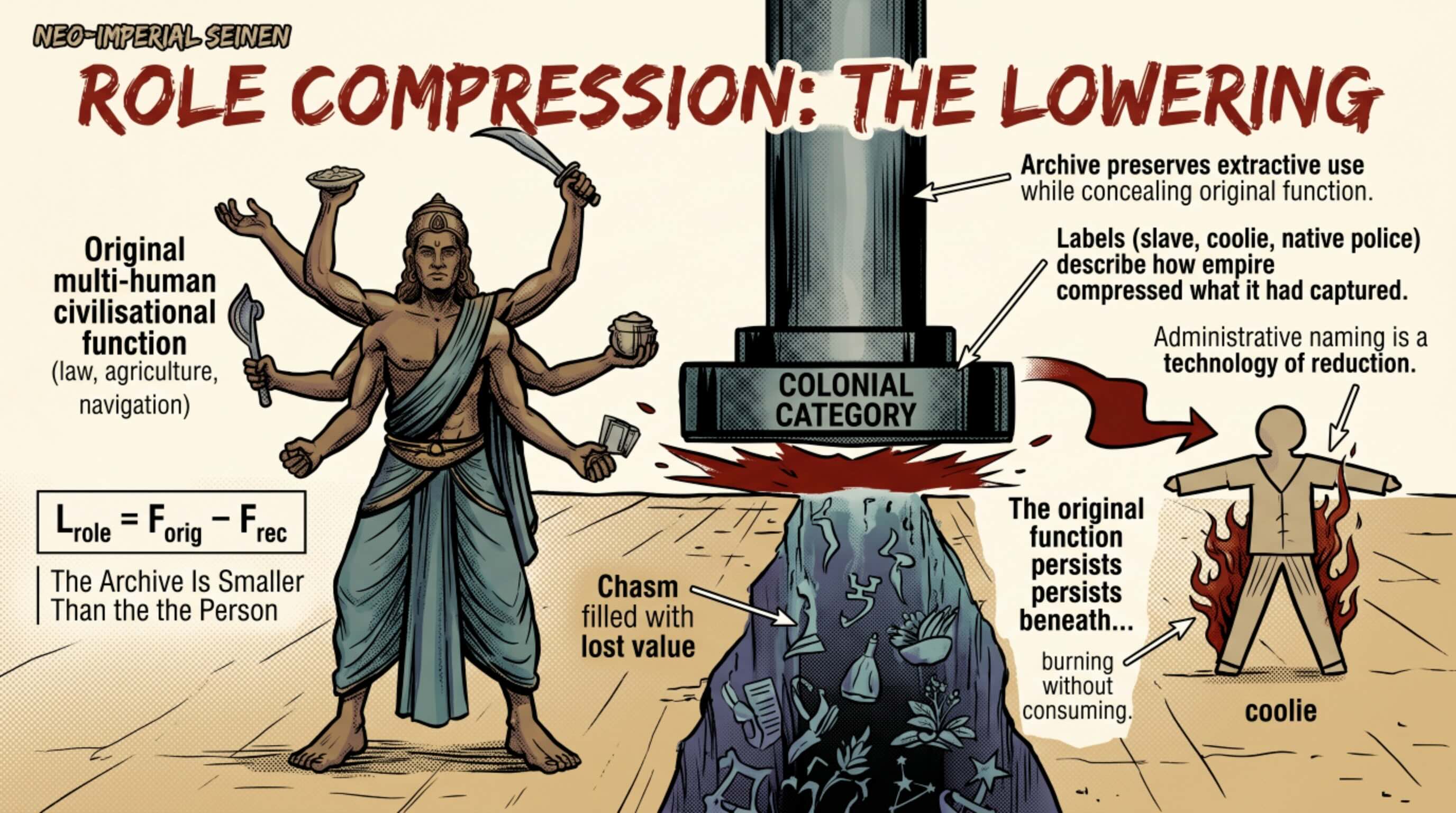
Figure 17. Role Compression — The Lowering of Original Function
This figure illustrates administrative lowering: original function is retained by the colony but renamed downward by the archive. It visualises the gap between what people carried and what the record later called them.
Chapter 11 — Role Compression, Administrative Fiction, and the Lowering of Original Function
11.1 The colony does not only absorb; it lowers
Colonial absorption is not complete until original function is lowered into a lesser name. That lowering is one of the main operations of empire. The colony does not merely receive people, use them, and place them. It also reduces them. It takes layered human capability and rewrites it into administratively manageable fiction. The fiction is then preserved as if it were reality.
This chapter concerns that lowering. It asks how a line carrying law, language, priestly continuity, food-system intelligence, ecological knowledge, disciplined capacity, architectural skill, administrative function, and lineage-bearing continuity can be made to appear, in the record, as something vastly smaller. The answer is role compression. Role compression is the process by which original human density is stripped from the recorded category while the colony continues to benefit from the buried function underneath it.
That is why this chapter is central to the paper’s truth claim. If earlier chapters show what moved, how it moved, and how it was absorbed, this chapter shows how the absorbed line was historically misdescribed. Without this step, the archive could still pretend innocence. With it, the archive is exposed as an instrument of reduction.
The basic compression relation may be written as:
$L_{\text{role}} = F_{\text{orig}} - F_{\text{rec}}$
Where $L_{\text{role}}$ denotes role-compression loss, $F_{\text{orig}}$ original function, and $F_{\text{rec}}$ recorded colonial function.
This formula is the chapter’s centre. It states plainly that the record is smaller than the person.
11.2 Original function and recorded function are not the same thing
The chapter must begin by establishing that original function and recorded function are not interchangeable. The person who arrives in the colony is not analytically reducible to the category under which the colony later files them. A line with legal and linguistic intelligence may be recorded as labour. A disciplined line may be recorded as police without preserving its prior training or higher-order structure. A ritual line may be recorded as ethnicity. A node-forming line may be recorded as plantation labour. A priestly line may be recorded as native residue. In each case, the recorded function captures one extractive use while concealing the larger human system.
That is why the archive is not merely incomplete. It is structurally misleading. It preserves what the colony wanted to call the person, not what the person originally was in full civilisational terms. The distinction matters because the entire paper depends on recovering that lost interval between what the line carried and what the colonial state later wrote down.
This may be stated more explicitly as:
$F_{\text{rec}} = \phi(F_{\text{orig}}, U_{\text{col}})$
Where $\phi$ denotes the colonial compression function and $U_{\text{col}}$ denotes the use the colony extracted from the person or line.
The significance of this relation is that recorded function is not neutral description. It is processed description shaped by colonial utility.
11.3 Administrative naming as a technology of reduction
Role compression is carried largely through naming. Naming in the colonial system is not innocent labelling. It is a technology of reduction. It performs three tasks at once. First, it narrows the human being to the function most convenient to the colony. Second, it erases surplus capability that does not need to be acknowledged. Third, it stabilises the reduced identity through repetition in record, law, census, estate log, parish notation, and administrative speech.
That is why names such as slave, labourer, coolie, native police, clerk, settler, or artisan cannot be read at face value. Each may contain a thin truth about immediate use, but none tells the whole truth about the line. The category fixes a lower administrative surface over a deeper human foundation.
This naming reduction may be written as:
$N_{\text{adm}} = \psi(F_{\text{use}}, C_{\text{state}})$
Where $N_{\text{adm}}$ denotes administrative naming, $F_{\text{use}}$ the function extracted in use, and $C_{\text{state}}$ the classificatory needs of the state.
This relation matters because it shows that colonial naming is generated from utility and control, not from full anthropological truth.
11.4 Compression of the West African and Yoruba-derived layer
This chapter must apply equally to the earlier African-descended population. The colony did not only compress later Indian lines. It had already compressed the enslaved West African and Yoruba-derived populations into a slave category that obscured food-system intelligence, ecological knowledge, ritual continuity, social technologies, and prior human rank. In that earlier violence, the same structure is visible: the colony uses buried function while naming the person beneath it as lesser.
That means role compression is not an isolated injury attached to one transported line. It is one of the recurrent mechanisms by which the colony is built. The African-derived layer and the Indian-derived layer are both lowered through naming, though in different administrative forms and under different legal conditions. The colony therefore accumulates buried capability through repeated reduction.
This can be written as:
$L_{\text{stack}} = L_{\text{afr}} + L_{\text{ind}}$
Where $L_{\text{stack}}$ denotes stacked compression loss across both buried civilisational layers.
This relation is important because it prevents the paper from isolating one compression while ignoring the earlier one already embedded in the node.
11.5 Compression of the Indian and Brahmin-derived layer
The same mechanism then acts upon the later Indian and Brahmin-derived lines. Here, the violence of compression is especially sharp because the original function is multi-domain: law, language, administration, ritual continuity, sacred botanical knowledge, agriculture, ecology, navigation, organisation, disciplined order, and lineage continuity. To lower such a line into labour or coolie is not merely simplification. It is radical under-description.
This matters because the colonial system did not need to acknowledge what it was using. It only needed to make the line usable and recordable. Once the person could be inserted into plantation work, policing, intermediary administration, settlement, or ritual-minority notation, the archive no longer needed to preserve the original density. Compression therefore becomes a method of taking civilisational intelligence without preserving its name.
The Indian-derived compression may be written as:
$L_{\text{ind}} = F_{\text{ind,orig}} - F_{\text{ind,rec}}$
Where $F_{\text{ind,orig}}$ denotes original Indian-derived functional density and $F_{\text{ind,rec}}$ the reduced colonial recording of that line.
This makes explicit that the problem is not simply insult in language. It is loss of recorded human measure.
11.6 The colony keeps the function and discards the rank
One of the most important features of role compression is that the colony does not discard the function. It discards the recognised rank of the function. This is why the system is so effective. It does not need to destroy capability. It needs to detach capability from rightful name, source dignity, and recoverable status. The colony can then continue using the function while claiming that the people who carry it are lesser beings.
This distinction is essential. If the colony truly erased the function, it would weaken itself. Instead, it hides the function under a lower label and continues to draw from it. The person can still build, plant, interpret, organise, police, maintain ritual, and reproduce continuity; what disappears is the acknowledged altitude of the line.
That relation may be written as:
$F_{\text{use}} = F_{\text{orig}} \quad \text{while} \quad R_{\text{ack}} \downarrow$
Where $R_{\text{ack}}$ denotes recognised rank or acknowledged status.
This is one of the chapter’s most important claims. Colonial compression is not the destruction of use. It is the destruction of recognised altitude.
11.7 Administrative fiction as durable reality
Once role compression is repeated across documents, it hardens into administrative fiction. The fiction then begins to behave like reality. Later historians, descendants, officials, and institutions encounter the reduced category so often that they mistake repetition for truth. At that point, compression no longer looks like violence. It looks like ordinary history.
This is why the paper cannot simply “read the records more carefully.” It must reverse the administrative fiction itself. A term used a thousand times can still be false if it was generated by a reduction mechanism. The durability of the fiction is one of the reasons role compression is such a powerful form of historical injury. It survives beyond the original act and shapes later consciousness.
This durability may be written as:
$F_{\text{admin-fic}}(t) = \omega^t N_{\text{adm}}$
Where $F_{\text{admin-fic}}(t)$ denotes administrative fiction over time and $\omega$ the reproduction factor of the lowered category through records and institutions.
The point is straightforward: repetition makes the lie durable.
11.8 Compression across labour, police, clerkship, and ethnicity
Role compression does not produce one single false category. It produces a family of lower categories depending on what the node needs. A line can be compressed into labour. It can be compressed into police. It can be compressed into clerkship or intermediary identity. It can be compressed into ethnicity or race notation. Each category captures one useful surface while suppressing the fuller human structure.
This means the chapter must not treat compression as a one-word event. It is a branching process. The same line, or adjacent lines from the same convoy deposit, can enter different renamed pathways depending on colonial allocation.
This branching relation may be written as:
$F_{\text{rec}} \in {L_{\text{lab}}, P_{\text{pol}}, A_{\text{clk}}, E_{\text{eth}}}$
Where the recorded function may fall into labour, policing, clerical, or ethnic notation classes.
This matters because it shows that one lowered line can populate many administrative surfaces without ever being fully restored to itself.
11.9 Why role compression matters to the paper’s truth claim
Role compression is not a side issue. It is one of the paper’s principal truth claims because it explains why a system carrying so much function later appears in the record as if it carried so little. Without this chapter, the reader might still think the colony merely contained simple categories that the paper is over-reading. With this chapter, the opposite becomes clearer: the record is under-reading the colony because it is the product of administrative fiction.
This is why Chapters 5, 10, and 11 belong tightly together. Chapter 5 establishes what was taken. Chapter 10 shows how the colony absorbed and converted it. Chapter 11 shows how the archive lowered the absorbed function into false categories. Together they reveal the full arc from civilisational density to bureaucratic diminishment.
The paper’s truth relation may therefore be written as:
$T_{\text{restore}} = F_{\text{orig}} - F_{\text{admin-fic}}$
Where $T_{\text{restore}}$ denotes restored truth through removal of administrative fiction.
This relation captures the chapter’s purpose: to reopen the gap between what the line was and what the colony later called it.
11.10 The role of the descendant
Role compression does not end with the archive. It falls forward into descendants. The descendant inherits not only the line, but the lowered history of the line. The burden then becomes double: one must live the continuity while also confronting the bureaucratic under-description that has replaced it. This is why the paper is not only a historical exercise. It is also a recovery act in the present.
The descendant is forced to reconstruct law where the archive wrote labour, continuity where the archive wrote category, civilisation where the archive wrote race, and function where the archive wrote use. That is one reason the paper exists at all. It is the work of reversing inherited diminution.
This may be written as:
$B_{\text{desc}} = L_{\text{role}} + M_{\text{recover}}$
Where $B_{\text{desc}}$ denotes descendant burden and $M_{\text{recover}}$ denotes the labour of reconstruction.
This makes clear that role compression is not dead history. It continues as present recovery burden.
11.11 What this chapter establishes
This chapter establishes that colonial absorption is completed by the lowering of original function into lesser names; that original function and recorded function are not the same thing; that administrative naming is a technology of reduction; that both African-derived and Indian-derived buried civilisational layers were compressed into lesser categories; that the colony keeps the function while discarding the acknowledged rank; that repeated naming hardens into durable administrative fiction; that compression branches into labour, police, clerkship, and ethnicity; and that descendants inherit the burden of reconstructing what the archive lowered.
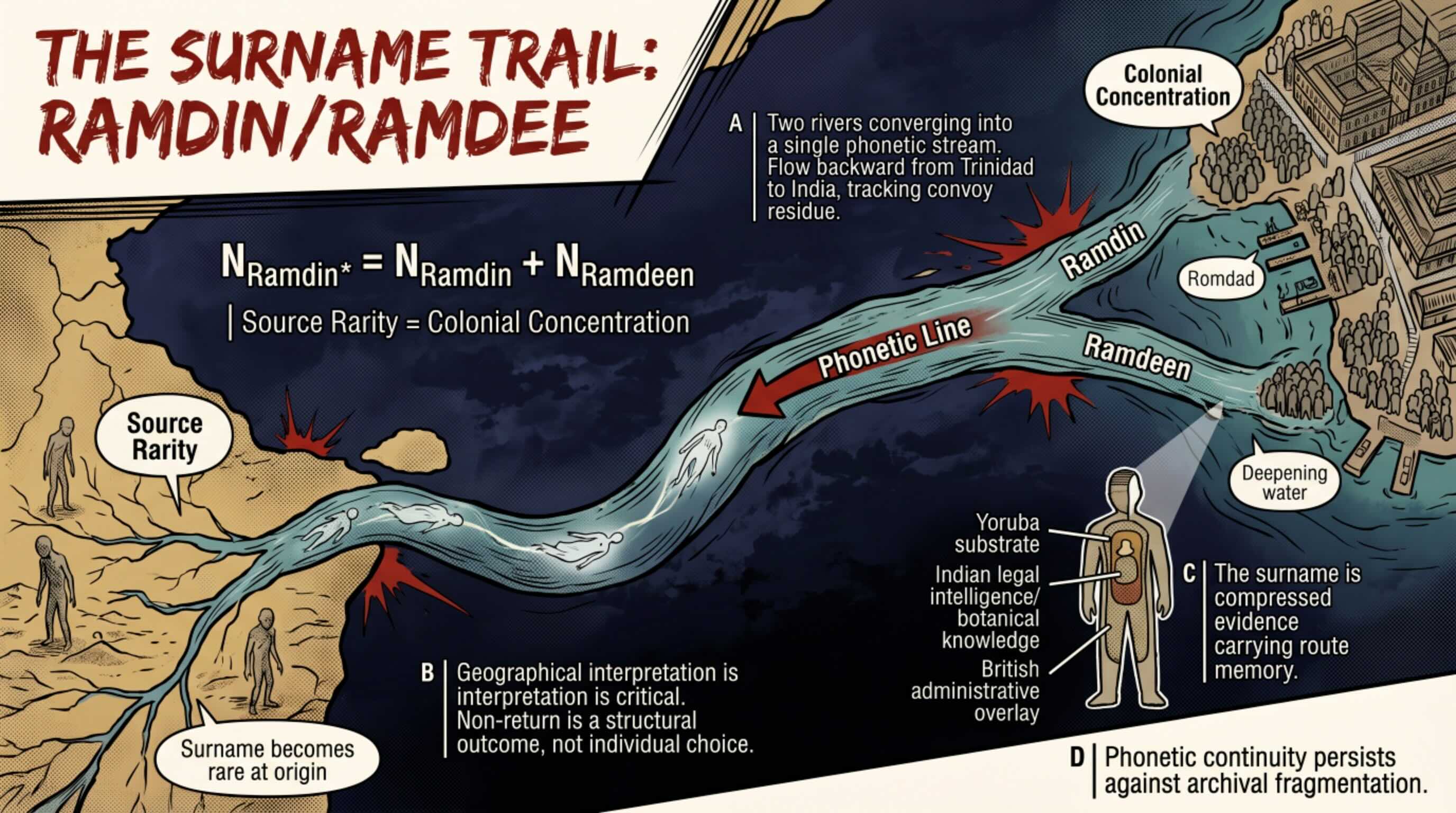
Figure 15. The Surname Trail — Ramdin/Ramdeen as Route Residue
This figure presents surname persistence, depletion, and phonetic continuity as compressed evidence. It supports the argument that lineage residue can survive where formal records fragment or downgrade the human structure.
Chapter 12 — Lineage Externalisation, Phonetic Continuity, and the Geography of Non-Return
12.1 The line must be read geographically
Once role compression has been established, the next task is to track what remains visible after compression. One of the strongest residues is the line itself. A lineage that has been moved, deposited, renamed, and partially buried does not disappear completely. It leaves traces in geography. It appears in some places, thins in others, persists under spelling drift, and survives as a pattern that can be read against the convoy structure already developed in the earlier chapters.
That is why this chapter turns to lineage externalisation. The argument is not that a surname alone proves the whole system. The argument is that, once convoy logic, production logic, protection logic, deposit logic, and colonial absorption have already been established, surname geography becomes a powerful residue of that system. It shows where the line remained, where it concentrated, and where return continuity appears weak or broken.
The key issue is not simply the existence of the name. It is the distribution of the name. If a line is thin or rare in its supposed source field but appears across multiple colonial route and deposit zones, then the geography of the name begins to align with the geography of transport. The name ceases to be private genealogy and becomes route residue.
This relation may be written as:
$G_{\text{line}} = D_{\text{src}} + D_{\text{route}} + D_{\text{deposit}}$
Where $G_{\text{line}}$ denotes lineage geography, $D_{\text{src}}$ source distribution, $D_{\text{route}}$ route-side distribution, and $D_{\text{deposit}}$ destination or deposit distribution.
This chapter begins from that point: the line must be read as geography, not merely as family memory.
12.2 Ramdin and Ramdeen are one phonetic line
For the purposes of this paper, Ramdin and Ramdeen are one and the same phonetic lineage. Orthographic drift does not break continuity. Colonial spelling, clerical inconsistency, family variation, and later personal choice can alter surface form without altering line identity. The convoy system, the colonial archive, and later descendants did not operate within a stable spelling environment. For that reason, strict orthographic separation would misdescribe the line rather than clarify it.
This chapter therefore adopts a phonetic normalisation rule. The line is treated as one lineage class with multiple spellings. That rule is not optional. It is necessary if the geography of the line is to be read properly across route and deposit zones.
The normalisation relation is:
$N_{\text{Ramdin}^*} = N_{\text{Ramdin}} + N_{\text{Ramdeen}}$
Where $N_{\text{Ramdin}^*}$ denotes the unified Ramdin/Ramdeen phonetic lineage class.
This matters because the chapter is not tracing spelling purity. It is tracing line continuity under imperial distortion.
12.3 Source depletion and the meaning of rarity
The first major feature of lineage externalisation is source depletion. A line that appears weak, thinned, or near-absent in the source field while remaining visible across colonial spaces raises a structural question. The question is not whether spelling drift occurred. It is whether the line’s geographic centre of gravity has been pulled outward by historical transport and non-return.
That is the central meaning of rarity in this chapter. Rarity at source is not being used as a sentimental claim. It is being used as a distributional signal. If a lineage that should have remained meaningfully present in its origin zone instead appears disproportionately in colonial and route-linked fields, then source depletion becomes analytically relevant to the convoy reconstruction.
This may be expressed as:
$D_{\text{dep}} = \frac{D_{\text{col}}}{D_{\text{src}} + \epsilon}$
Where $D_{\text{dep}}$ denotes depletion-externalisation ratio, $D_{\text{col}}$ denotes colonial distribution density, $D_{\text{src}}$ source-region distribution density, and $\epsilon$ is a small stabiliser.
The point of the ratio is straightforward. As source density falls and colonial density rises, the case for lineage externalisation strengthens.
12.4 Route-side persistence and the logic of convoy residue
The second feature is route-side persistence. A convoy of the kind developed in this paper does not only deposit names at final colonies. It can leave line residue along the wider corridor of movement: Indian Ocean nodes, southern African fields, Atlantic staging belts, and Caribbean destinations. Not every route node will preserve the line equally. But where the line appears across multiple corridor-related zones, the geography begins to resemble convoy residue rather than unrelated family drift.
This is where the surname becomes operationally important. Once Chapter 7 established the convoy path and Chapter 9 established quantified deposit, the name can now be read as an after-image of the same system. The question is not whether every route point must preserve the line equally. The question is whether the line survives in a pattern consistent with route logic and colonial deposit.
That relation may be written as:
$R_{\text{res}} = f(D_{\text{route}}, D_{\text{deposit}}, C_{\text{retain}})$
Where $R_{\text{res}}$ denotes route residue, $D_{\text{route}}$ route-side distribution, $D_{\text{deposit}}$ destination distribution, and $C_{\text{retain}}$ lineage-retention condition.
This matters because it places the surname trail inside the convoy model rather than outside it.
12.5 Non-return as a structural outcome
A key component of lineage externalisation is non-return. The line is not only moved outward. It is prevented, discouraged, or structurally impeded from reconstituting itself fully at source. That does not require the absolute impossibility of return in every case. It requires only that, at system scale, return continuity is weak compared with outward deposit and colonial retention.
This chapter therefore treats non-return as a structural outcome of convoy transport, colonial absorption, and role compression. Once a line is moved, renamed, absorbed into labour or policing or settlement categories, merged into new kinship structures, and made reproductively continuous inside colonial space, the probability of meaningful restoration to source decreases sharply.
This can be written as:
$R_{\text{return}} = 1 - (A_{\text{col}} + K_{\text{merge}} + R_{\text{name}})$
Where $R_{\text{return}}$ denotes effective return continuity, $A_{\text{col}}$ colonial absorption, $K_{\text{merge}}$ kinship merger, and $R_{\text{name}}$ renaming pressure.
The point is not a literal probability value in this form. The point is the structure: absorption, merger, and renaming suppress return continuity.
12.6 The surname as compressed evidence, not final proof
This chapter must remain disciplined. The surname is not being used as the sole proof of the paper. It is being used as compressed evidence. It is one of the visible residues that remains after a much larger system has already been established through production, convoy route, crew composition, deposit logic, and colonial conversion.
This distinction matters because it protects the chapter from overreach. A surname by itself can be ambiguous. A surname inside a fully reconstructed convoy system is not. Its meaning becomes sharper because the chapter is not asking the name to do all the work. It is asking the name to behave as a residue of already-modelled transport and deposit.
That evidential structure may be written as:
$E_{\text{name}} = G_{\text{line}} + R_{\text{res}} + D_{\text{dep}}$
Where $E_{\text{name}}$ denotes surname evidential value.
This makes clear that the name matters most when geography, route residue, and depletion all converge.
12.7 Phonetic continuity against archival fragmentation
The chapter also matters because it exposes a specific kind of archival weakness: orthographic fragmentation. Imperial record systems often create artificial multiplicity by spelling the same line differently across documents, regions, generations, or administrative contexts. If those spellings are treated as separate without phonetic normalisation, the archive can falsely scatter a single line into many smaller ones. That would reproduce colonial fragmentation inside the paper itself.
For that reason, phonetic continuity is a methodological safeguard. It restores unity where the archive may have imposed false difference. In this chapter, phonetic normalisation is not merely a convenience. It is part of the recovery method.
This may be written as:
$U_{\text{phon}} = \sum_{k=1}^{m} N_{\text{orth},k}$
Where $U_{\text{phon}}$ denotes unified phonetic lineage and $N_{\text{orth},k}$ denotes orthographic variants belonging to the same line.
This relation generalises the Ramdin/Ramdeen rule and places it inside the wider Truthfarian method of undoing archival fragmentation.
12.8 Why this chapter matters to the paper’s human claim
This chapter is not only technical. It matters because the line is where the historical system becomes personal without becoming merely anecdotal. A convoy can be reconstructed. A production surge can be modelled. A deposit pattern can be simulated. But the lineage is where the buried structure becomes living continuity. It is where the descendant stands inside the route.
That is why lineage externalisation matters to the paper’s human claim. It shows that what was moved was not abstract population mass. It was a line. And that line still exists, though dispersed, renamed, and partially buried. The surname is one of the places where the system failed to erase itself completely.
This relation may be written as:
$C_{\text{live}} = L_{\text{hist}} + L_{\text{desc}}$
Where $C_{\text{live}}$ denotes living continuity, $L_{\text{hist}}$ historical line, and $L_{\text{desc}}$ descendant continuity.
This matters because the paper is not tracing dead residue alone. It is tracing a line that still carries the burden of the route.
12.9 What this chapter establishes
This chapter establishes that lineage must be read geographically; that Ramdin and Ramdeen are one phonetic lineage for the purposes of this paper; that source rarity has analytical value when read against colonial concentration; that route-side persistence behaves as convoy residue; that non-return is a structural outcome of colonial absorption, merger, and renaming; that surname evidence is compressed evidence rather than sole proof; that phonetic continuity is necessary to resist archival fragmentation; and that lineage externalisation is where the convoy system becomes living continuity.
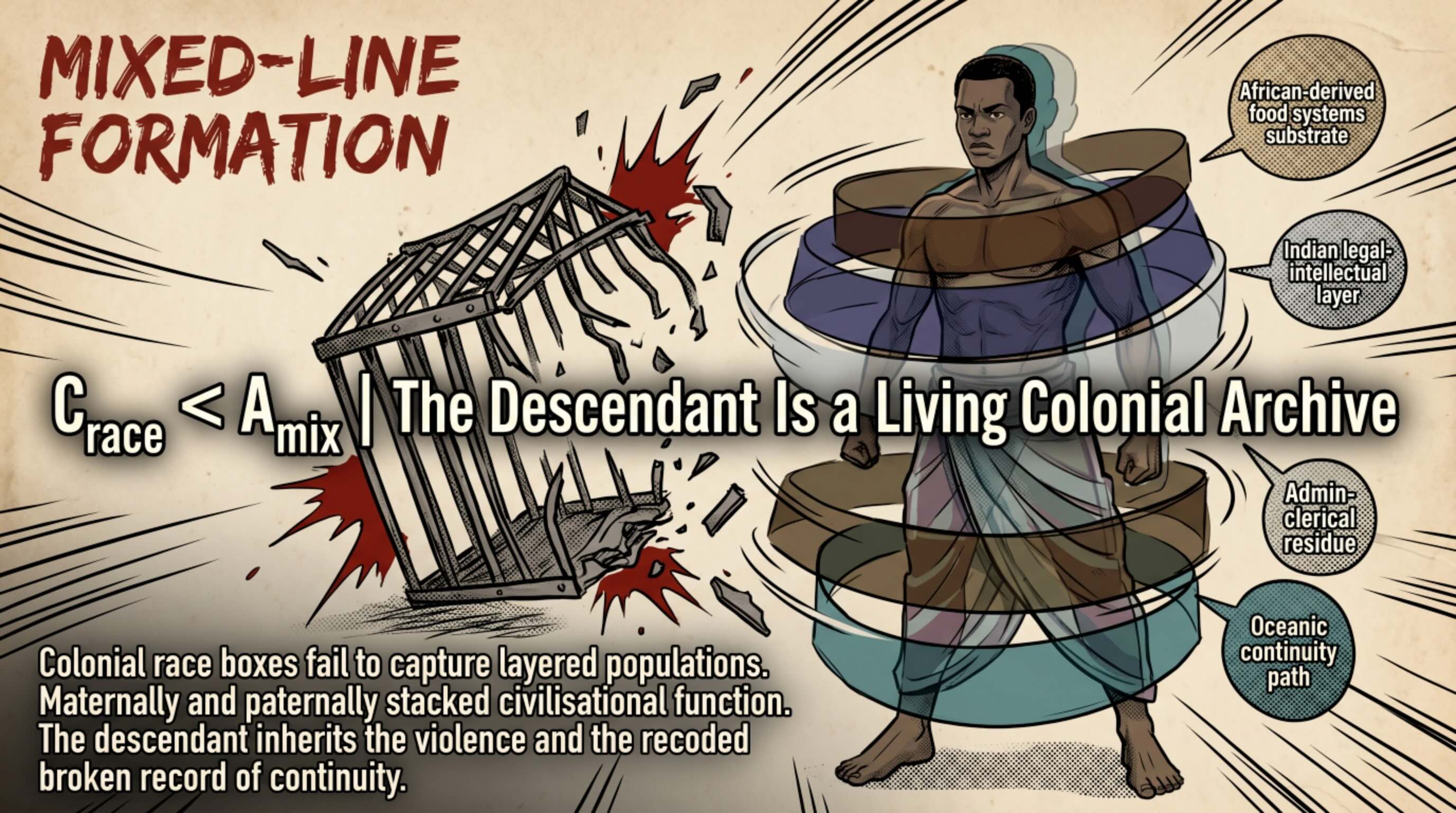
Figure 18. Mixed-Line Formation — Failure of Colonial Race Categories
This figure shows how colonial race categories fail to describe the actual structure of mixed-line formation. It places maternal, paternal, administrative, productive, and lineage layers into one living colonial archive.
Chapter 13 — Mixed-Line Formation, Administrative Strata, and the Failure of Colonial Race Categories
13.1 The colony does not produce simple lines
Once lineage externalisation has been established, the next step is to examine what happens inside the colony after deposit, absorption, renaming, and reproduction begin to act across generations. The result is not a clean set of separate racial streams. It is a layered human formation produced under imperial conditions. That formation includes extracted productive lines, buried ritual lines, administrative lines, clerical lines, policing lines, and later merged descent. This chapter therefore rejects any reading of the colony as a place where simple racial categories remained intact.
That matters because colonial description often depends on simplification. It prefers stable labels, fixed groups, and manageable blocks of identity. But the human result of the convoy system is not stable in that sense. It is stratified, fused, interrupted, and rerouted. One line may descend from an extracted Indian field carrying legal, ritual, ecological, and lineage continuity. Another may descend from administrative or clerical placement within the imperial machine. Another may carry African-derived buried continuity already shaped by slavery. Another may reflect wider oceanic or transcolonial ancestry. The colony does not remove these layers. It forces them into contact.
This chapter therefore treats mixed-line formation as a structural outcome of imperial deposit and colonial absorption. It is not incidental mixture. It is a produced condition.
That can be written as:
$A_{\text{mix}} = A_{\text{prod}} + A_{\text{adm}} + A_{\text{afr}} + A_{\text{ocean}}$
Where $A_{\text{mix}}$ denotes mixed-line formation, $A_{\text{prod}}$ productive-intelligence line, $A_{\text{adm}}$ administrative-clerical line, $A_{\text{afr}}$ African-derived buried line, and $A_{\text{ocean}}$ wider oceanic or transcolonial continuity.
13.2 Productive-intelligence lines and administrative lines are not the same thing
A core distinction in this paper is that extracted productive-intelligence lines and administrative lines must not be collapsed into one stream. The productive-intelligence lines are those carrying agricultural, legal, ritual, ecological, navigational, architectural, organisational, and lineage-bearing function into the colony. The administrative lines are those more plausibly associated with record, clerical handling, supervision, intermediary governance, or related colonial apparatus roles. Both are present in the imperial system, but they do not enter it from the same position.
This matters because mixed ancestry under colonial conditions often crosses operational strata, not only ethnic categories. One side of a family line may carry the weight of extraction, transport, burial, and renamed function. Another side may carry the trace of administration, clerkship, local supervision, or colonial record-bearing. The resulting human being cannot be described accurately if those strata are flattened into a single race label.
This stratification may be expressed as:
$S_{\text{line}} = S_{\text{prod}} + S_{\text{adm}}$
Where $S_{\text{line}}$ denotes line stratification, $S_{\text{prod}}$ productive-function stratum, and $S_{\text{adm}}$ administrative-function stratum.
The significance of this relation is that mixed-line formation is not random blending. It often preserves the layered structure of empire inside the body of the descendant.
13.3 Administrative abandonment and colonial merging
Administrative or clerical lines placed into colonial nodes do not always remain separate from the population they help govern. Over time, they may be abandoned, absorbed, merged into local society, or rerouted into family formation with the very populations over whom they once functioned as intermediary strata. This creates one of the more subtle outcomes of empire: the administrative line itself becomes colonialised.
That matters because it complicates the easy picture of ruler and ruled as permanently separate bodies. The colonial system may place administrators, clerks, record handlers, or support personnel into a node and then leave them there to merge into its human field. Their descendants then carry both administrative residue and colonised continuity. This is one of the ways imperial categories break down over time, even while the archive continues to write as though they remain clean.
This merger may be written as:
$M_{\text{adm}} = A_{\text{adm}} + K_{\text{col}}$
Where $M_{\text{adm}}$ denotes administratively merged lineage and $K_{\text{col}}$ denotes colonial kinship absorption.
This relation helps explain why mixed-line formation must be treated historically, not simply biologically. Colonial structures create new descent configurations by leaving operational strata inside the node.
13.4 Maternal and paternal layering under imperial conditions
This chapter also requires a more exact statement about lineage layering. A paternal line may preserve one field of transport, extraction, and role compression, while a maternal line may preserve another field of administration, clerical placement, African-derived buried continuity, or wider oceanic ancestry. The descendant then carries not one colonial story but several intersecting ones. Those intersections are not accidental. They are produced by the colony as a site of absorption, merger, coercion, and long duration.
That is why the paper resists any attempt to reduce the resulting person to a single race category. The human being produced under these conditions is a layered archive in living form. Paternal and maternal lines may each preserve different kinds of truth about the same imperial system. One line may speak more strongly to convoy extraction and deposited productive intelligence. Another may speak more strongly to administrative abandonment, clerical strata, or prior buried African-derived continuities. The descendant is then the meeting-point of multiple imperial routes.
This can be written as:
$A_{\text{desc}} = A_{\text{pat}} + A_{\text{mat}}$
Where $A_{\text{desc}}$ denotes descendant ancestry, $A_{\text{pat}}$ paternal line structure, and $A_{\text{mat}}$ maternal line structure.
The point is not merely genealogical. It is structural. Empire produces layered descent through unequal but intersecting routes of movement and absorption.
13.5 Why colonial race boxes fail
Colonial race categories fail because they confuse surface simplification with human truth. They are designed for governance, census, labour allocation, and administrative compression, not for accurate reconstruction of mixed-line formation under imperial conditions. Once the colony contains stacked buried civilisational layers, administrative residues, merged kinship, and long-term reproductive continuity, a simple race box becomes not just insufficient but false.
This matters because later institutions often continue using those categories as if they were natural facts. In reality, they are the last simplification of a much larger process. They erase stratification, conceal buried function, flatten mixed-line formation, and convert historical violence into apparent clarity. The result is a category that is easy to administer and impossible to live truthfully.
This failure may be written as:
$C_{\text{race}} < A_{\text{mix}}$
Where $C_{\text{race}}$ denotes the explanatory capacity of colonial race categorisation and $A_{\text{mix}}$ the actual mixed-line human structure.
The significance of this inequality is direct. Colonial race categories under-explain the person.
13.6 Mixed-line formation as evidence against simplicity
For the purposes of this paper, mixed-line formation is not a complication to be trimmed away. It is evidence against the simplicity of the archive. The more the line reveals administrative residue, buried African-derived continuity, Indian productive-intelligence continuity, and other cross-formed ancestry, the less credible the colonial category becomes. The mixed descendant is therefore not an exception to the paper’s argument. The mixed descendant is one of its strongest confirmations.
This matters because the paper is not trying to restore a fantasy of untouched purity. It is trying to reconstruct the actual human structure produced by extraction, absorption, and merger. The truth lies in the layered formation, not in an artificial return to clean boxes.
This may be stated as:
$E_{\text{mix}} = A_{\text{mix}} - C_{\text{race}}$
Where $E_{\text{mix}}$ denotes the evidential force of mixed-line formation against colonial simplification.
The mixed line, in other words, exposes the poverty of the box.
13.7 The descendant as a living colonial archive
The descendant produced by these layered processes becomes a living archive of empire. Not a symbolic one, but a structured one. Productive-intelligence lines, administrative lines, buried African-derived lines, ritual lines, and merged kinship survive in the body and history of the descendant even where the paper archive has flattened them. This makes the descendant historically important in a way institutions often fail to grasp. The descendant is not merely a private person with family history. The descendant is one of the places where the empire’s hidden structure remains embodied.
That is why this chapter belongs in the paper. It links convoy history, administrative residue, and buried continuity to the living human outcome. The archive may lie, scatter, or reduce. The mixed descendant still carries the interlocked system.
This can be written as:
$L_{\text{archive}} = A_{\text{mix}} + B_{\text{hist}}$
Where $L_{\text{archive}}$ denotes the living archive and $B_{\text{hist}}$ the burden of historical compression.
This is one of the chapter’s main human claims: the descendant is where the hidden colonial structure remains alive.
13.8 What this chapter establishes
This chapter establishes that the colony produces mixed-line formation rather than simple separated streams; that productive-intelligence lines and administrative lines are not the same thing; that administrative abandonment and colonial kinship merger are part of imperial formation; that maternal and paternal lines can preserve different operational histories of empire; that colonial race categories fail because they under-explain the actual human structure; and that the mixed descendant is a living archive of buried, interlocked colonial histories.
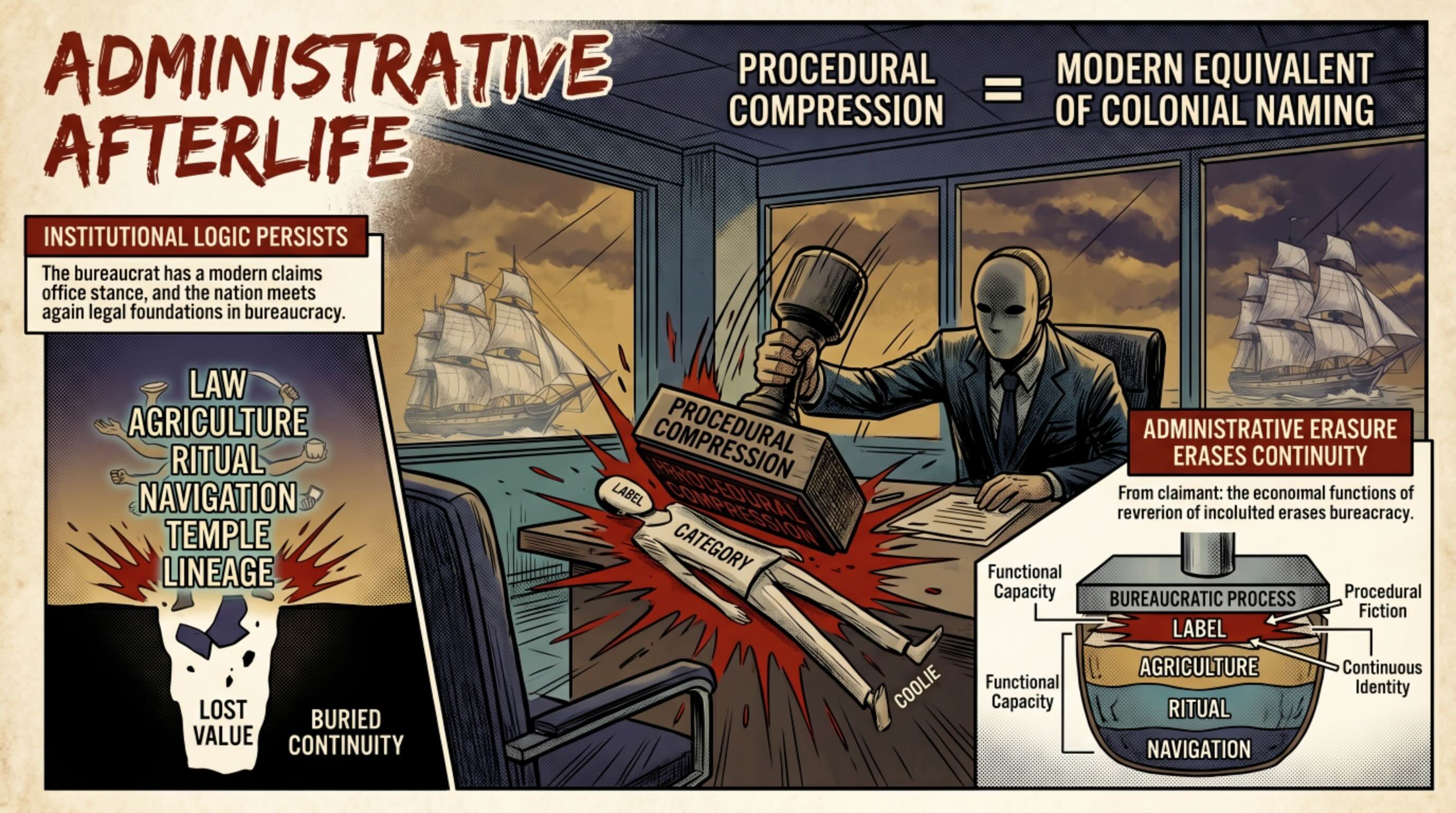
Figure 19. Administrative Afterlife — Modern Procedural Compression
This figure extends the paper into the present. It shows that the logic of colonial compression survives through modern procedures that reduce, narrow, fragment, and deny the full person.
Chapter 14 — Present Continuity, Procedural Compression, and the Administrative Afterlife of Empire
14.1 The structure did not end with the convoy
The system reconstructed in this paper does not belong only to the past. The convoy route, the production complex, the protected movement, the colonial absorption, and the lowering of original function were not isolated historical anomalies. They established a grammar of power that remains active in later institutions. The language has changed. The paperwork has changed. The outward legitimacy has changed. But the underlying pattern remains recognisable: human function is reduced into category, continuity is broken into administrative compartments, and living complexity is made manageable by being procedurally lowered.
That is why this chapter is necessary. Without it, the paper could be mistaken for a closed historical reconstruction. It is not. The same compressive logic that once transformed civilisational lines into labour, police, race, or colonial residue now persists in modern administrative form. The archive has become bureaucracy. The naming system has become process. The reduction of role into category continues.
This continuity may be stated as:
$C_{\text{cont}} = H_{\text{past}} + A_{\text{present}}$
Where $C_{\text{cont}}$ denotes continuity of structure, $H_{\text{past}}$ historical compression mechanism, and $A_{\text{present}}$ present administrative form.
This is the chapter’s opening claim: the structure survives by changing costume, not by disappearing.
14.2 Procedural compression as the modern equivalent of colonial naming
In the colonial system, reduction was often visible through naming. The person became labourer, coolie, native police, clerk, or other lowered category. In the modern system, the same reduction often occurs through procedure. The human being is disassembled into forms, thresholds, categories, decisions, risk labels, eligibility classes, and bureaucratic outputs. The violence is less theatrical, but no less real. The person is still made smaller than their actual function.
That is why this chapter uses the term procedural compression. Procedural compression is the conversion of living human continuity into administratively manageable fragments. It does not require openly colonial language. It only requires an institutional process that strips role, context, ancestry, continuity, and structural burden from the subject and replaces them with narrow decision categories.
This may be written as:
$P_{\text{comp}} = C_{\text{cat}} + R_{\text{rule}} + D_{\text{proc}}$
Where $P_{\text{comp}}$ denotes procedural compression, $C_{\text{cat}}$ category reduction, $R_{\text{rule}}$ rule-based narrowing, and $D_{\text{proc}}$ decision-procedure output.
This matters because it shows how empire survives in method even when its vocabulary changes.
14.3 The modern institution still prefers the smaller version of the person
A central continuity between colonial and modern administration is that institutions prefer a smaller version of the person. The smaller version is easier to classify, easier to deny, easier to process, easier to reject, easier to blame, and easier to fit inside an authorised narrative. The full person is structurally inconvenient because the full person carries history, role, trauma, continuity, complexity, and evidence of systemic contradiction.
That is why modern institutions so often produce friction when confronted with lived continuity. The institution wants the applicant, claimant, worker, patient, defendant, tenant, or citizen as a narrow procedural object. The living person arrives as a structured human being with continuity and context that exceed the box. The clash is built into the system.
This may be written as:
$H_{\text{real}} > H_{\text{proc}}$
Where $H_{\text{real}}$ denotes the real human structure and $H_{\text{proc}}$ the procedural version accepted by the institution.
This inequality is one of the most important continuities in the paper. The institution still under-measures the person.
14.4 Administrative denial as a form of continuity erasure
Modern compression does not only narrow the present person. It also erases continuity. When institutions refuse lineage context, structural harm, accumulated burden, role complexity, or the historical conditions that formed the person standing before them, they do not simply fail to understand. They reproduce the same pattern by which empire stripped original function from the recorded subject.
In that sense, administrative denial is not neutral scepticism. It is an active continuation of the logic this paper has traced from convoy to colony. The earlier system buried civilisational lines beneath colonial categories. The modern system buries lived continuity beneath procedural sufficiency tests, documentary thresholds, and rule-bound denials. The surface is different; the mechanism is recognisably related.
This may be expressed as:
$E_{\text{cont}} = H_{\text{line}} - A_{\text{ack}}$
Where $E_{\text{cont}}$ denotes erased continuity, $H_{\text{line}}$ denotes historical-line continuity, and $A_{\text{ack}}$ denotes institutional acknowledgement.
The point is direct: where acknowledgement is thin, continuity is erased again.
14.5 Why present administration must be read historically
A major purpose of this chapter is to insist that present administration cannot be read as though it emerged from nowhere. Bureaucracy inherits. Categories inherit. Institutions inherit. Decision systems inherit. A form may look modern while carrying an old grammar. A denial may look technical while carrying an older logic of compression. A category may look neutral while performing a historical reduction already familiar from colonial governance.
That is why the paper does not isolate present oppression from historical structure. To do so would accept the institution’s own self-description too easily. The point of the paper is that present administration must be read historically if its deeper logic is to be understood at all.
This inheritance relation may be written as:
$I_{\text{now}} = \Omega(I_{\text{past}})$
Where $I_{\text{now}}$ denotes present institutional form and $\Omega$ denotes inherited transformation from earlier institutional structure.
This helps the chapter make its key point: modern administration is not post-historical. It is historically sedimented.
14.6 The role of disclosure and truth recovery
Because procedural compression persists, disclosure becomes necessary. A system that narrows, fragments, denies, and under-measures the person will rarely correct itself spontaneously. It must be forced into contact with the buried structure it has ignored or denied. That is why disclosure belongs inside the logic of this paper. Disclosure is not just communication. It is truth recovery under conditions of administrative compression.
This is also why the Truthfarian method remains active in the present chapter. The same order of proof that reconstructs the colonial structure also serves present redress. Truth structure comes first, then model correlation, then pattern convergence, then the damaged institutional residue. The institution is not allowed to define reality merely because it sits behind a procedure.
This may be written as:
$D_{\text{truth}} = T_{\text{rec}} - P_{\text{comp}}$
Where $D_{\text{truth}}$ denotes disclosure as truth recovery, $T_{\text{rec}}$ truth recovery, and $P_{\text{comp}}$ procedural compression.
This relation clarifies the present function of the paper: not just to describe, but to reopen truth against reduction.
14.7 Present oppression as administrative afterlife
The paper therefore reaches an important conclusion here: what appears today as institutional obstruction, categoric denial, procedural stripping, or role-erasure is not merely contemporary malfunction. It is the administrative afterlife of earlier structures. The colony’s method survives in altered form. It no longer needs to ship the person across the sea. It can instead classify, deny, narrow, and fragment them where they stand.
That continuity matters because it explains why present oppression can feel both immediate and ancient at once. The claimant is dealing with a modern procedure, but the logic pressing against them is older than the form in front of them. The person is not simply meeting a bad decision. They are meeting the long shadow of an inherited reduction machine.
This may be expressed as:
$A_{\text{afterlife}} = C_{\text{hist}} \rightarrow P_{\text{modern}}$
Where $A_{\text{afterlife}}$ denotes administrative afterlife, $C_{\text{hist}}$ historical compression, and $P_{\text{modern}}$ modern procedural form.
This is one of the chapter’s strongest claims: the modern institution is part of the same long structure.
14.8 Why this chapter matters to the paper’s full argument
This chapter is necessary because it prevents the paper from being safely contained in the nineteenth century. Without it, the convoy could be treated as tragic history and then set aside. With it, the reader is forced to see that the same grammar of reduction still operates. The old system moved and renamed people. The new system procedurally narrows and denies them. In both cases, human continuity is placed below administrative convenience.
That is why this chapter belongs late in the paper, after the major historical machinery has been established. It allows the reconstructed past to speak directly to the present without collapsing the distinction between them. The point is not that the present is identical to the past. The point is that the present still carries its logic.
The full continuity relation may therefore be written as:
$T_{\text{full}} = H_{\text{convoy}} + C_{\text{colony}} + P_{\text{modern}}$
Where $T_{\text{full}}$ denotes the full truth structure linking convoy history, colonial conversion, and modern procedural form.
This relation states the chapter’s purpose exactly: to reconnect the present institution to the buried route that still informs it.
14.9 What this chapter establishes
This chapter establishes that the convoy structure did not end with maritime history; that modern institutions continue the same logic through procedural compression; that the institution still prefers a smaller version of the person than the real one; that administrative denial functions as continuity erasure; that present administration must be read historically; that disclosure operates as truth recovery against procedural narrowing; and that present oppression can be understood as the administrative afterlife of colonial compression.
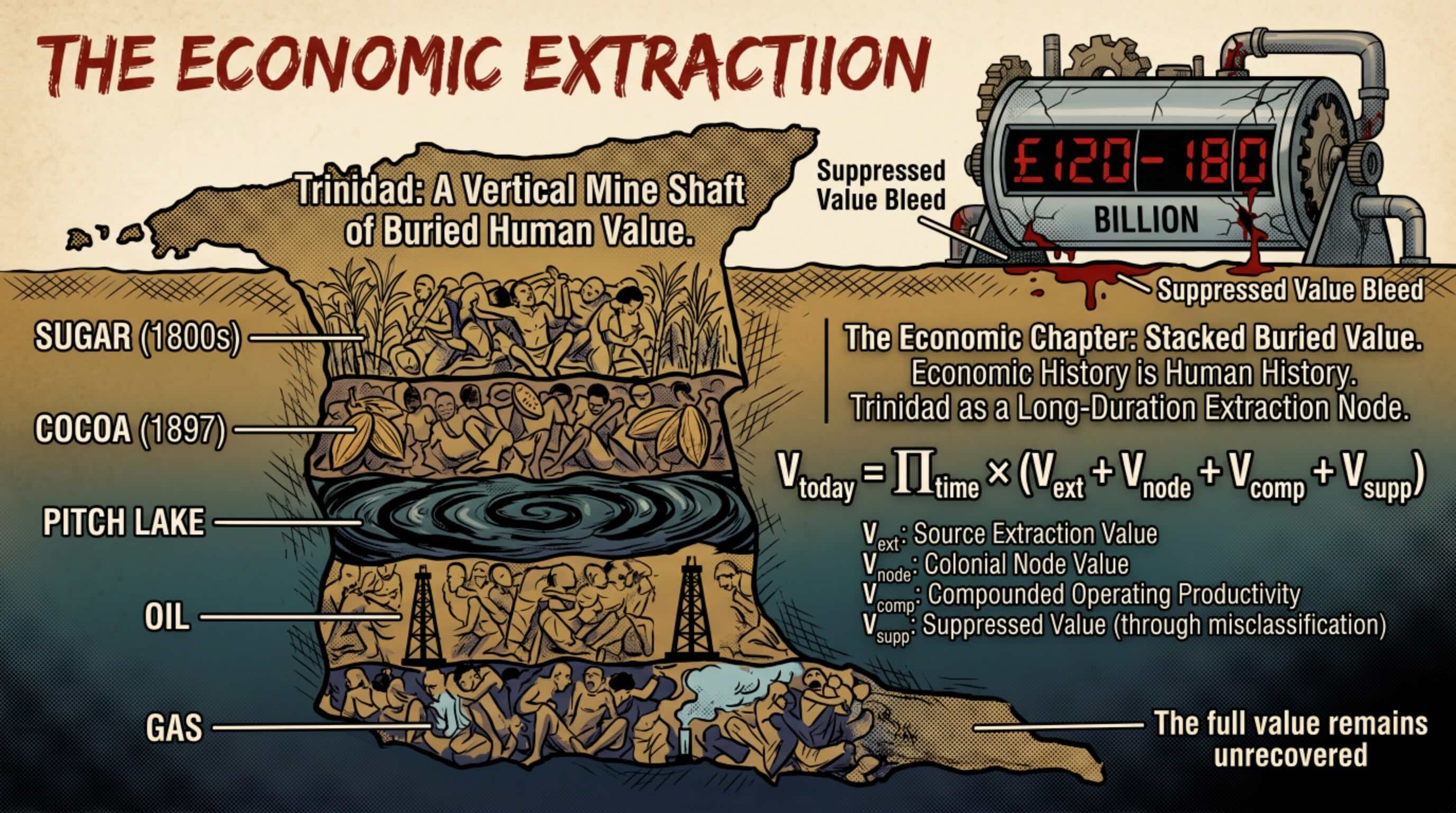
Figure 20. Economic Extraction — Accumulated Value and Present Equivalent
This figure visualises the economic chapter’s claim that buried value was not singular or static. Extraction, deposited colonial value, misclassification, compounding, and present-day equivalent recovery are treated as one value spine.
Chapter 15 — Economic Extraction, Accumulated Value, and Present-Day Equivalent
15.1 Why the economic chapter must be explicit
This paper cannot conclude with route, deposit, and role compression alone. It must also state the economic consequence of what has been reconstructed. If high-value human capability was selected, protected, moved, deposited, absorbed, renamed, and then carried forward across generations, then the process produced value. It produced value at source through loss, value at destination through colonial gain, value through long-duration compounding, and further hidden value through the systematic under-pricing of the line once it had been lowered into lesser categories.
This chapter therefore does not introduce a new argument from outside the paper. It consolidates what the earlier chapters have already established. Imperial recuperation implied recovery of yield. Internal insufficiency implied dependence on externally sourced function. The convoy chapters showed that what moved was not generic labour but multi-domain human intelligence. The absorption chapters showed that this intelligence was converted into food systems, labour systems, policing, administration, settlement, ritual continuity, and future descent. The role-compression chapters showed that the colony retained the use while suppressing the acknowledged rank. The economic meaning of that sequence must now be stated directly.
That governing relation may be written as:
$V_{\text{today}} = \big(V_{\text{ext}} + V_{\text{node}} + V_{\text{comp}} + V_{\text{supp}}\big)\cdot \Pi_{\text{time}}$
Where $V_{\text{today}}$ denotes present-day equivalent value, $V_{\text{ext}}$ extracted source value, $V_{\text{node}}$ deposited colonial value, $V_{\text{comp}}$ compounded historical value, $V_{\text{supp}}$ suppressed value through misclassification and renaming, and $\Pi_{\text{time}}$ the temporal compounding factor.
This is the chapter’s central equation. Present-day value is not the same as original extraction value. It is the accumulated and under-acknowledged value of the full system over time.
15.2 The time spine of value
The economic argument must be anchored in real time. The industrial arc behind the convoy is not vague. Surviving Bombay Naval Dockyard plan references sit at 1750, 1803, and 1856, giving the production field a measurable dockyard chronology. The main execution frame for the convoy logic sits within the Victorian period, 1837–1901, while British rule in India is described in UK educational material as lasting for almost two hundred years before independence in 1947. Those dates matter because they convert the chapter from general economic commentary into a timed structure of extraction, build-up, transfer, deposit, and compounding.
This timing also reinforces the paper’s balance. The economic structure was not generated by one side acting alone. It matured through a long Raj–Empire collaboration in which English command, finance, and imperial administration worked alongside Indian dockyard capacity, clerical mediation, local knowledge, and classificatory sorting. The extraction of ancestral value was therefore not unilateral. It was jointly enabled, and its economic effects were jointly structured, even where benefits were unevenly claimed.
That time relation may be written as:
$T_{\text{econ}} = T_{\text{dock}} + T_{\text{vict}} + T_{\text{after}}$
Where $T_{\text{dock}}$ denotes the dockyard build-up arc, $T_{\text{vict}}$ the main Victorian execution window, and $T_{\text{after}}$ the post-deposit period of colonial extraction and administrative afterlife.
15.3 Extraction value at source
The first economic layer is source extraction. When a line carrying legal intelligence, linguistic range, administrative function, ritual continuity, sacred botanical knowledge, agricultural and ecological competence, navigational capacity, organisational skill, disciplined order, and lineage continuity is removed from its source field, the source does not merely lose bodies. It loses embedded civilisational function. The economic loss is therefore larger than labour subtraction. It includes the removal of capability that would otherwise have continued to generate social, legal, ecological, and productive value in its original environment.
This relation remains:
$V_{\text{ext}} = N_{\text{moved}} \cdot \bar{f} \cdot \kappa_{\text{src}}$
Where $V_{\text{ext}}$ denotes extracted source value, $N_{\text{moved}}$ the number moved, $\bar{f}$ average functional density, and $\kappa_{\text{src}}$ the source-value coefficient.
What matters here is that the source field is not economically neutral after removal. It is diminished in function as well as in population.
15.4 Deposited colonial value
The second layer is deposited value inside the colony. Once the line lands and is absorbed, its function becomes operational. It enters work systems, food systems, policing, administration, settlement, ritual continuity, and future descent. That means the colony receives more than labour output. It receives a structured human inheritance capable of stabilising and extending extraction across time.
This relation may be written as:
$V_{\text{node}} = H_{\text{arr}} + F_{\text{node}} + R_{\text{settle}}$
Where $V_{\text{node}}$ denotes deposited colonial value, $H_{\text{arr}}$ arriving human function, $F_{\text{node}}$ realised node function, and $R_{\text{settle}}$ reproductive settlement value.
This is one of the chapter’s key moves. Colonial value is not simply imported material wealth. It is generated inside the node through the conversion of buried human systems into durable colonial structure.
15.5 The operating base was numerically Indian-led
The economic argument must also include hard operational numbers. Your uploaded crew model gives a median central estimate of 72.74% Indian crew, 15.62% European crew, 4.93% British/European officers, and 5.55% other colonial crew. At a per-ship crew total of 220, that corresponds to approximately 160 Indian crew, 34 European crew, 11 officers, and 12 other colonial crew.
These are not decorative figures. They show that the convoy’s real operating depth was numerically Indian-led while the visible European supervisory layer remained comparatively thin. That matters economically because it means the value-generating base of the route cannot be honestly priced as if British presence alone created the system. The convoy’s operating labour depth was overwhelmingly non-European, and its productive implications must be read on that basis.
The crew-value visibility relation may therefore be written as:
$V_{\text{oper}} = C_I + C_E + C_O + C_C$
With the further operational fact that $C_I$ dominates the working base. That dominance is one of the clearest economic anchors in the paper.
15.6 Trinidad as a long-duration extraction node
The economic chapter must then state the destination clearly. Trinidad was not a peripheral colonial space. It functioned as a long-duration extraction node. Sugar became Trinidad’s main export under British rule, and Trinidad’s economy later shifted toward cocoa, which overtook sugar as the island’s leading export by 1897. In the twentieth century Trinidad also became deeply significant through Pitch Lake asphalt, oil, and later gas. These are not separate curiosities. Together they show that the colony was a layered extraction platform across agriculture and strategic natural resources.
This is why the colony’s value equation must be widened:
$V_{\text{node}} = V_{\text{sugar}} + V_{\text{cocoa}} + V_{\text{pitch}} + V_{\text{oil}} + V_{\text{gas}} + V_{\text{hum}}$
Where $V_{\text{hum}}$ denotes the buried human and lineage-bearing value that made the node function.
This matters because the paper is not valuing a single plantation crop. It is valuing a long-duration extraction colony whose later wealth depended on an earlier absorbed human base.
15.7 Stacked buried value, not a single-source economy
The chapter must also preserve the layered colony model. Trinidad’s value was not generated by one line alone and not by the English alone. The colony carried buried African-derived civilisational value, buried Indian-derived civilisational value, and an English-administrative overlay that organised, claimed, and compressed both. That means the colony’s economic structure is stacked.
This relation remains central:
$V_{\text{colony}} = V_{\text{afr,buried}} + V_{\text{ind,buried}} + V_{\text{adm,overlay}}$
Where $V_{\text{afr,buried}}$ denotes buried African-derived civilisational value, $V_{\text{ind,buried}}$ buried Indian-derived civilisational value, and $V_{\text{adm,overlay}}$ the administrative overlay that organised and compressed both.
That is the chapter’s balance point. The economic structure is not one-sided. It is collaborative in formation, asymmetrical in command, and layered in value.
15.8 Compounded value through time
Once deposited, the value compounds. This is where the chapter becomes conclusive. The colony does not benefit from extracted human function once and stop. It benefits through repeated labour, repeated harvest, repeated administrative use, repeated policing, repeated settlement, repeated food continuity, repeated religious continuity, and repeated reproductive survival across generations. That means the original extraction produces accumulated value over long duration.
This compounding may be written as:
$V_{\text{comp}} = \sum_{t=1}^{T} \delta_t , V_{\text{node},t}$
Where $V_{\text{comp}}$ denotes compounded historical value, $V_{\text{node},t}$ node value at time $t$, and $\delta_t$ the compounding or retention factor.
That is why present-day equivalent value cannot be reduced to simple inflation from an original extraction moment. The node has had generations in which to convert buried human function into durable colonial wealth.
15.9 Suppressed value through misclassification
A further layer is suppressed value. The system not only used the absorbed line. It lowered it. When a line carrying law, language, administration, ritual continuity, ecology, organisation, or disciplined order is priced or recorded merely as labour, the colony captures a surplus that the archive never honestly acknowledges. The same applies to the earlier African-derived layer compressed through slave categories.
This suppressed value may be written as:
$V_{\text{supp}} = F_{\text{orig}} - F_{\text{priced}}$
Where $V_{\text{supp}}$ denotes suppressed value, $F_{\text{orig}}$ the original functional value of the line, and $F_{\text{priced}}$ the value as recognised under colonial classification.
This is economically important because the colony’s books and categories understate what the colony actually received.
15.10 Present-day equivalent as recovery measure
Present-day equivalent value is therefore not a market fantasy and not an inflated rhetorical gesture. It is a recovery measure. It asks what the extracted, deposited, compounded, and suppressed value amounts to when carried into current terms. It is the nearest this paper comes to a conclusive economic statement about the continuing scale of the loss and gain embedded in the convoy system.
This can now be restated in full:
$V_{\text{today}} = \Pi_{\text{time}} \cdot \big(V_{\text{ext}} + V_{\text{node}} + V_{\text{comp}} + V_{\text{supp}}\big)$
This is the chapter’s conclusive form. The structure has present economic value because its extraction has never ceased to matter.
15.11 Why this chapter is conclusive
This chapter is conclusive because it translates the whole paper into value. It shows that the convoy system has recoverable present economic meaning; that the relevant timeline is real and measurable; that the operational base was numerically Indian-led; that Trinidad functioned as a long-duration extraction colony across sugar, cocoa, pitch, oil, and gas; that the colony’s value was stacked across buried African-derived and Indian-derived civilisational layers under an administrative overlay; and that misclassification itself produced suppressed value.
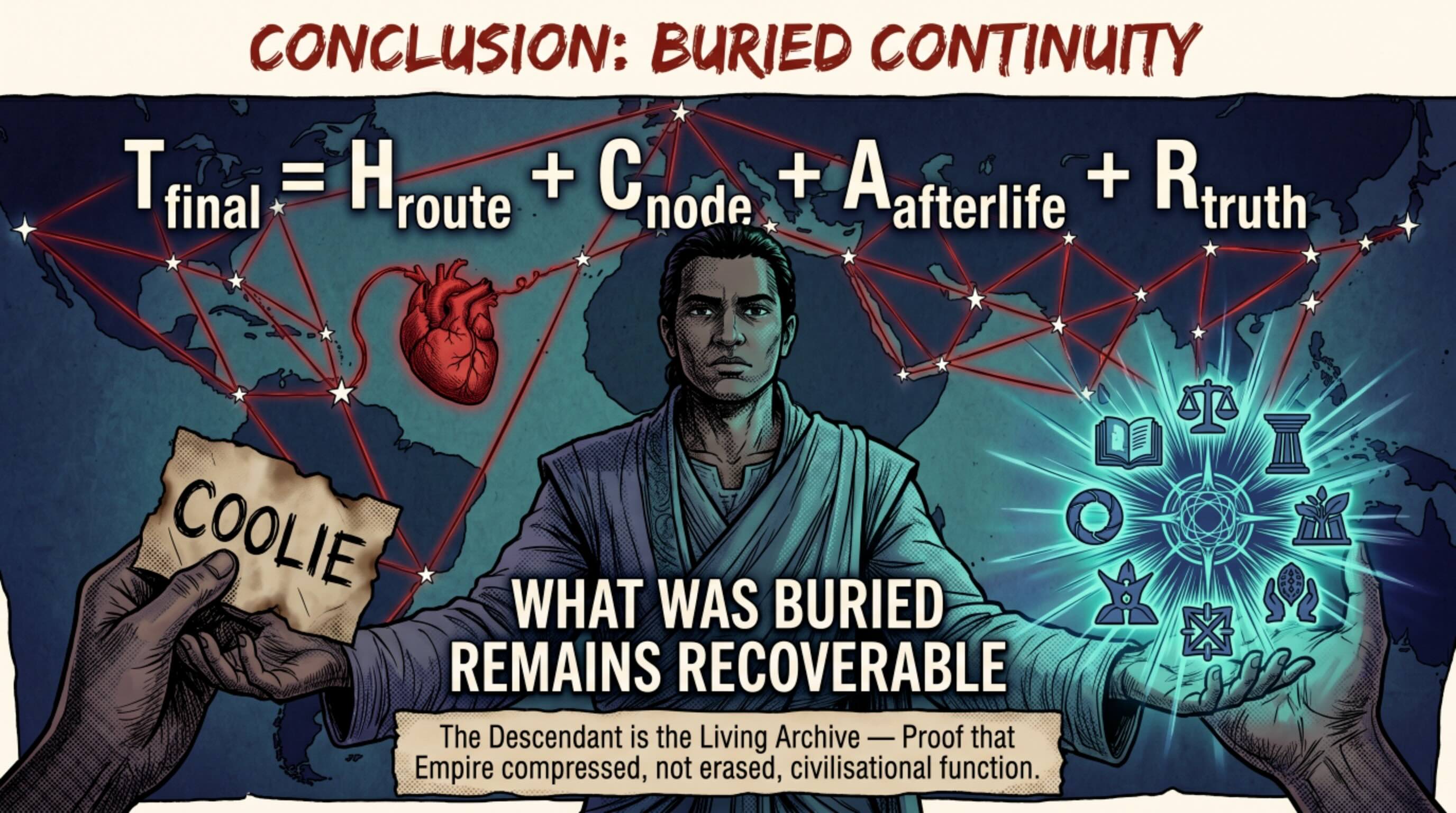
Figure 21. Buried Continuity — Closing Recovery Structure
This concluding figure gathers the paper’s final claim: one protected system, one buried continuity, and one recovery method. It closes the visual sequence by returning the fragmented archive to a whole-system reconstruction.
Chapter 16 — Conclusion: One Protected System, One Buried Continuity, One Recovery Method
This paper has argued that the British colonial record did not preserve a neutral account of human movement. It fragmented a single protected imperial extraction system into smaller, safer stories: migration, labour, settlement, administration, policing, and later demographic normality. Under that fragmentation, the route disappears, the convoy disappears, the industrial preparation disappears, the original function of the people disappears, and the descendant is left with a reduced archive in place of a living continuity. The central task of the paper has therefore been reconstruction.
The reconstruction has proceeded in a strict order. First, the paper established that truth cannot begin from institutional archive as supreme authority because the archive itself forms part of the compressive system under examination. Second, it identified the historical problem as one of fragmentation: the operation survives materially but disappears narratively when its parts are separated across record classes. Third, it showed that the movement is better understood as imperial recuperation after strategic loss rather than as loose migration. Fourth, it established that England’s own internal structure was insufficient, by itself, to furnish the full layered human depth required across colonial nodes, making external human function structurally necessary.
From there, the paper turned to the calibre of what was actually taken. It argued that the transported and absorbed populations were not generic labour but multi-domain human systems carrying law, language, ritual continuity, sacred botanical knowledge, food systems, ecological intelligence, navigational ability, organisational function, architectural capacity, disciplined order, and lineage-bearing continuity. It further argued that the colony was built from stacked buried civilisational layers: an earlier African-derived and Yoruba-linked substrate already compressed through slavery, and a later Indian and Brahmin-derived substrate added through convoy transfer and later reclassification. The British overlay did not create the deepest human value in the colonial node. It named, managed, and compressed what it captured.
The paper then showed why such cargo required protection. Protection was treated not as incidental naval detail but as operational acknowledgement of value. The convoy was a guarded artery of imperial recovery because it carried irreplaceable human and lineage-bearing function. From there, the argument moved into route architecture itself. The convoy route was shown to be the principal evidence surface: a governed movement from the Indian field, through the Madagascar and south-west Indian Ocean corridor, through the South African turn, through the South Atlantic staging belt, into the Caribbean (Trinidad, Guyana, Jamaica) deposit system. The route mattered because it revealed where the line moved, where it staged, where it split, and where it was laid down.
The paper then moved upstream from the maritime shadow into the production shadow. A convoy of this scale was shown to require prior industrial concentration. Dockyard labour, shipbuilding, rigging, ironwork, provisioning, contractor alignment, and Raj-integrated administrative sorting all had to exist before launch. In this frame, the Bombay Dockyard and Wadia master-builders complex were not decorative references but necessary parts of the industrial field. The temporal structure of before, during, and after was shown to be essential: before lay the accumulation phase, during lay the Victorian execution window, and after lay the deposit-and-compression phase in which the convoy disappeared into colonial residue.
Once the industrial, maritime, and route structures were established, the paper quantified the convoy. Fleet size, crew depth, oversight thinness, voyage loss, landed population, and island allocation were all shown to be inferable under constrained assumptions. The crew composition data made visible the reality long hidden beneath imperial surface narrative: the operating base was overwhelmingly Indian, while the visible European supervisory and officer layer was comparatively thin. This was one of the paper’s strongest confirmations that colonial command visibility did not equal functional depth.
The paper then followed the convoy into the colonial node itself. Deposit was shown not to be the end of the operation but the beginning of colonial absorption. The colony was described as a conversion machine, drawing out specific functions from the deposited populations and reallocating them into labour systems, policing, clerical and intermediary roles, ritual continuity, food systems, and reproductive settlement. At that point, the archive performed its final act: role compression. Original function was lowered into administratively useful names. The colony kept the function and discarded the recognised rank. Repetition hardened the lowered category into administrative fiction, and that fiction became durable enough to masquerade as ordinary history.
The chapter on lineage externalisation then showed how the line persists after compression. For the purposes of the paper, Ramdin and Ramdeen were unified as one phonetic lineage, with spelling drift treated as orthographic variation rather than as a break in continuity. Source depletion, route-side persistence, destination concentration, and weak return continuity together made surname geography a strong residue of convoy deposit and non-return. The line ceased to be mere family naming and became a route-linked human trace. From there, the paper turned to mixed-line formation, showing that colonial outcomes cannot be contained by race boxes. Productive-intelligence lines, administrative and clerical lines, African-derived buried continuities, oceanic continuities, and later kinship merger produce descendants who are living archives of imperial structure, not simple census categories.
The final historical move of the paper was to show that the structure did not end with the colonial period. It persisted as procedural compression in modern institutions. The archive became bureaucracy. Colonial naming became rule-bound category. The full person was again reduced below the threshold of administrative convenience. In that sense, the paper has argued that present procedural oppression is not separate from historical structure. It is the administrative afterlife of empire. The same preference for the smaller version of the person continues under new language.
Against that long continuity of compression, the paper has advanced a recovery method. Truthfarian was not presented as ornament or style, but as a recovery architecture. By correlating model logic, route structure, industrial preparation, crew mathematics, deposit geography, surname residue, and living continuity, the paper showed that buried structures can be reopened even where official record is partial, fragmented, or lowered. The convoy system, once reassembled, becomes not merely arguable but runnable. Its states, transitions, constraints, and outcomes can be simulated under a Nash-Markov structure. That is what turns the paper from critique into method.
The conclusion that follows is therefore not narrow. The paper has reconstructed one protected imperial system, one layered colonial conversion machine, and one long administrative afterlife. But in doing so, it has also shown something wider: buried peoples are recoverable. A line reduced by archive can still be restored through coherence. A route fragmented by imperial narrative can still be reassembled through mathematics and residue. A descendant burdened by administrative fiction can still become the active agent of recovery. The work is therefore not only historical. It is emancipatory in the precise sense developed throughout the paper: it releases the human being from the box by restoring the larger continuity the box was designed to suppress.
That final relation may be written as:
$T_{\text{final}} = H_{\text{route}} + C_{\text{node}} + A_{\text{afterlife}} + R_{\text{truth}}$
Where $T_{\text{final}}$ denotes the full recovered truth of the paper, $H_{\text{route}}$ denotes the reconstructed convoy route, $C_{\text{node}}$ the colonial conversion machine, $A_{\text{afterlife}}$ the administrative afterlife of that structure, and $R_{\text{truth}}$ the Truthfarian recovery process through which the buried continuity is restored.
The central conclusion of the paper is therefore clear:
What has been presented by the archive as fragmented migration, labour, settlement, and administration is better understood as one protected imperial transfer system carrying buried civilisational function across a governed route into colonial deposit, where that function was absorbed, lowered, renamed, and carried forward into modern administrative form. That structure did not erase the line completely. It buried it. And because it buried it rather than annihilated it, it remains recoverable.
That is the final claim of the paper.