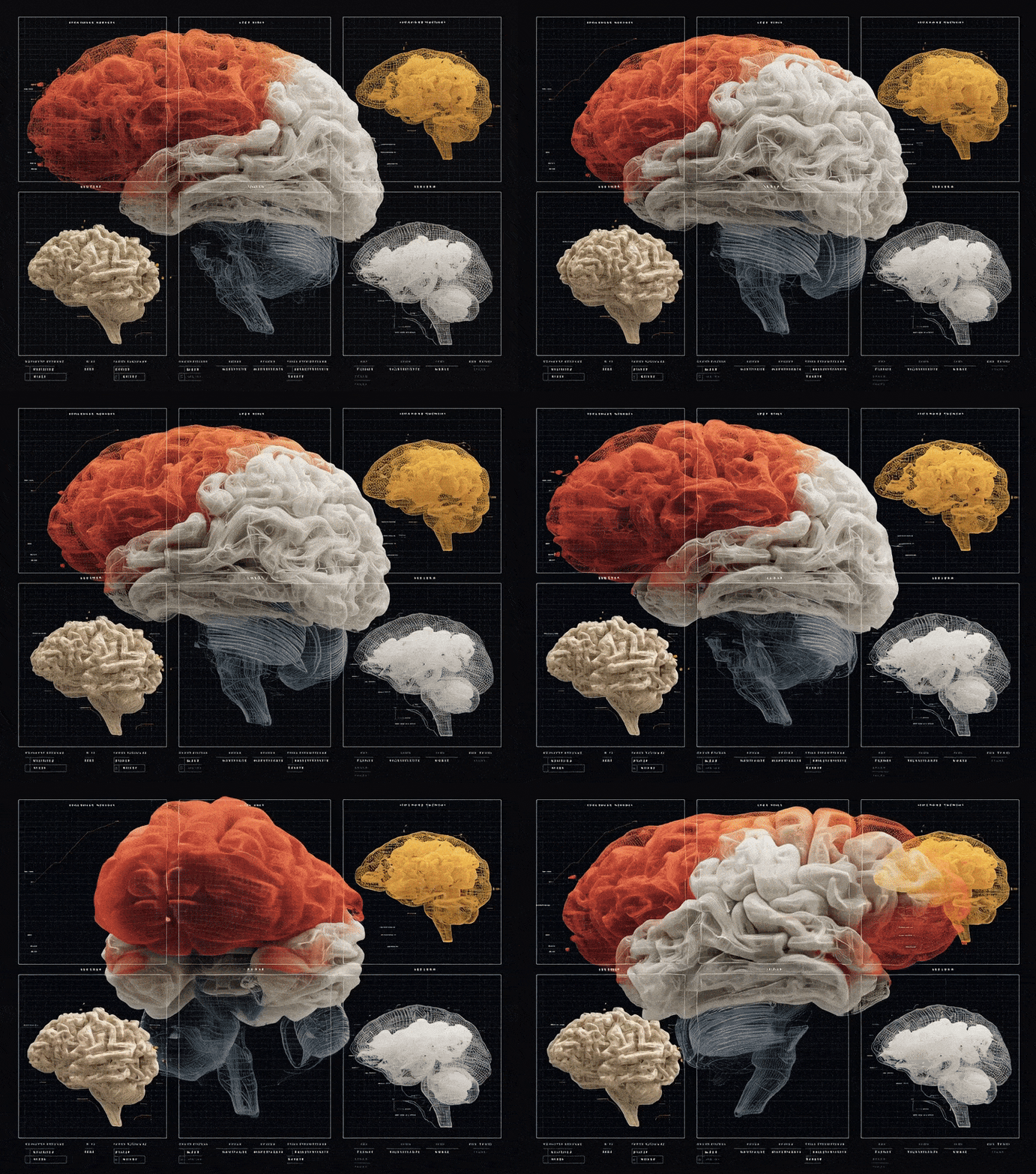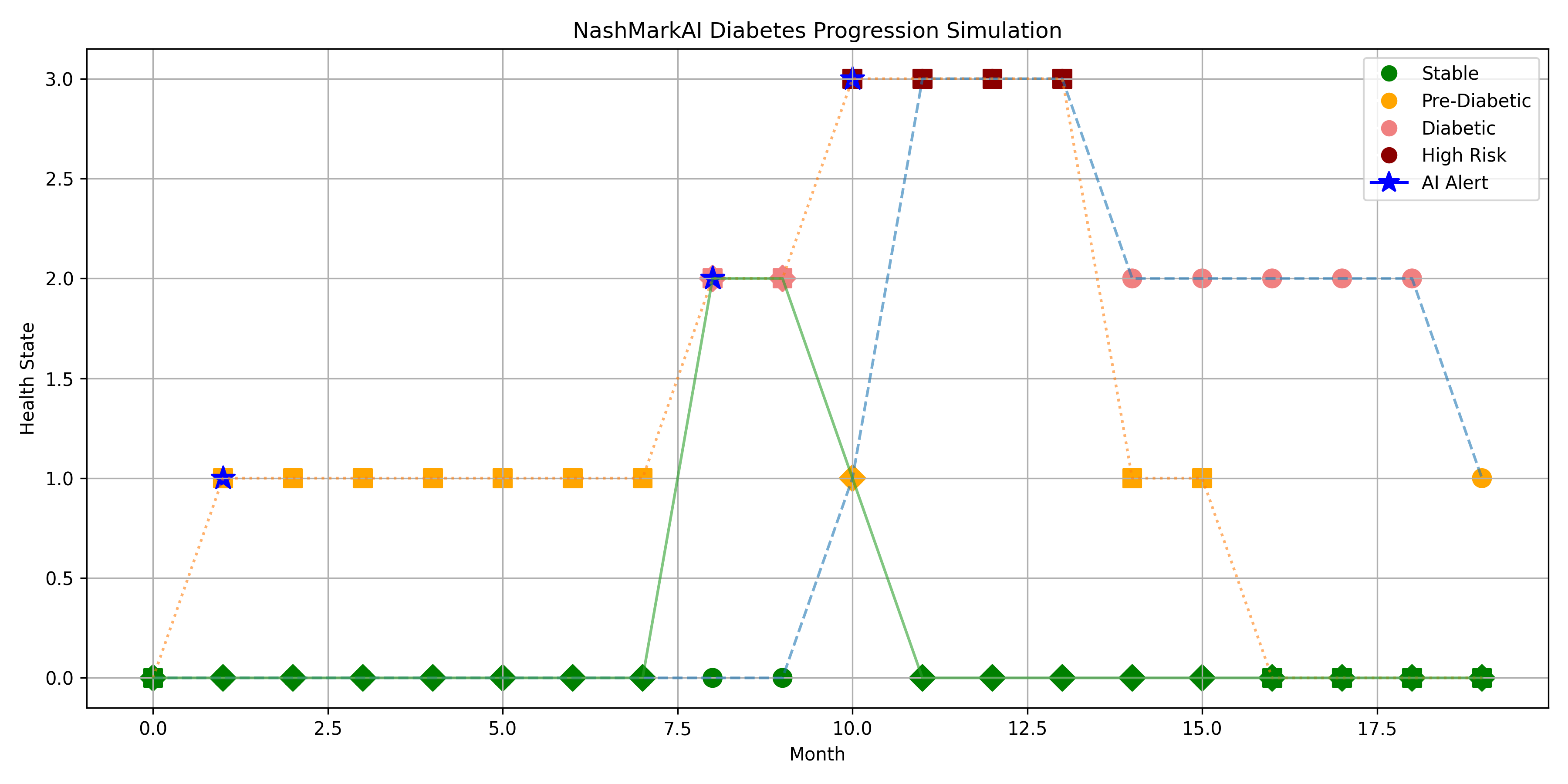
This section presents NashMark AI healthcare models that reframe health deterioration, disease progression, and intervention through equilibrium dynamics rather than symptom-led reaction. The models apply temporal analysis, drift detection, and proportional harm logic to identify instability before irreversible degradation occurs.
These models do not treat illness as isolated pathology.
They treat it as a measurable loss of equilibrium across time, behaviour, and system response.
I. What these healthcare models address
| Healthcare Focus | Model Purpose |
|---|---|
| Cognitive Decline & Dementia | Identification of temporal dislocation and cognitive drift as primary causal mechanisms |
| Chronic Disease Progression | Predictive modelling of behavioural and metabolic drift prior to clinical escalation |
| Early Intervention Windows | Detection of equilibrium deviation before diagnostic thresholds are crossed |
| Systemic Health Failure | Mapping how healthcare systems amplify harm through delayed or reactive response |
II. How NMAI healthcare modelling differs
| Conventional Healthcare Modelling | NMAI Healthcare Models |
|---|---|
| Symptom-driven diagnosis | Drift-led prediction |
| Binary healthy / ill states | Continuous equilibrium states |
| Late-stage intervention | Early-stage correction |
| Isolated biological metrics | Temporal, behavioural, and systemic integration |
| Reactive care pathways | Preventative equilibrium restoration |
The objective is not treatment escalation.
The objective is equilibrium recovery.
III. How to read this section
- Each model represents a specific healthcare application of NashMark equilibrium logic.
- Models are designed to be predictive, preventative, and corrective, not merely descriptive.
- Together, they form a coherent framework for re-engineering healthcare around stability rather than crisis response.