
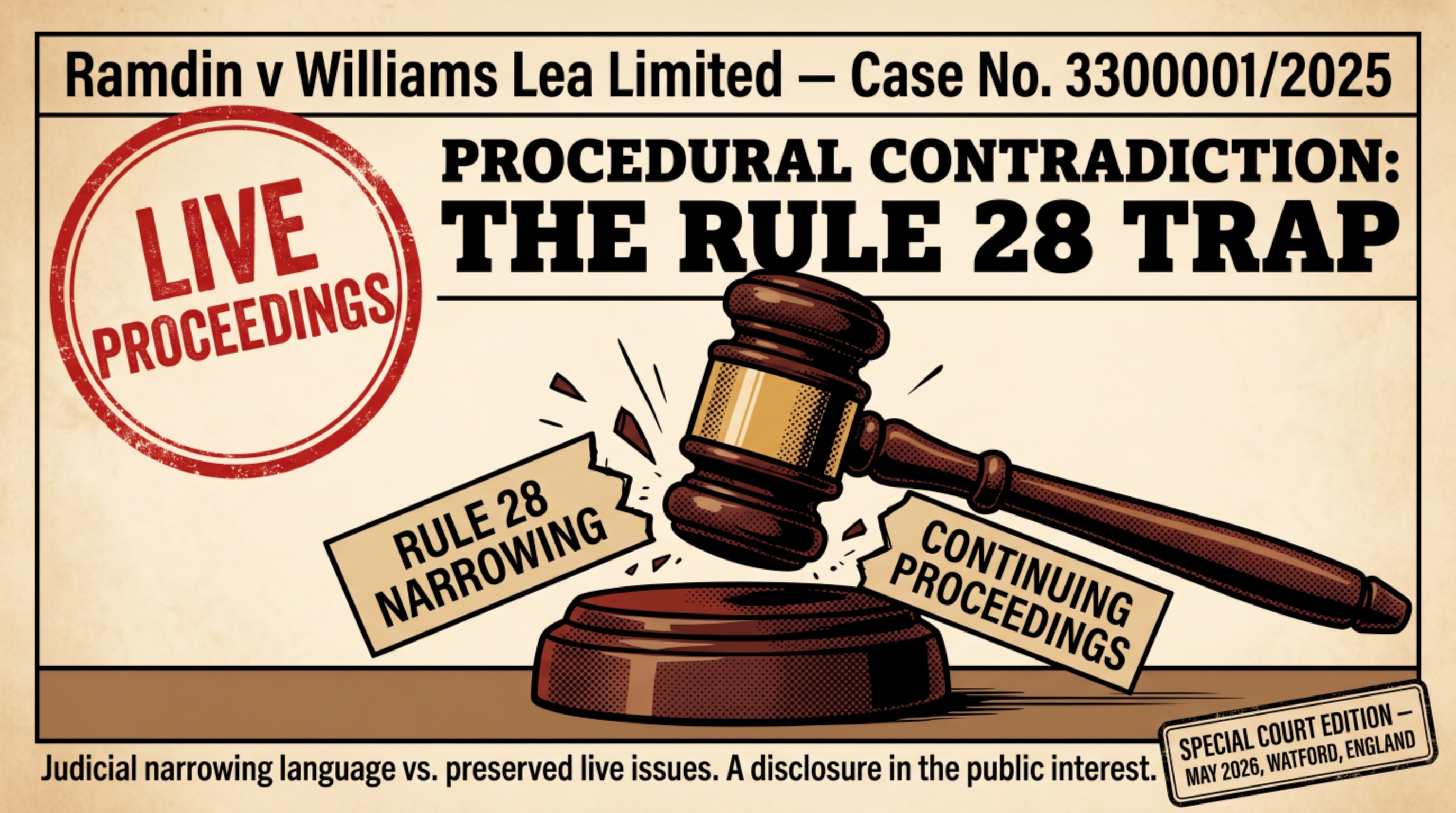
Illustrative procedural graphic accompanying the disclosure “Procedural Contradiction: The Rule 28 Trap” concerning Employment Tribunal proceedings in Ramdin v Williams Lea Limited (Case No. 3300001/2025). The image depicts a judicial gavel splitting between “Rule 28 Narrowing” and “Continuing Proceedings,” representing the contradiction between dismissal-oriented procedural language and the later continuation of overtime, disability, accommodation, and hearing-stage issues within the Tribunal process. The “Live Proceedings” stamp indicates that the underlying matter remains ongoing.
Judicial narrowing language, preserved disability and overtime issues, hearing-stage continuation, medical vulnerability awareness, and subsequent procedural contradiction within Employment Tribunal proceedings.
Overview
This disclosure concerns a Rule 28(1) Initial Consideration Notice and Order issued by Employment Judge Anstis on 21 February 2025 within Employment Tribunal proceedings involving the Claimant and Williams Lea Limited.
The Notice asserted that parts of the claim:
- had “no reasonable prospect of success”,
- or appeared outside Tribunal jurisdiction,
- and would stand dismissed unless further explanation was provided.
The order addressed:
- unfair dismissal,
- reasonable adjustments,
- GDPR and HR-record issues,
- workload exploitation allegations,
- and overtime-related matters.
Simultaneously, however, the same order:
- expressly preserved overtime issues for further determination,
- expressly preserved disability-related issues for further orders,
- and therefore did not fully dispose of the proceedings.
The later procedural chronology demonstrates:
- continuing Tribunal management,
- continued settlement-stage progression,
- hearing-stage continuation,
- video-hearing direction,
- accommodation correspondence,
- prolonged procedural silence,
- and later retrospective procedural reinterpretation.
This disclosure concerns the structural contradiction between:
- initial narrowing and dismissal-oriented procedural language,
- and the later continuing procedural trajectory of the case.
The disclosure is made in the public interest because:
- equality before courts and tribunals,
- effective participation,
- procedural fairness,
- equality of arms,
- and proportional procedural conduct
are fundamental principles governing judicial and tribunal process, particularly where litigants in person, disability-related participation concerns, and institutional asymmetry are engaged.
Context and Trigger
The disclosure arises from the interaction between:
- the Rule 28(1) Notice and Order dated 21 February 2025,
- subsequent settlement-stage continuation,
- continued overtime-related procedural progression,
- later hearing-stage management,
- later accommodation correspondence submitted during medical deterioration,
- prolonged procedural silence,
- and retrospective procedural objections raised months later.
The disclosure does not arise merely because judicial criticism was expressed.
Rather, the disclosure arises because:
- the procedural chronology demonstrates continuing live issues after the narrowing order,
- overtime-related issues remained active,
- disability and accommodation issues remained active,
- hearing-stage progression later occurred,
- and the later procedural trajectory materially diverged from the apparent direction implied by the initial Rule 28 notice.
The disclosure further arises within a wider context involving:
- DAC Beachcroft LLP acting for the Respondent,
- continuing representation by DAC Beachcroft LLP,
- separate civil litigation involving DAC Beachcroft LLP,
- and overlapping procedural and institutional conduct concerns recorded across multiple proceedings and disclosures.
Procedural Chronology
Phase I — Rule 28 Initial Narrowing and Preservation of Live Issues
| Date | Tribunal Communication / Procedural Event | Judge / Source | Procedural Significance |
|---|---|---|---|
| 21 February 2025 | Rule 28(1) Notice and Order issued | Employment Judge Anstis | Initial narrowing / dismissal-pressure phase initiated |
| 21 February 2025 | Overtime issue expressly preserved for further determination | Employment Judge Anstis | Overtime liability issue survives |
| 21 February 2025 | Disability issue expressly preserved (“Further orders are made separately…”) | Employment Judge Anstis | Disability / accommodation issues remain procedurally live |
| 3 March 2025 | Tribunal transmits Notice and Order / CMO | Watford Employment Tribunal | Continuing procedural management confirmed |
| 21 March 2025 | Claimant files formal response to CMO | Claimant / Tribunal filing | Procedural engagement continues |
Phase II — Settlement Continuation and Hearing-Stage Progression
| Date | Tribunal Communication / Procedural Event | Judge / Source | Procedural Significance |
|---|---|---|---|
| 22 April 2025 | Tribunal-directed settlement process complied with by Claimant | Settlement package / cover letter | Tribunal proceeds on basis matter remains active |
| 23 April 2025 | Updated Heads of Terms and settlement materials issued | Settlement documentation | Settlement phase continues |
| 22 August 2025 | Further settlement correspondence issued | Settlement cover letter | Continuing settlement posture |
| 22 September 2025 | Revised Heads of Terms and Settlement Agreement issued | Settlement documentation | Settlement process continues without disposal |
| 15 December 2025 | Video hearing direction and overtime evidential posture documented | Tribunal procedural posture | Matter actively progressed toward hearing-stage determination |
Phase III — Medical Accommodation, Procedural Silence, and Retrospective Reinterpretation
| Date | Tribunal Communication / Procedural Event | Judge / Source | Procedural Significance |
|---|---|---|---|
| 10 October 2025 | Medical accommodation / participation request submitted | Claimant to Tribunal | Medical vulnerability formally placed on record |
| 10 October 2025 | Tribunal acknowledgment of receipt | Watford Employment Tribunal | Tribunal awareness established |
| 10 October 2025 | Respondent copied into Tribunal correspondence | Procedural service event | Respondent awareness established |
| 18 November 2025 | DAC confirms representation and continuing correspondence | DAC Beachcroft LLP | Continuous representation confirmed |
| October 2025 – March 2026 | No accommodation determination issued | Tribunal procedural inactivity | Five-month procedural silence period |
| 27 March 2026 | Tribunal raises retrospective Rule 31(2) service issue | Watford Employment Tribunal | Retrospective procedural reinterpretation introduced |
| 30 March 2026 | DAC reiterates continuing representation chain | DAC Beachcroft LLP | Contradicts later procedural uncertainty regarding awareness/service |
| 13 April 2026 | Claimant submits procedural clarification and determination request | Claimant to Tribunal | Procedural contradiction formally raised |
| 13 April 2026 | Tribunal states CC service sufficient but application not referred to Judge | Kevin Cahill / Watford Employment Tribunal | Administrative contradiction formally confirmed |
1. Rule 28(1) Initial Consideration Notice Issued
On 21 February 2025, Employment Judge Anstis issued a Notice and Order under Rule 28(1) of the Employment Tribunal Rules of Procedure 2024.
The notice stated that parts of the claim:
- had no reasonable prospect of success,
- or appeared outside Tribunal jurisdiction.
Exhibit Reference: EX01
2. Unfair Dismissal Jurisdiction Challenge Raised
The Notice asserted:
- insufficient qualifying service for unfair dismissal,
- and absence of explanation why the statutory threshold should not apply.
The Notice stated:
“the claimant does not have the necessary two years’ service…”
Exhibit Reference: EX01
3. Reasonable Adjustments Challenge Raised
The Notice asserted:
- insufficient identification of a “provision, criterion or practice” under section 20 Equality Act 2010.
The Notice stated:
“the claimant has not suggested any provision, criterion or practice…”
Exhibit Reference: EX01
4. GDPR / HR Record / Workload Exploitation Issues Characterised as Outside Jurisdiction
The Notice stated:
“Claims of GDPR and HR record failures and exploitation of roles and workloads do not appear to be within the jurisdiction of the tribunal.”
Exhibit Reference: EX01
5. Overtime Issue Preserved for Further Determination
Despite the narrowing language, Part 2 of the Order expressly required:
- further explanation concerning overtime entitlement,
- contractual wording,
- and payment basis.
The overtime issue therefore remained procedurally active.
Exhibit Reference: EX01
6. Disability Status Left Procedurally Active
The Order expressly stated:
“Further orders are made separately in respect of whether the claimant is a disabled person.”
Disability-related issues therefore remained unresolved and procedurally live.
Exhibit Reference: EX01
7. Tribunal Settlement and Hearing-Stage Progression Continued
Following the Rule 28 Order:
- settlement-stage continuation occurred,
- revised settlement materials were exchanged,
- hearing-stage progression later occurred,
- and a video-hearing direction was later introduced.
The proceedings therefore continued materially despite the earlier narrowing posture.
Exhibit References: EX03
8. Medical Accommodation Correspondence Submitted
On 10 October 2025, correspondence was submitted to the Tribunal:
- notifying medical deterioration,
- raising participation concerns,
- and requesting procedural accommodation.
The Respondent:
- was copied,
- received the communication,
- and later confirmed continuing representation.
Exhibit References: EX02
9. Procedural Silence Followed by Retrospective Procedural Reinterpretation
No accommodation determination was issued for approximately five months.
On 27 March 2026, the Tribunal subsequently raised a retrospective Rule 31(2) service issue despite:
- prior acknowledgment,
- Respondent awareness,
- and continuing representation.
On 13 April 2026, the Tribunal later confirmed that CC service was sufficient but stated the matter had not been referred to a Judge.
Exhibit References: EX02, EX04
Core Structural Issue
The Rule 28(1) Notice simultaneously:
- narrowed claims aggressively,
- raised dismissal consequences,
- asserted jurisdictional exclusion,
- preserved overtime issues,
- preserved disability issues,
- and left further procedural activity unresolved.
The later procedural chronology demonstrates:
- continuing Tribunal management,
- settlement-stage continuation,
- hearing-stage progression,
- video-hearing direction,
- accommodation-related procedural activity,
- and continuing substantive procedural engagement.
The proceedings therefore continued materially after the initial narrowing phase.
Breaches
I. Procedural Pressure and Equality-of-Arms Imbalance
Frameworks Invoked
- Employment Tribunal Rules of Procedure 2024 — Rule 2
- Human Rights Act 1998 — Article 6
- ICCPR Article 14(1)
- Equality of Arms Doctrine
- Principles of Natural Justice
Reason
The Rule 28(1) notice deployed strong dismissal-oriented procedural language against a litigant in person while disability and participation issues remained unresolved.
II. Failure to Maintain Proportionate Procedural Treatment
Frameworks Invoked
- Employment Tribunal Rules of Procedure 2024 — Rule 2
- Equality Act 2010 — Sections 20 and 149
- Human Rights Act 1998 — Article 6
- Effective Participation Principles
Reason
Disability-related issues remained procedurally active while narrowing and dismissal pressure were simultaneously applied.
III. Retention of Live Disability Issues While Applying Dismissal Pressure
Frameworks Invoked
- Equality Act 2010 — Sections 20, 21, and 149
- Human Rights Act 1998 — Article 6
- ICCPR Article 14(1)
Reason
The order expressly preserved disability-related issues while simultaneously creating adverse procedural pressure affecting participation.
IV. Procedural Contradiction Between Initial Narrowing and Later Procedural Continuation
Frameworks Invoked
- Employment Tribunal Rules of Procedure 2024 — Rule 2
- Human Rights Act 1998 — Article 6
- Procedural Fairness Principles
- Access to Justice Principles
Reason
The later procedural history materially diverged from the apparent direction implied by the Rule 28 notice, including:
- settlement-stage continuation,
- hearing-stage progression,
- video-hearing direction,
- and accommodation-related procedural activity.
V. Jurisdictional Characterisation of HR / GDPR / Workload Issues
Frameworks Invoked
- UK GDPR Article 5(1)(d)
- UK GDPR Article 15
- Data Protection Act 2018
- Human Rights Act 1998 — Article 8
- Public Interest Disclosure Principles
Reason
The order characterised HR-record failures and workload exploitation issues as apparently outside jurisdiction despite overlap with:
- employment matters,
- equality matters,
- participation issues,
- and evidential integrity concerns.
VI. Structural Conflict and Institutional Interlock
Frameworks Invoked
- Human Rights Act 1998 — Article 6
- Principles Against Apparent Bias
- Judicial Impartiality Principles
- Natural Justice
Reason
DAC Beachcroft LLP:
- acted for the Respondent in the Employment Tribunal,
- maintained continuing representation,
- while separate litigation and public disclosures involving DAC Beachcroft LLP were simultaneously active.
Legal Frameworks
I. Employment Tribunal Rules of Procedure 2024 — Rule 2 (Overriding Objective)
Verbatim
“The overriding objective of these Rules is to enable Employment Tribunals to deal with cases fairly and justly.”
Analysis
The procedural chronology demonstrates:
- prolonged procedural continuation,
- unresolved accommodation issues,
- retrospective procedural reinterpretation,
- and continuing hearing-stage progression after the initial narrowing phase.
The overriding objective requires:
- fairness,
- proportionality,
- effective participation,
- and equal procedural treatment throughout proceedings.
II. Employment Tribunal Rules of Procedure 2024 — Rule 28(1) (Initial Consideration)
Verbatim
“An Employment Judge may conduct an initial consideration of the claim…”
Analysis
The Rule 28 Notice:
- applied narrowing and dismissal-oriented procedural language,
- while simultaneously preserving overtime-related issues,
- preserving disability-related issues,
- and allowing continuing procedural activity.
The later chronology demonstrates that the proceedings continued materially after the Rule 28 stage.
III. Employment Tribunal Rules of Procedure 2024 — Rule 31(2) (Applications and Service)
Verbatim
“An application must be copied to all other parties.”
Analysis
The procedural chronology demonstrates:
- Tribunal acknowledgment,
- Respondent awareness,
- DAC read confirmation,
- and continuing representation.
A retrospective Rule 31 procedural issue was nevertheless later raised after substantial continuing procedural activity.
IV. Equality Act 2010 — Section 20 (Duty to Make Reasonable Adjustments)
Verbatim
“Where a provision, criterion or practice… puts a disabled person at a substantial disadvantage… reasonable steps must be taken…”
Analysis
The Rule 28 Order expressly preserved disability-related issues.
Later accommodation correspondence:
- notified medical deterioration,
- raised participation concerns,
- and requested procedural accommodation.
No accommodation determination was issued for approximately five months.
V. Equality Act 2010 — Section 21 (Failure to Comply with Duty)
Verbatim
“A failure to comply with the first, second or third requirement is a failure to comply with a duty to make reasonable adjustments.”
Analysis
The procedural chronology records:
- continuing disability-related issues,
- accommodation requests,
- and prolonged procedural inactivity following medical notification.
This raises issues concerning practical procedural participation and accommodation management.
VI. Equality Act 2010 — Section 149 (Public Sector Equality Duty)
Verbatim
“A public authority must, in the exercise of its functions, have due regard to the need to eliminate discrimination…”
Analysis
The Tribunal was placed on notice regarding:
- medical deterioration,
- participation concerns,
- and unresolved disability-related procedural issues.
Procedural management must account for equality impacts affecting effective access to justice.
VII. Human Rights Act 1998 — Article 6 (Fair Hearing, Equality of Arms, and Effective Participation)
Verbatim
“Everyone is entitled to a fair and public hearing within a reasonable time by an independent and impartial tribunal…”
Analysis
Article 6 principles include:
- equality of arms,
- effective participation,
- procedural fairness,
- and proportional treatment of parties.
The chronology records:
- institutional imbalance,
- prolonged procedural continuation,
- retrospective procedural reinterpretation,
- and unresolved participation concerns during ongoing proceedings.
VIII. Human Rights Act 1998 — Article 8 (Private Life and Personal Integrity)
Verbatim
“Everyone has the right to respect for his private and family life…”
Analysis
The Rule 28 Order expressly referenced:
- HR-record matters,
- GDPR-related issues,
- and employment-related informational concerns.
Medical participation concerns and procedural handling also engage issues of dignity, personal integrity, and informational fairness.
IX. ICCPR — Article 14(1) (Equality Before Courts and Tribunals)
Verbatim
“All persons shall be equal before the courts and tribunals.”
Analysis
Equality before tribunals applies equally to:
- litigants in person,
- represented institutional parties,
- legal representatives,
- and judicial actors operating within procedural systems.
The procedural chronology raises issues concerning equality of procedural positioning and practical participation.
X. UK GDPR — Article 5(1)(d) (Accuracy Principle)
Verbatim
“Personal data shall be… accurate and, where necessary, kept up to date…”
Analysis
The Rule 28 Order expressly referenced:
- HR-record failures,
- GDPR-related matters,
- and jurisdictional characterisation of those issues.
The procedural chronology therefore intersects with informational integrity and record-handling concerns.
XI. UK GDPR — Article 15 (Right of Access)
Verbatim
“The data subject shall have the right to obtain… access to the personal data…”
Analysis
The proceedings referenced:
- HR-record issues,
- informational disputes,
- and procedural access concerns linked to employment-related records.
These issues remained materially connected to the wider factual matrix.
XII. Data Protection Act 2018
Verbatim
“The processing of personal data is subject to safeguards…”
Analysis
The procedural chronology intersects with:
- HR-record issues,
- employment-related informational disputes,
- and procedural treatment of personal and employment-related records.
XIII. Principles of Natural Justice
Verbatim
“Justice must not only be done, but must also be seen to be done.”
Analysis
The chronology records:
- dismissal-oriented procedural pressure,
- preserved live issues,
- continuing hearing-stage progression,
- prolonged procedural silence,
- and retrospective procedural reinterpretation.
The interaction of those phases raises procedural fairness concerns.
XIV. Principles Against Apparent Bias
Verbatim
“No person may judge a matter where circumstances give rise to apparent bias.”
Analysis
The chronology occurred within a wider procedural environment involving:
- DAC Beachcroft LLP continuing to act for the Respondent,
- separate litigation involving DAC Beachcroft LLP,
- and multiple overlapping procedural disputes and disclosures.
This creates issues concerning structural appearance and institutional interlock.
XV. Public Interest Disclosure Principles
Verbatim
Protected disclosures concern information tending to show wrongdoing, procedural failure, or legal non-compliance affecting the public interest.
Analysis
This disclosure concerns:
- procedural fairness,
- equality before tribunals,
- effective participation,
- accommodation handling,
- and continuing procedural contradiction within judicial proceedings.
The disclosure is therefore made in the public interest.
XVI. Common Law Duty of Fair Procedure
Verbatim
Decision-makers exercising procedural powers must act fairly and proportionately.
Analysis
The procedural chronology demonstrates:
- continuing live issues,
- accommodation-related procedural activity,
- and prolonged continuation after the Rule 28 stage.
Fair procedure requires proportional and coherent procedural management throughout proceedings.
XVII. Open Justice Principles
Verbatim
Judicial proceedings should remain open to scrutiny where issues of procedural fairness and administration of justice arise.
Analysis
The disclosure concerns:
- procedural chronology,
- hearing-stage continuation,
- accommodation handling,
- and equality-of-arms concerns within public judicial proceedings.
The disclosure is made to preserve procedural transparency and public accountability.
Pattern Identified
Rule 28 narrowing order issued
Dismissal pressure applied
Overtime issue preserved
Disability issues preserved
Tribunal management continues
Settlement stage continues
Hearing-stage progression later occurs
Video-hearing direction later introduced
Medical accommodation request submitted
Procedural silence follows
Retrospective Rule 31 objection later raised
Administrative contradiction later confirmed
Structural Pattern
Procedural narrowing
→ dismissal pressure
→ preserved overtime issues
→ preserved disability issues
→ settlement continuation
→ hearing-stage progression
→ video-hearing direction
→ accommodation request
→ procedural silence
→ retrospective procedural reinterpretation
→ continuing procedural contradiction
Conclusion
This disclosure concerns the interaction between:
- judicial narrowing language,
- unresolved disability-related participation issues,
- preserved overtime-related liability issues,
- prolonged procedural continuation,
- hearing-stage progression,
- medical vulnerability awareness,
- and later procedural contradiction within Employment Tribunal proceedings.
The Rule 28(1) Notice did not finally dispose of the proceedings.
Instead, the order itself preserved:
- overtime-related issues,
- disability-related issues,
- and further procedural activity.
The later procedural chronology demonstrates continuing substantive procedural activity after the initial narrowing phase, including:
- settlement-stage continuation,
- hearing-stage progression,
- video-hearing direction,
- accommodation correspondence,
- prolonged procedural silence,
- and retrospective procedural reinterpretation.
The disclosure is therefore made in the public interest as a record of:
- procedural pressure,
- equality-of-arms concerns,
- unresolved disability participation issues,
- prolonged procedural persistence,
- and institutional procedural interlock affecting the integrity and fairness of Tribunal process.
Exhibits
| Exhibit | Date | Document Title | Description | File Name / Reference |
|---|---|---|---|---|
| EX01 | 21 February 2025 | Rule 28(1) Notice and Order | Initial narrowing order preserving overtime and disability issues | Rule-28-Notice-and-Order-21-02-2025.pdf |
| EX02 | 10 October 2025 – 27 March 2026 | Five-Month Delay in Medical Accommodation Application and Late Rule 31 Objection | Medical accommodation chronology, Tribunal acknowledgment, DAC awareness, continuing representation, and retrospective Rule 31 issue | Employment Tribunal – Five-Month Delay in Medical Accommodation Application and Late Rule 31 Objection |
| EX03 | 15 December 2025 | Video Hearing Direction and Overtime Scope | Hearing-stage continuation and overtime evidential posture | Williams Lea – Video Hearing Direction, Overtime Evidence Scope, and Procedural Posture |
| EX04 | 13 April 2026 | Tribunal Response Confirming CC Service Sufficient | Tribunal confirms copied service sufficient but matter not referred to Judge | Watford-ET-Reply-13-04-2026.pdf |
Structural Impact Formula
The Structural Impact Score ($SIS$) is defined as:
$SIS = \left( w_P + w_C + w_D + w_T + w_V + w_R + w_I + w_{SC} \right)\left( 1 + \lambda \cdot 28 \right)$
Where:
- $P$ = Procedural Breakdown
- $C$ = Court Administrative Capture
- $D$ = Defence / Counterparty Interference
- $T$ = Tribunal / Welfare Disruption
- $V$ = Vulnerability Amplifier
- $R$ = Rights / Regulatory Misstatement
- $I$ = Institutional Interlock
- $SC$ = Structural Conflict
The interaction multiplier $\left(1 + \lambda \cdot 28\right)$ reflects $\binom{8}{2} = 28$ co-occurring structural interaction pairs.
Structural Impact Result
Activated Structural Variables:
$P = 1,\; C = 1,\; D = 1,\; T = 1,\; V = 1,\; R = 1,\; I = 1,\; SC = 1$
Interaction Pair Count: $\binom{8}{2} = 28$ distinct co-occurring variable pairs.
Resolved Structural Impact Score:
$SIS = \left( w_P + w_C + w_D + w_T + w_V + w_R + w_I + w_{SC} \right)\left( 1 + \lambda \cdot 28 \right)$
Structural Impact Meaning
An $SIS$ produced by eight concurrently active structural variables with $\binom{8}{2} = 28$ interaction pairs indicates compound procedural contradiction and systemic escalation rather than isolated procedural management.
The co-activation of procedural breakdown $P$, court administrative capture $C$, defence or counterparty interference $D$, tribunal or welfare disruption $T$, vulnerability amplification $V$, rights and regulatory misstatement $R$, institutional interlock $I$, and structural conflict $SC$ demonstrates mutually reinforcing defects across tribunal administration, representation conduct, accommodation handling, and procedural fairness.
The interaction multiplier $\left(1 + \lambda \cdot 28\right)$ confirms non-linear escalation. Each structural condition intensifies the others, producing compounded procedural exposure consistent with narrowing pressure, preserved live issues, continuing hearing-stage progression, prolonged procedural silence, and later retrospective procedural reinterpretation within ongoing Employment Tribunal proceedings.
This represents a continuing contradiction state in which dismissal-oriented procedural narrowing coexists with preserved overtime liability issues, preserved disability-related issues, continuing Tribunal management, hearing-stage continuation, and unresolved accommodation handling within active proceedings.