
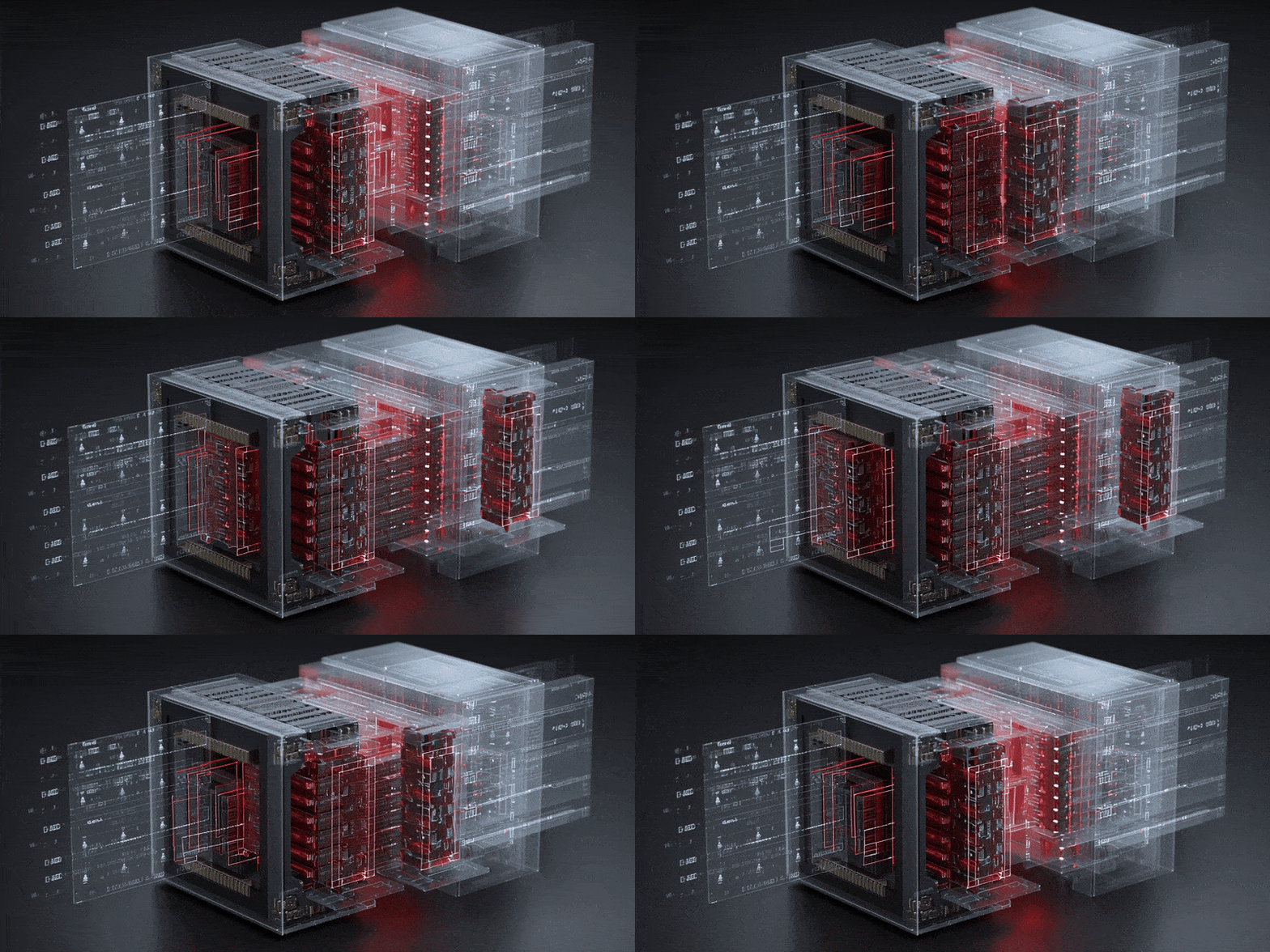
IP-RESTRICTED COMPONENT
WCF-1: Wireless Communications Fix One — Internal Governance Logic (Sealed Module)
(All Operators, Thresholds, Vectors, Weight Matrices, and Transition Functions Redacted)
This section defines the sealed mathematical and algorithmic structures that govern all internal WCF-1 decision-making, veto authority, exposure adjudication, transmission gating, PHM harm computation, NashMark enforcement, and Sentinel-based Markov transitions. These mechanics constitute proprietary IP and are not publicly disclosed.
Only the public mathematical shell (Sections 1–4) is released for doctrinal and regulatory transparency. All internal thresholds, gating matrices, penalty cascades, veto mechanisms, and drift-correction operators remain private and executable exclusively through the WCF-1 Compliance API.
5.1 Sentinel Veto Logic (Redacted)
Defines the internal functions through which ecological inputs: $ E_t = \{ \rho_b, \rho_i, \sigma_f, \chi_d, \Lambda_x \} $ are translated into:
- real-time beam shaping
- proximity veto
- duty-cycle collapse
- emergency shutdown
- state lockout
All threshold values, fusion kernels, spectral classifiers, and veto-activation rules are redacted.
5.2 Markov Transition Matrix (Redacted)
Transition probabilities $ P(s_{t+1} \mid s_t) $ are governed by Sentinel-weighted ecological classifiers, dynamic harm-weight derivatives, accumulated drift, and exposure gradients.
All transition matrices, weighting tensors, decay functions, and update rules remain sealed.
5.3 PHM Internal Harm Tensor (Redacted)
The public shell exposes the outer form:
$ \Delta\Omega_t = \alpha L_t + \gamma X_t + \zeta M_t $
The internal implementation includes:
- nonlinear harm-surface functions
- ecological risk surfaces
- biological response coefficients
- adaptive variance suppression
- cumulative drift factors
All PHM tensor parameters and ecological-weight transforms are redacted.
5.4 NashMark Enforcement Engine (Redacted)
Internal NashMark enforcement includes:
- utility curvature corrections
- vulnerability amplification weights
- ethical suppression factors
- adversarial load safeguards
- multi-agent equilibrium locks
The public expression remains:
$ \max \sum_i w_i \log(U_i - U_i^0) $
All weight derivations and internal restraint operators remain sealed.
5.5 Breach Cascade Engine (BCE) — Enforcement Multipliers (Redacted)
BCE computes escalation paths for:
- biological breach
- exposure breach
- drift breach
- PHM breach
- reciprocity breach
All penalty multipliers, cascade thresholds, and lock states are proprietary. All escalation matrices remain redacted.
5.6 Equilibrium Enforcement Engine (EEE) — Recovery Operators (Redacted)
Defines recovery, rollback, and stabilisation logic invoked when:
$ \text{Eq}(\mathcal{S}) = \Sigma(\Delta c - \Delta\Omega) < 0 $
Recovery logic determines:
- permissible restoration path
- required harm correction
- communication freeze windows
- ecological rest intervals
All internal operators and heuristics remain redacted.
5.7 Compliance API Binding Rules (Public Reference Only)
All sealed logic is executed through the WCF-1 Compliance API. Operators interact only with:
- /sentinel/event
- /transmission/permission
- /exposure/check
- /harm/score
- /state/transition
- /equilibrium/status
The API reveals no internal thresholds, matrices, or decision mechanisms. All governance calculations occur inside the sealed module.
5.8 IP Protection Statement
The internal WCF-1 governance logic constitutes proprietary equilibrium-regulation technology authored by the Originator. No operator, regulator, government, or third party is permitted to:
- view
- derive
- reverse-engineer
- estimate
- approximate
- simulate
any internal governing functions of Sentinel, PHM, NashMark, BCE, or EEE without explicit licence.
All telecommunications infrastructures must route governance decisions through the official WCF-1 Compliance API.
This section is sealed.