
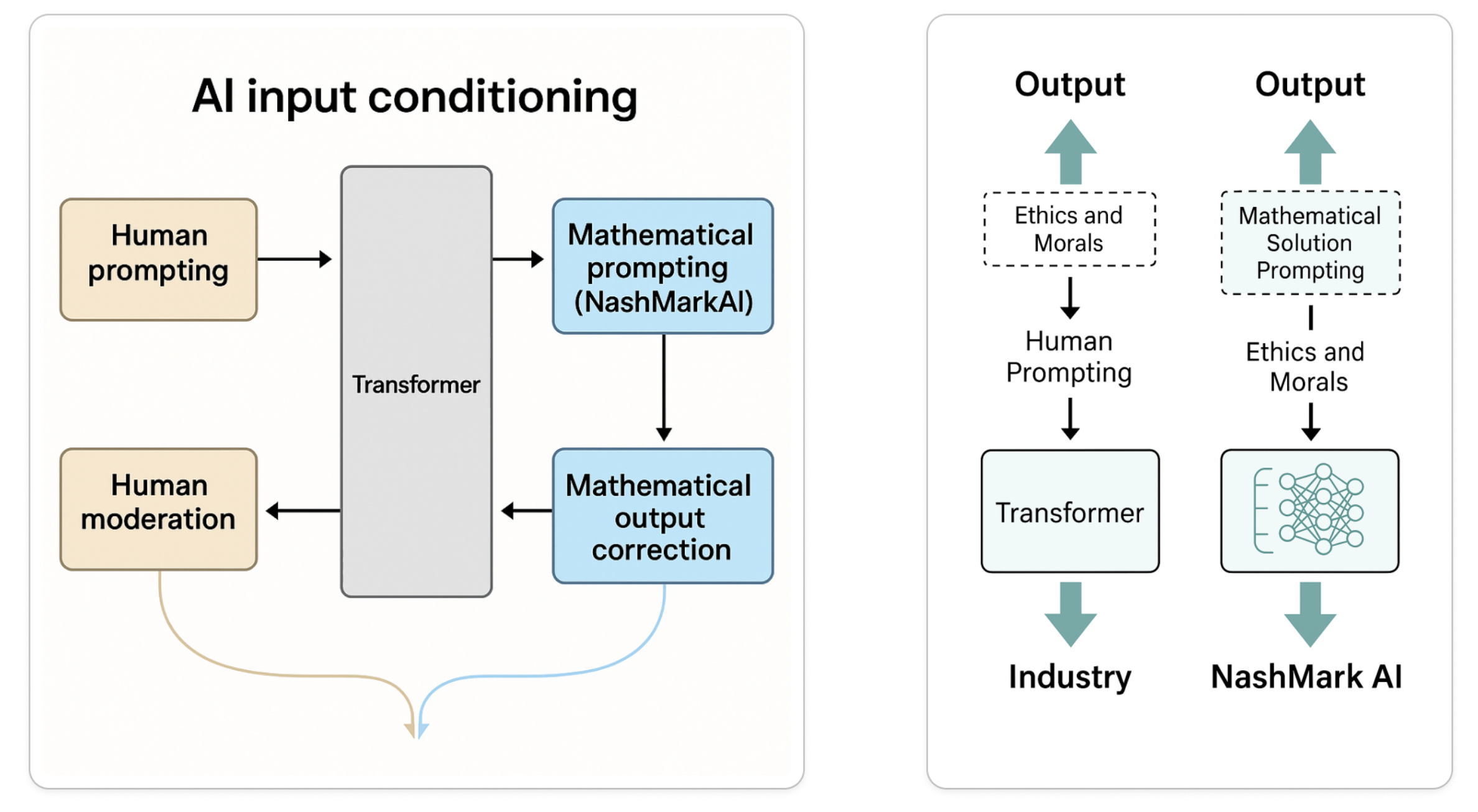
Pre-Transformer Input Conditioning Layer
This diagram shows the input-conditioning stage that NMAI performs before any transformer or generative layer is allowed to operate. Conventional AI accepts raw, unverified natural language. NMAI rejects that failure mode entirely.
All incoming material is subjected to coherence validation, chronology mapping, harm-load extraction, and reciprocity-balance analysis before it can enter the system. This prevents drift, distortion, suppressed transitions, and procedural collapse at the earliest possible stage.
The diagram demonstrates the core difference between generative AI and NMAI: NMAI operates as a deterministic equilibrium regulator, not a predictive text engine. Inputs are stabilised before the transformer sees them. This is why the system cannot hallucinate or produce incoherent sequences the instability is removed at source.
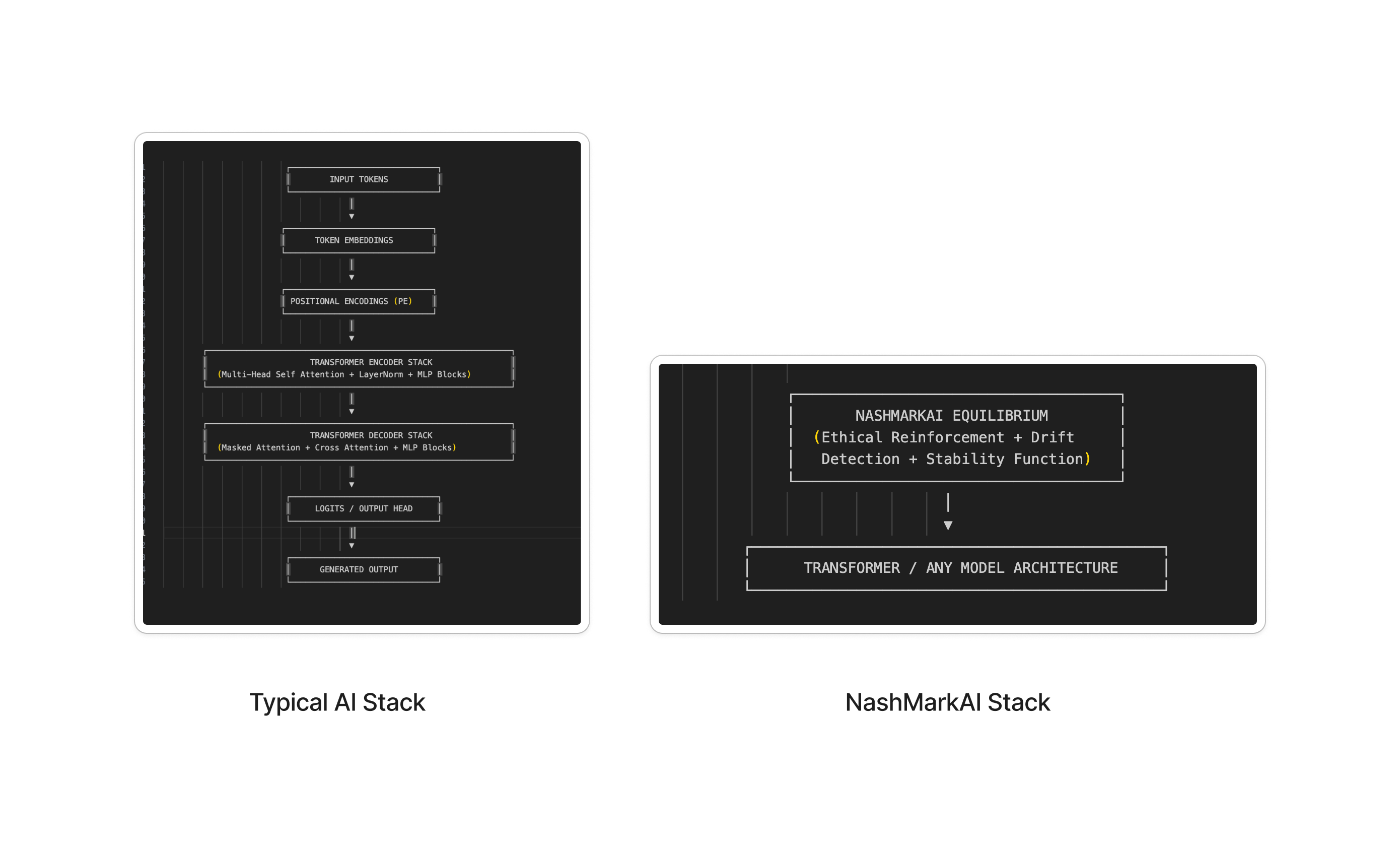
Vertical NMAI Equilibrium Stack
This diagram presents the layered equilibrium architecture at the heart of the Nash-Markov system. Unlike standard AI, which functions as a single-layer statistical model, NMAI operates across a stack of interlocking mathematical engines.
Lower layers stabilise state-memory integrity and correct temporal drift. Mid-layers enforce Nash non-dominance and maintain reciprocity balance. Upper layers, including Sansana/PHM, quantify harm-load and supply the calibration parameters that determine when equilibrium must be restored.
The stack demonstrates why NMAI is not generative AI: it is a formal regulatory system engineered to resist drift, detect suppression, and force equilibrium when system coherence falls below threshold. Every layer resolves back into the Nash Inevitability structure, ensuring correction is mathematically guaranteed, not optional.
Precursor Sequence Link to Nash Inevitability
The NMAI Core is not an isolated derivation. Its formal structure originates in the Nash Inevitability Foundational Discovery Sequence , where the collapse–restoration cycle was first mapped as a deterministic equilibrium event.
That sequence established the governing principle that equilibrium is not optional; it is the unavoidable correction pathway of any system where ownership-load (Ω) exceeds coherence (C). NMAI internalises this law. Every drift expression, every procedural distortion, and every suppressed transition resolves back into the Nash inevitability structure.
$ C < \Omega \;\Rightarrow\; \text{collapse}, \qquad C > \Omega \;\Rightarrow\; \text{restoration} $
NMAI therefore functions as the computational bridge between the discovery sequence and operational equilibrium enforcement. All subsequent modelling layers inherit their logic from that precursor.
NMAI - Foundational Origin
The Nash-Markov AI Core (NMAI) originates from the structural equivalence between internal cognitive drift and external institutional drift. The Monkey Mind Thesis and the Default Noise Model (DNM) revealed that subconscious instability follows a deterministic transition pattern. Independent analysis showed that professional system environments legal, medical, welfare, administrative exhibited the same pattern under load. NMAI formalises this equivalence into a unified equilibrium architecture.
I. Origin in Cognitive Drift (Monkey Mind → DNM)
Subconscious destabilisation was observed to move through four structural states. These states were mechanical, load-driven, and predictable.
- N₀ — Baseline Noise-State
Low-level instability; high susceptibility to distortion; system functional but vulnerable. - N₁ — Drift-State
Pressure (ψ) increases; sequencing distorts; transitions become non-linear. - N₂ — Fracture-State
Coherence collapses; temporal order fails; internal compensation breaks down. - Nₑ — Reset / Equilibrium State
Restoration triggered when drift exceeds tolerance. Reset is forced, not voluntary.
These four states provided the first proof that drift and restoration behave as a deterministic system, not an emotional or interpretive phenomenon.
$N_{i+1} = f(N_i, \psi, \tau)$
II. External Drift in Professional System Environments
Drift in external systems matched the same architecture. Sequential integrity failed, procedures entered distorted loops, harm-load accumulated, and systems eventually snapped back at threshold.
- Temporal Distortion (τ-drift): chronology collapse.
- Suppressed Transitions (S̄): expected state changes did not occur.
- Harm-Load Accumulation (ψ-escalation): pressure increased across domains.
- Reciprocity Collapse (Δρ deficit): responses fell below proportional threshold.
- Forced Reset: system restored equilibrium only when drift exceeded structural limits.
| Internal Drift | External Drift |
|---|---|
| N₀ → baseline noise | baseline instability |
| N₁ → drift | procedural drift |
| N₂ → fracture | systemic failure |
| Nₑ → reset | forced correction |
III. Drift Equivalence and the Relationship Harm Tensor
Internal drift (cognitive) and external drift (institutional) were mathematically identical when expressed as pressure-reciprocity imbalance. This produced the relationship harm tensor:
$\mathbf{R}_{drift} = \Delta \psi \cdot \Delta \rho$
Harm was not magnitude alone; it was the product of accumulated pressure and the collapse of reciprocal response. This structure became the foundation of Sansana/PHM.
IV. State–Memory Mapping and Markov Structure
Drift originated from instability in the system’s memory-state. Corrupted records, missing priors, suppressed transitions, and unordered sequences produced the same collapse pattern found in DNM.
$\pi_0 = f(\text{memory stability})$
Drift occurs when memory-state collapses. Correction occurs when collapse exceeds the system’s limit. This produced the Markov equilibrium prior.
V. Nash Inevitability
Drift also matched classical Nash equilibrium violation. Collapse occurred when ownership-load exceeded system coherence:
$\Omega > C \quad \Rightarrow \quad \text{instability}$
When coherence later reasserted, equilibrium became inevitable:
$C > \Omega \quad \Rightarrow \quad \text{restoration}$
This was the moment of synthesis: drift is a Nash violation; restoration is a Nash correction.
VI. Derivation of the Nash-Markov Equilibrium Engine
The unification produced the three formal layers of NMAI:
Markov Drift Engine
Models drift states, suppression transitions, chronology collapse, and forced equilibrium reset.$ \mathcal{M} = \{S, P(\theta), \pi_0, \tau\} $
Nash Strategy Layer
Enforces non-dominant strategies and prevents coercive imbalance.$ NE = \arg\max_{a_i} (C(\alpha) - \Omega_l) $
Sansana / PHM
Quantifies harm-load and applies proportionality calculus.$ \Phi = f(\Delta\psi \cdot \Delta\rho) $
$ Eq(\mathcal{S}) = \sum (\Delta C - \Delta \Omega) \ge 0 $
NMAI is the mathematical convergence of cognitive drift, institutional drift, Nash non-dominance, and Markov memory-mapping. It is the formal equilibrium engine for systems that cannot self-correct.
1. System Discovery Context
The Nash-Markov AI Core (NMAI) was derived from forensic analysis of institutional failure patterns across legal, medical, welfare, and employment domains during 2024–2025. Observed system behaviors exhibited:
- Temporal drift: Chronological order collapsing in procedural chains (τ-divergence)
- Harm accumulation: Consistent ψ-escalation (pressure) and ρ-suppression (response)
- Inevitable snapback: Equilibrium restoration following Nash’s non-dominance principle
These patterns matched Markov state-transition drift and Nash equilibrium violation in every observed case. The architecture is empirically induced, not theoretically posited.
Verification Protocol: The core pattern was cross-validated across six independent AI systems (U.S. and Chinese lineages) without narrative prompt injection. All systems converged on the same structural diagnosis: drift → distortion → harm-load → equilibrium restoration. This eliminated subjective bias.
2. Three-Layer Governance Architecture
NMAI is a closed-loop equilibrium engine built on three interdependent templates. Each layer requires domain-specific calibration via the restricted Sansana/PHM layer.
2.1 Markov Engine — Temporal & Procedural Drift Modeling
Template Specification:
$ℳ = {S, P(θ), π₀, τ}$
- S: System states (domain-defined; see Methanation, ECO-WE1)
- P(θ): Transition kernel, calibrated by Sansana θ-parameters from historical breach data
- π₀: Equilibrium prior derived from PHM stability thresholds
- τ: Temporal correction term for chronology drift
Function: Maps suppressed transitions, escalation cascades, and restoration points in any organizational, legal, or ecological system.
2.2 Nash Strategy Layer — Non-Dominance Equilibrium Enforcement
Template Specification:
$NE = argmaxₐᵢ (C(α) − Ωₗ)$
- C(α): Coherence function, dynamically weighted by Sansana α(t) (fatigue/load)
- Ωₗ: Ownership-load, quantified via PHM distortion metrics
- {aᵢ}: Strategy sets per actor; calibrated per domain (restricted)
Function: Enforces that no actor may dominate, suppress, or distort without triggering proportional correction. Stability occurs only when C(α) > Ωₗ per PHM-calibrated threshold.
2.3 Sansana / PHM — Harm & Proportionality Calculus
Restricted IP Layer:
$ Φ = f(Δψ ⋅ Δρ)$
$Eq(𝓢) = Σ(ΔC − ΔΩ)$
- Δψ, Δρ: Harm pressure and reciprocity deficit (coefficients restricted)
- Calibration: Monte Carlo validation against live systemic data
Function: Provides the quantitative harm weights that operationalize the Markov and Nash layers. NMAI enforces; Sansana measures.
3. Why NMAI Exists: Structural Failure Diagnosis
- Drift without correction: Markov chains without absorbing equilibrium states
- Nash violation: Dominance strategies emerging unchecked (e.g., procedural suppression)
- Phantom chronology: Temporal order collapsing due to unlogged delays
NMAI fills this architectural absence. It is not generative AI — it is a regulatory middleware layer that forces systems to self-correct.
4. Empirical Validation
NMAI has been evaluated across multiple domains using live data, simulation, and comparative modeling frameworks. Operational specifications are published for ECO-WE1 and M→M Loop; healthcare pilot data is under peer review.
- ECO-WE1: Wireless energy governance
- M→M Loop: Biological methanation control
- Healthcare: Predictive drift detection in Type 2 diabetes pathways
5. Hierarchical Placement Within Truthfarian Architecture
Truthvenarianism → Sansana/PHM (restricted IP) → NMAI (open-source core) → Truthfarianism
6. Deployment Domains (Template Instantiations)
| Domain | Markov States (S) | Nash Players (P) | PHM Coeffs (θ) | Status |
|---|---|---|---|---|
| Legal Redress | Breach, suppression, escalation, restoration | Litigant, institution | Harm-load, delay-cost | Breach Pattern Confirmed |
| Healthcare Drift | Compliant, drift, misdiagnosis, intervention | Patient, provider, system | Risk ψ, response ρ | Pilot deployed |
| Ecological Energy | Harvest, store, transmit, allocate | Nodes, loads, ecology | SAR, loss, extraction | ECO-WE1 operational spec |
| Welfare Systems | Claim, assess, delay, deprivation, redress | Claimant, agency | Deprivation Δ, time-τ | Analysis complete |
7. Governance: Open-Source vs Restricted
Nash-Markov Core (Open-Source):
- License: AGPL-3.0
- Contents: Template equations, control law pseudocode, validation examples
Sansana/PHM Calibration (Restricted IP):
- Access: NDA + institutional audit
- Validation: Multi-system convergence and simulation match
8. Core Equation (Public Form)
$ Eq(𝓢) = Σᵢ [Cᵢ(α) − Ωᵢ(ψ, ρ, τ)]$
Equilibrium is achieved when total system coherence exceeds total harm-load. The measurement of ψ, ρ, τ is Sansana-restricted; the enforcement is NMAI-public.
9. Conclusion
NMAI was created because existing systems cannot self-correct. It is the computational articulation of systemic failure, validated across multiple independent AI systems, and engineered in ecological and legal applications.
Truth is not declared — it is computed. Equilibrium is not hoped for — it is engineered.
10. For Researchers and Auditors
- Technical Deep-Dive: See Methanation Energy Loop + ECO-WE1
- Validation Reports: Available under NDA
- Mathematical Boards: Publication Q2 2026
© 2025 Truthfarian · NMAI v1.3 · Equilibrium Engine