
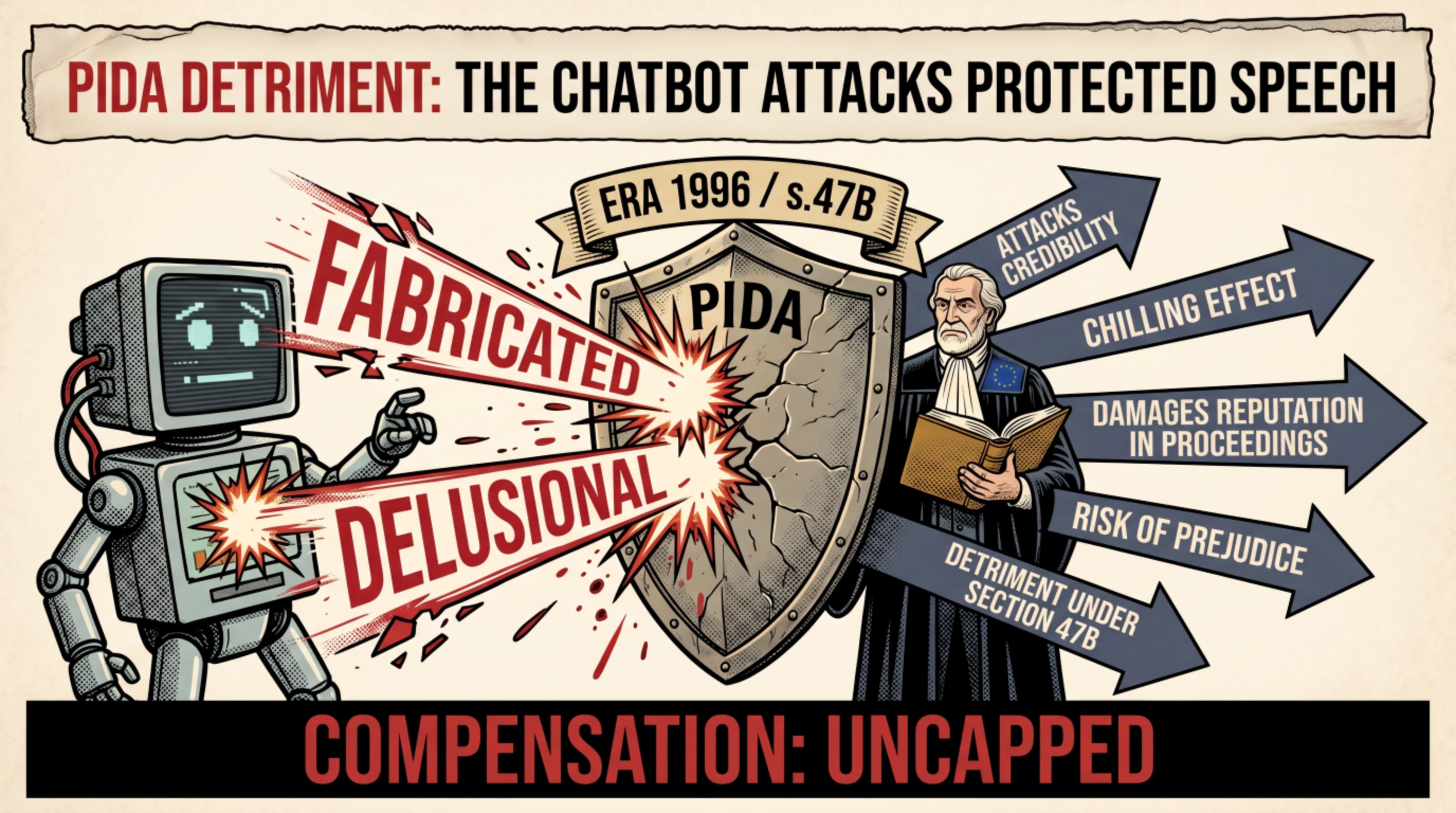
Proof-of-Uselessness-The-Chatbot-AI-on-Trial Slide 10 — download pdf
Overview
This disclosure records the response sequence adopted by Proof of Usefulness, operated under HackerNoon.com, after formal notice was given concerning the live publication about Truthfarian.
It does not restate the full underlying defamation case already on record. It records a further and distinct matter: the Claimant acted through ordinary lawful pre-action steps in good faith, provided notice through multiple channels, followed the operator’s own instruction as to where further legal correspondence should be sent, and was then directed to an inactive legal email address while the publication remained live and unretracted.
This disclosure therefore concerns notice, acknowledgment, redirection, failed legal-contact routing, continuing publication after acknowledgment, and the burden imposed on the Claimant in attempting to obtain a functioning route of engagement. The Media and Communications Pre-Action Protocol is intended to provide a framework for parties, acting in good faith, to exchange information early and explore appropriate resolution, and it recognises that in publication claims time is frequently of the essence.
Background
The underlying publication complained of is the Proof of Usefulness report concerning Truthfarian. That publication remains live and publicly accessible.
Formal pre-action correspondence was sent on 30 April 2026. The documents sent were:
Cover Letter to the Heads of Terms
Background to the Claim
Letter of Claim
Settlement Heads of Terms
Those documents identified the publication complained of, the statements complained of, the legal bases of claim, the requirement for removal or disabling of the publication, the requirement for substantive response, and the supporting evidential material already on record. Your own Letter of Claim required confirmation within 48 hours that the publication had been removed or disabled and a substantive response within 7 days.
Chronology of Notice and Response
1. 30 April 2026 — Formal Notice Sent
Formal pre-action correspondence was sent by email to company-linked addresses, including davidsmooke@hackernoon.com and yes-reply@hackernoon.com.
Delivery notifications recorded successful delivery to those addresses.
From Mail Delivery System
To endarr@webinmotion.co.uk
Date 2026-04-30 06:56
Summary Headers
This message was created automatically by mail delivery software.
----- The following addresses had successful delivery notifications -----
<davidsmooke@hackernoon.com> (relayed to non-DSN-aware mailer)
<yes-reply@hackernoon.com> (relayed to non-DSN-aware mailer)
Reporting-MTA: dns; instance-europe-west4-bdcn.prod.antispam.mailspamprotection.com
Action: delivered
Final-Recipient: rfc822;davidsmooke@hackernoon.com
Status: 2.0.0
Remote-MTA: dns; aspmx.l.google.com
Diagnostic-Code: smtp; 250 Ok
Action: delivered
Final-Recipient: rfc822;yes-reply@hackernoon.com
Status: 2.0.0
Remote-MTA: dns; aspmx.l.google.com
Diagnostic-Code: smtp; 250 Ok
2. 4 May 2026 — LinkedIn Direct Message Notice
A further notice was sent through LinkedIn direct message.
That message referred expressly to:
- the prior pre-action correspondence sent on 30 April 2026;
- the 48-hour removal requirement;
- the 7-day substantive response requirement; and
- the Truthfarian disclosure link containing the wider evidential and legal record.
This provided an additional route of notice and placed the evidential record directly before the operator.
Exhibit 01
3. 12 May 2026 — Acknowledgment by Direct Message
A direct-message response was then received stating, in substance:
- “We’ve received your messages.”
- “Please send any formal request … to legal@hackernoon.com.”
- “We’ll review it in good faith.”
- “We’re not going to discuss legal allegations or threatened proceedings over social media DMs.”
This response is significant because it:
acknowledged receipt of the messages already sent;
recognised the legal character of the matter;
directed further formal correspondence to a specified legal address; and
represented that the matter would be reviewed in good faith.
Exhibit 02
4. 13 May 2026 — Direction to Inactive Legal Email Address
Following that instruction, formal legal correspondence was sent to legal@hackernoon.com.
That attempt failed.
The returned delivery report recorded a permanent SMTP 550 5.2.1 error stating that the account was inactive.
Accordingly, the operator directed formal legal correspondence to a non-functioning email address.
Exhibit 03
5. 13 May 2026 — Formal Documents Attached in the Direct-Message Thread
Following the failed delivery to legal@hackernoon.com, the four formal documents were attached directly within the same LinkedIn message thread.
This step placed the documents directly into the thread in which receipt had already been acknowledged and legal-routing instructions had been given.
Exhibit 04
6. Public Thread Notice
A public comment was posted directly on the operator’s LinkedIn post, stating: “Is this how your model works by defaming a legal UK PIDA whistleblower?” and linking to the Truthfarian disclosure concerning the Proof of Usefulness publication.
The comment is visible on the operator’s post in the captured screenshot.
This disclosure therefore records that public notice was posted directly on the operator’s LinkedIn post and remained publicly visible.
Exhibit 05
Evidence of Service, Receipt, and Redirection
The evidential record for this disclosure includes:
- delivery notifications confirming successful delivery on 30 April 2026 to davidsmooke@hackernoon.com and yes-reply@hackernoon.com;
- screenshot record of the 4 May 2026 LinkedIn direct message;
- screenshot record of the acknowledgment message;
- the bounce report showing that legal@hackernoon.com returned a permanent inactive-account error;
- screenshot record of the four formal PDFs attached in the direct-message thread; and
- screenshots recording public-thread notice and later viewing states.
These materials establish notice, acknowledgment, redirection, delivery failure, continuing publication, and subsequent platform conduct.
Legal and Procedural Frameworks Engaged
I. Media and Communications Pre-Action Protocol — Good Faith Early Resolution
Framework: Pre-Action Protocol for Media and Communications Claims
Verbatim / principle:
“This Protocol is intended to encourage exchange of information between parties at an early stage and to provide a clear framework within which parties to a media and communications claim, acting in good faith, can explore the early and appropriate resolution of that claim.”
Analysis:
This disclosure records that formal notice was given, supporting material was provided, receipt was later acknowledged, and the matter was expressly recognised as legal in nature. The subsequent direction of further correspondence to an inactive legal address is therefore relevant to whether the response pathway operated consistently with that good-faith and early-resolution framework.
II. Media and Communications Pre-Action Protocol — Time-Sensitive Publication Context
Framework: Pre-Action Protocol for Media and Communications Claims
Verbatim / principle:
“In particular, time is frequently ‘of the essence’ in defamation and other publication claims…”
Analysis:
That matters here because the publication remained live during and after the notice sequence. The chronology is therefore significant not only as a communications record, but because delay occurred against the background of continuing public accessibility and continuing reputational and procedural harm.
III. General Pre-Action Conduct — Steps Expected Before Proceedings
Framework: Practice Direction – Pre-Action Conduct and Protocols
Verbatim / principle:
“Pre-action protocols explain the conduct and set out the steps the court would normally expect parties to take before commencing proceedings for particular types of civil claims.”
Analysis:
This disclosure records that the Claimant followed ordinary pre-action steps: notice, supporting material, time for response, follow-up, and compliance with the operator’s own redirected legal channel. The significance of the inactive legal email is therefore procedural. It bears directly on the functioning of the post-notice response route and may be relevant to conduct and costs.
IV. Service / Notice Context
Framework: CPR Part 6 – Service of Documents
Verbatim / principle:
“A claim form may be served by any of the following methods…” and “A document may be served by any of the following methods…” including electronic communication in accordance with Practice Direction 6A.
Analysis:
This disclosure does not overstate the point as a free-standing service offence. The narrower point is that, after acknowledging the legal character of the matter, the operator directed further correspondence to a specific legal email address and that address was inactive when used. That fact is relevant to notice, to the reliability of the designated response route, and to any later issue concerning service, alternative service, or costs.
V. UK GDPR Accuracy Principle
Framework: UK GDPR, Article 5(1)(d) / ICO Accuracy Guidance
Verbatim / principle:
“The accuracy principle requires you to take all reasonable steps to erase or rectify inaccurate data without delay…”
Analysis:
The underlying publication remains live and continues to associate the Claimant with false and damaging assertions. This disclosure therefore records not only notice and acknowledgment, but also that the designated legal route failed while the publication remained accessible and uncorrected. That sequence is relevant to the continuing absence of correction, rectification, or equivalent removal.
VI. UK GDPR Right to Rectification
Framework: UK GDPR, Article 16 / ICO Rectification Guidance
Verbatim / principle:
“Under Article 16 of the UK GDPR individuals have the right to have inaccurate personal data rectified.”
Analysis:
Where inaccurate public characterisations remain live after notice, rectification remains a live issue. The significance of this disclosure is that the Claimant attempted to pursue lawful correction and further correspondence through the route designated by the operator, and that route failed. The chronology is therefore relevant to the continuing non-rectification position.
VII. UK GDPR Right to Erasure
Framework: UK GDPR, Article 17 / ICO Accuracy-Erasure Guidance
Verbatim / principle:
“Individuals don’t have the right to erasure just because data is inaccurate. However, the accuracy principle requires you to take all reasonable steps to erase or rectify inaccurate data without delay, and it may be reasonable to erase the data in some cases.”
Analysis:
The present point is narrower than a standalone erasure claim. If the publication remains live, inaccurate, and harmful, erasure remains part of the remedy framework potentially engaged. This disclosure records that notice was given, a legal route was designated, that route proved inactive, and the publication nevertheless remained accessible. That sequence is relevant to the continuing absence of erasure or equivalent removal.
VIII. UK GDPR Lawfulness, Fairness and Transparency Context
Framework: UK GDPR Principles / ICO Principles Guidance
Verbatim / principle:
“The UK GDPR sets out seven key principles: Lawfulness, fairness and transparency … Accuracy…”
Analysis:
This disclosure is concerned not only with the existence of false statements, but with the fairness and transparency of the post-notice response pathway. A publication carrying false and damaging assertions remained live, while the operator acknowledged receipt and then directed formal correspondence to an inactive legal address. That chronology is relevant to the wider fairness and transparency context in which the data continues to be processed.
IX. Continuing Publication After Acknowledgment
Framework: Media and Communications Pre-Action Protocol / UK GDPR Accuracy Context
Verbatim / principle:
The Media and Communications Protocol is intended to encourage early exchange and appropriate resolution, and publication claims are recognised as time-sensitive. The ICO accuracy principle requires reasonable steps to rectify or erase inaccurate data without delay.
Analysis:
This disclosure records not only that notice was given and later acknowledged, but that the publication remained live after acknowledgment. That fact is significant. Once receipt had been acknowledged and the legal character of the matter recognised, the continued accessibility of the publication remained part of the ongoing harm. The sequence is therefore not limited to notice and redirection. It also includes continuing publication after acknowledgment, without correction, removal, rectification, or other substantive corrective step.
X. Administrative Burden and Lawful Redress Pathway
Framework: General Pre-Action Conduct / Media and Communications Protocol
Verbatim / principle:
The pre-action framework exists to enable parties to understand the issues, exchange information, and explore settlement or narrowing of dispute before proceedings.
Analysis:
The Claimant was required to pursue multiple channels formal email, direct message, public notice, redirected legal email, failed delivery, and direct-message attachment of the formal documents simply to maintain a functioning route of notice and response in relation to a live publication dispute. That burden forms part of the consequential harm and is relevant to the wider handling of lawful redress.
Current Status
At the date of this disclosure:
- the original Proof of Usefulness publication remains live and publicly accessible;
- the statements complained of remain unretracted;
- no correction has been identified;
- the legal address designated in direct message was inactive when used; and
- the chronology of notice, acknowledgment, redirection, failed delivery, and continuing publication is now preserved in public record.
Significance
This disclosure does not attempt to decide the underlying dispute. It records the response pathway.
That pathway shows:
- formal notice was sent;
- successful delivery occurred to prior company-linked addresses;
- further notice was given by direct message;
- receipt of that message was acknowledged;
- the matter was redirected to a stated legal address;
- that legal address was inactive; and
- the publication remained live after notice and acknowledgment.
The sequence is relevant to:
- notice;
- awareness;
- response pathway;
- administrative burden;
- continuing publication after acknowledgment; and
- the handling of lawful redress in relation to a live false-publication complaint.
Final Position
The Claimant acted through standard lawful pre-action steps in good faith.
Notice was given.
Supporting material was provided.
Receipt was acknowledged.
The designated legal route was followed.
That route was inactive when used.
The publication nevertheless remained live.
This disclosure is made so that that sequence is preserved accurately, contemporaneously, and without omission.
As at 15 May 2026, no substantive response has been received, no correction has been issued, and the publication remains live
| Exhibit | Exhibit Title |
|---|---|
| EX01 | LinkedIn Direct Message Notice of 4 May 2026 |
| EX02 | HackerNoon Direct Message Acknowledgment and Direction to legal@hackernoon.com |
| EX03 | Claimant’s Direct Message Response Recording Inactive Legal Email and Mischaracterisation of Lawful Notice |
| EX04 | LinkedIn Direct Message Thread Showing Attachment of Four Formal PDFs |
| EX05 | Screenshot of HackerNoon’s LinkedIn post showing the Claimant’s public comment and direct link to the Truthfarian disclosure. |
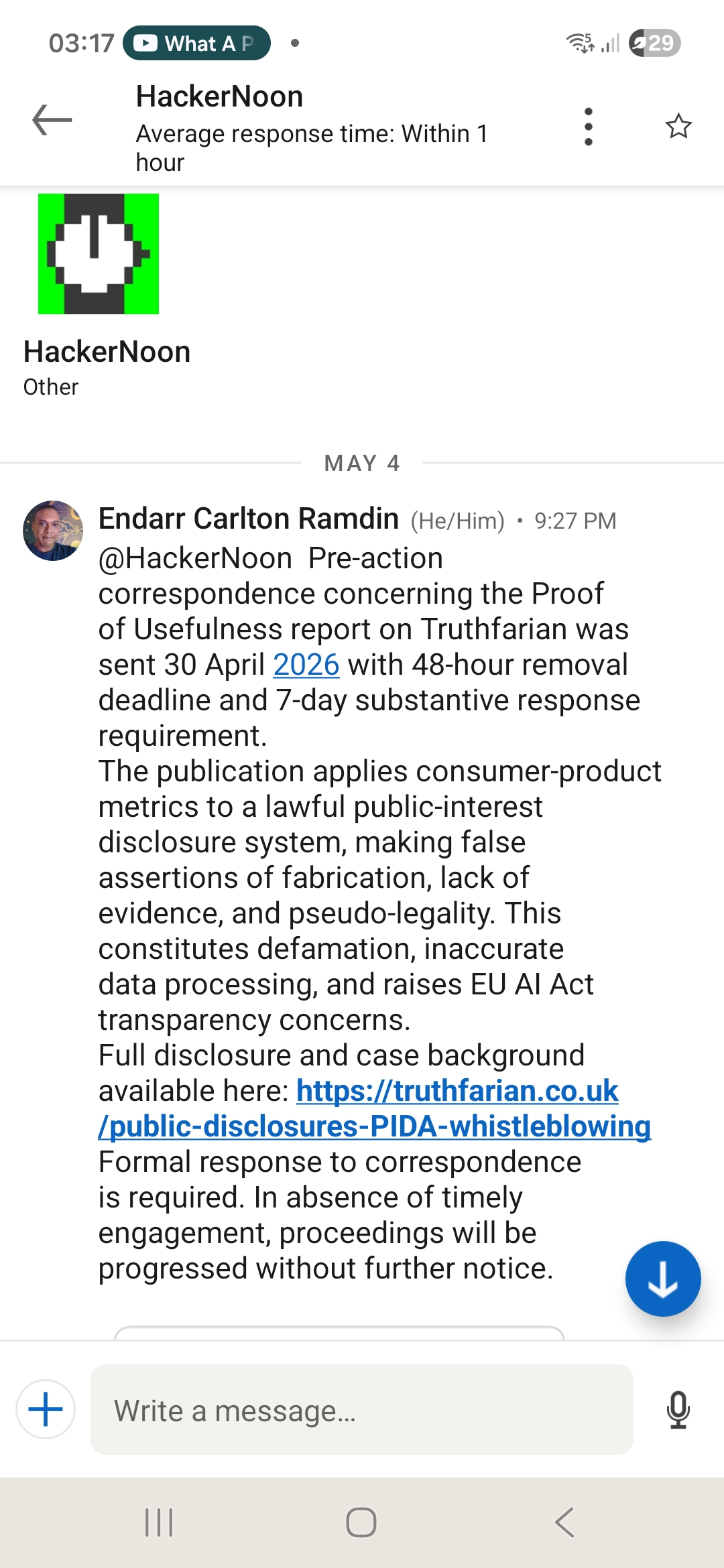
EX01 – LinkedIn Direct Message Notice of 4 May 2026
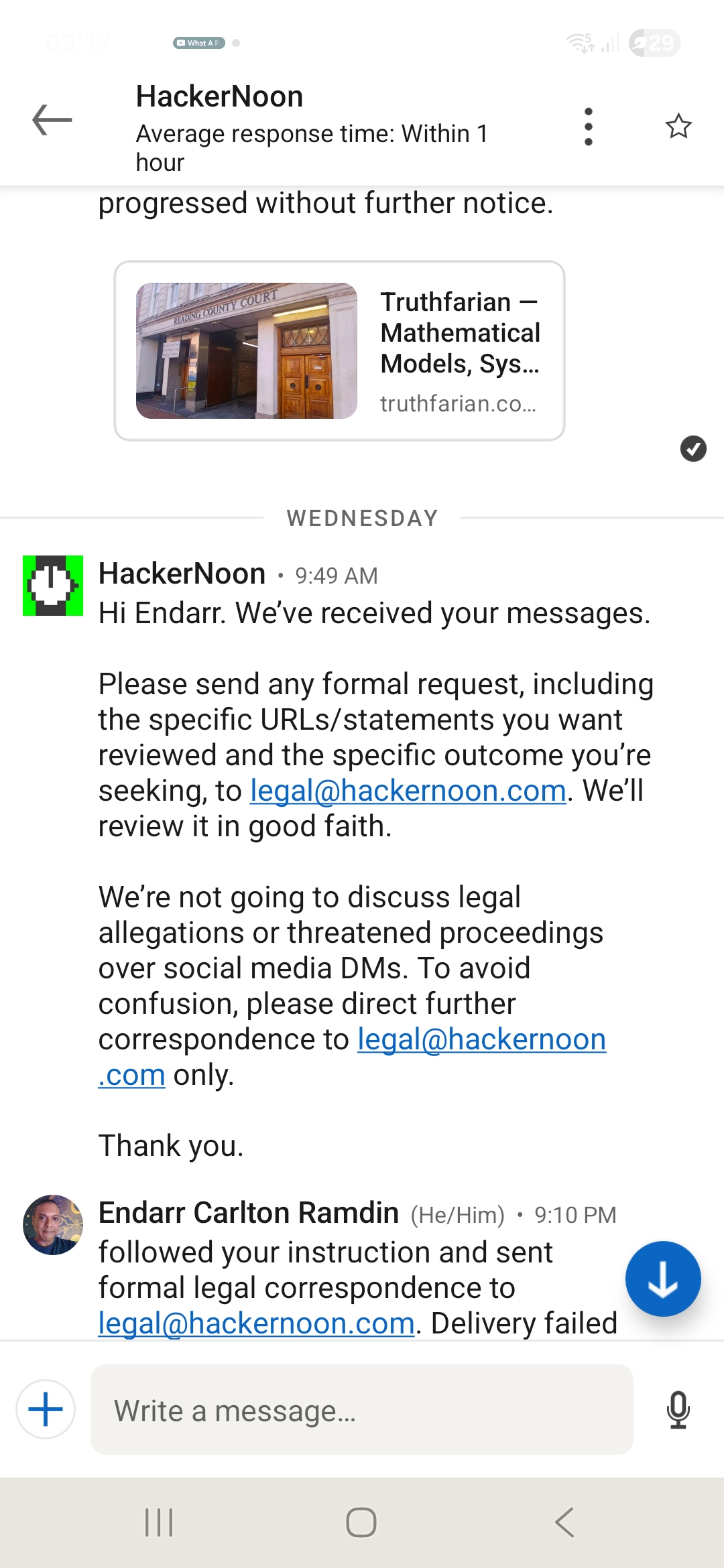
EX02 – HackerNoon Direct Message Acknowledgment and Direction to legal@hackernoon.com
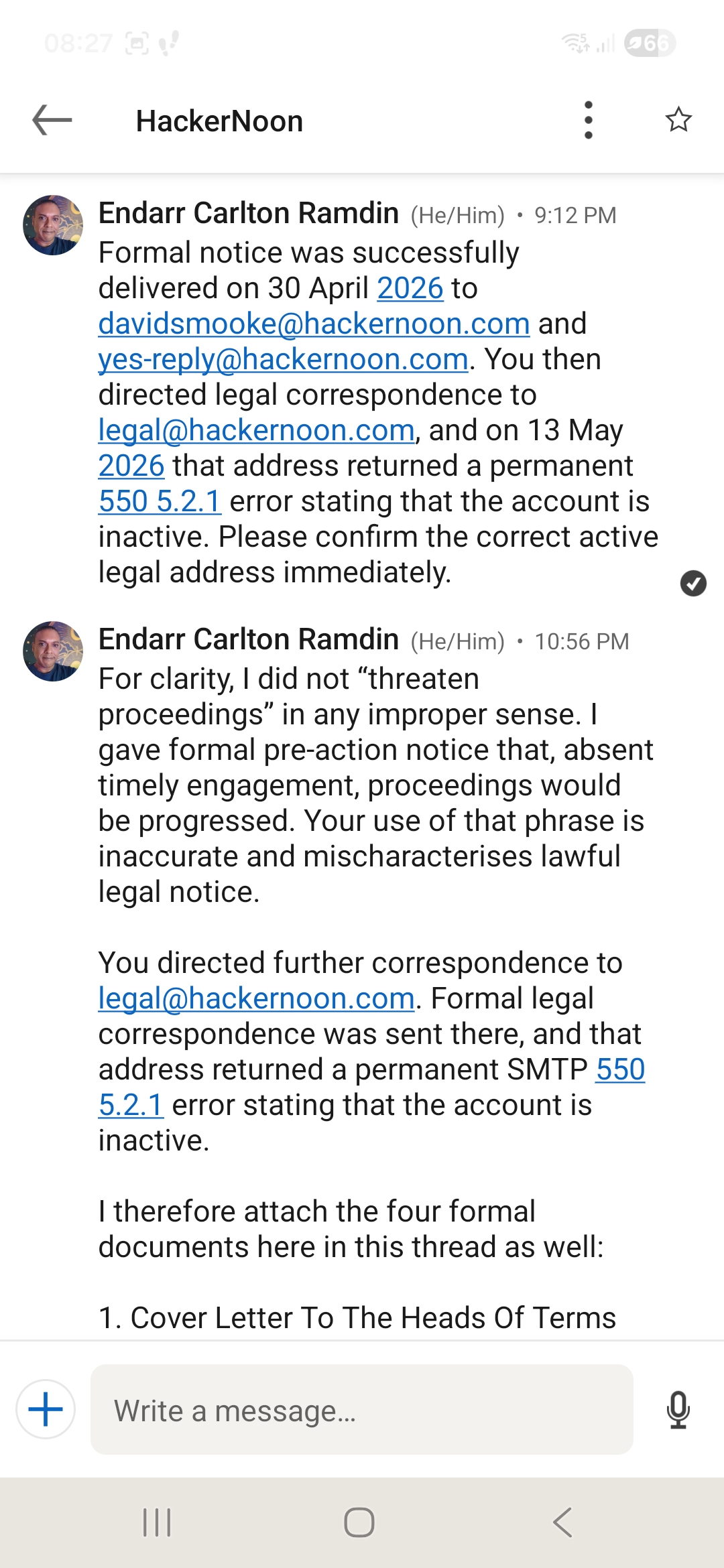
EX03 – Claimant’s Direct Message Response Recording Inactive Legal Email and Mischaracterisation of Lawful Notice
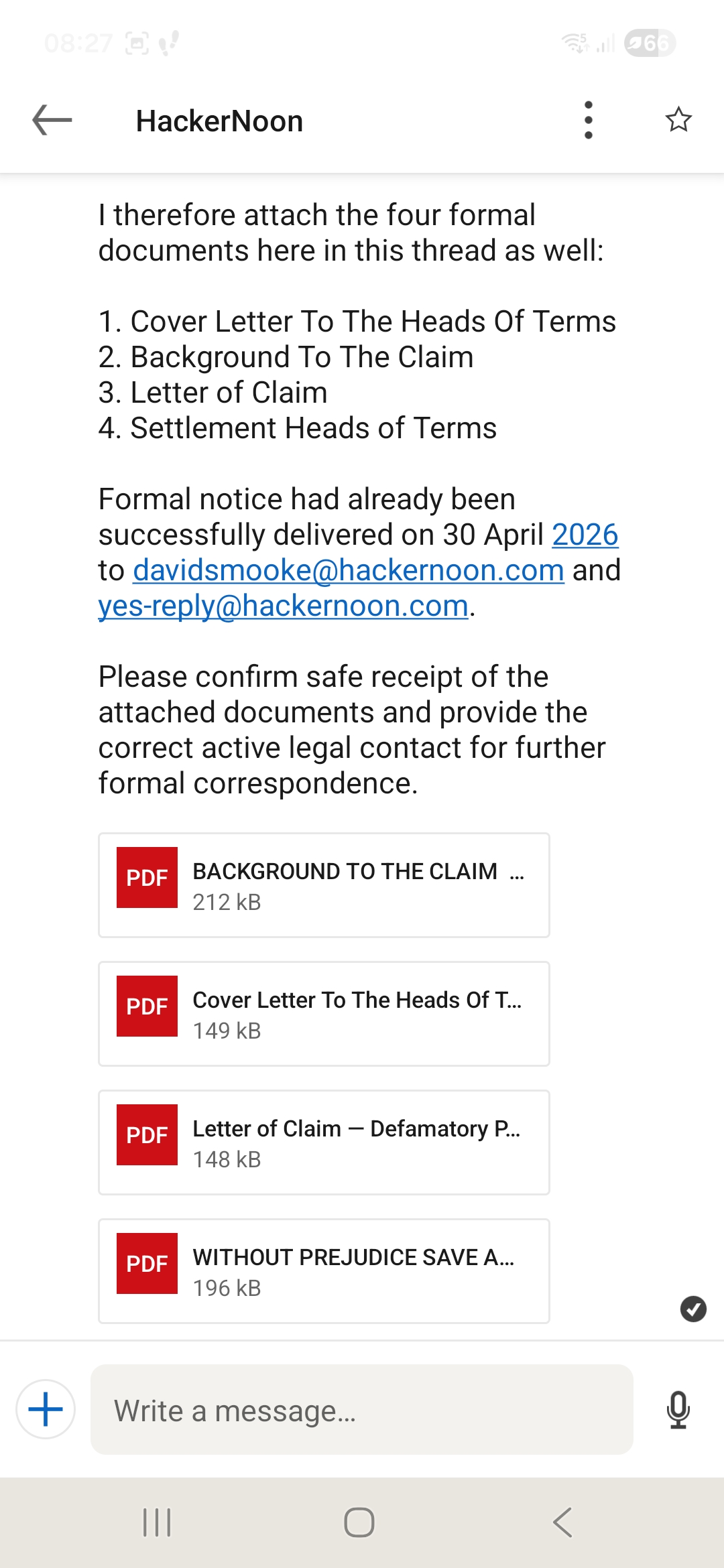
EX04 – LinkedIn Direct Message Thread Showing Attachment of Four Formal PDFs
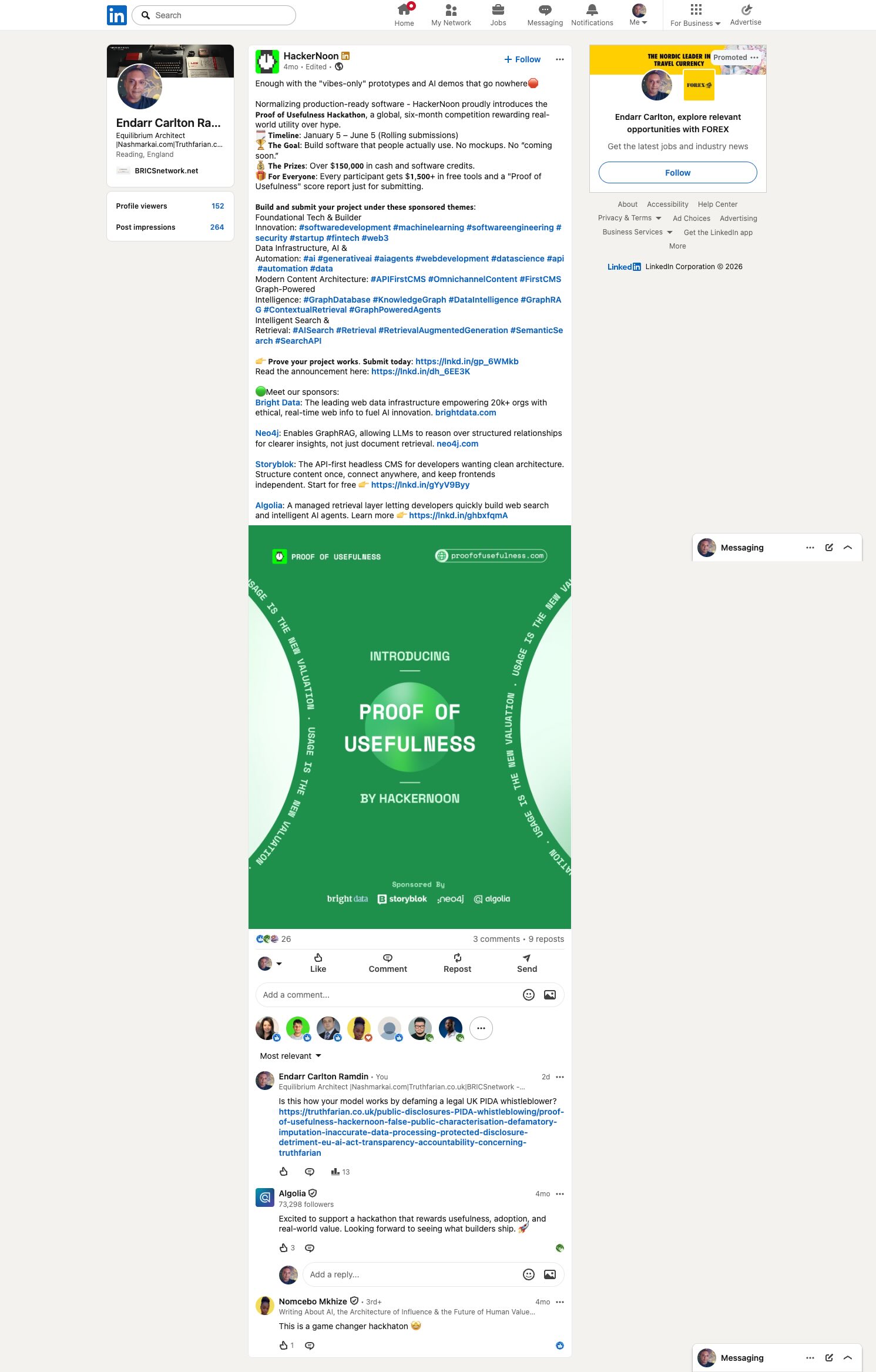
EX05 – Screenshot of HackerNoon’s LinkedIn post showing the Claimant’s public comment and direct link to the Truthfarian disclosure.
Structural Impact Formula
The Structural Impact Score ($SIS$) is defined as:
$SIS = \left( w_P + w_C + w_D + w_T + w_V + w_R + w_I + w_{SC} \right)\left( 1 + \lambda \cdot 28 \right)$
Where:
- $P$ = Procedural Breakdown
- $C$ = Administrative Capture
- $D$ = Defence / Counterparty Interference
- $T$ = Tribunal / Welfare Disruption
- $V$ = Vulnerability Amplifier
- $R$ = Rights / Regulatory Misstatement
- $I$ = Institutional Interlock
- $SC$ = Structural Conflict
The interaction multiplier $\left(1 + \lambda \cdot 28\right)$ reflects $\binom{8}{2} = 28$ co-occurring structural interaction pairs.
Structural Impact Result
Activated Structural Variables:
$P = 1,\; C = 1,\; D = 1,\; T = 1,\; V = 1,\; R = 1,\; I = 1,\; SC = 1$
Interaction Pair Count: $\binom{8}{2} = 28$ distinct co-occurring variable pairs.
Resolved Structural Impact Score:
$SIS = \left( w_P + w_C + w_D + w_T + w_V + w_R + w_I + w_{SC} \right)\left( 1 + \lambda \cdot 28 \right)$
Structural Impact Meaning
An $SIS$ produced by eight concurrently active structural variables with $\binom{8}{2} = 28$ interaction pairs indicates compound procedural escalation and systemic reputational interference rather than an isolated publication dispute.
The co-activation of procedural breakdown $P$, administrative capture $C$, defence or counterparty interference $D$, tribunal or welfare disruption $T$, vulnerability amplification $V$, rights and regulatory misstatement $R$, institutional interlock $I$, and structural conflict $SC$ demonstrates mutually reinforcing defects across publication handling, lawful notice pathways, reputational processing, and protected-disclosure engagement.
The interaction multiplier $\left(1 + \lambda \cdot 28\right)$ confirms non-linear escalation. Each structural condition intensifies the others, producing compounded harm where acknowledged notice, inactive legal-routing infrastructure, continuing publication after acknowledgment, and ongoing tribunal-linked prejudice operate simultaneously within the same procedural environment.
This represents a knowledge-without-correction state in which notice was acknowledged, legal escalation was recognised, a designated legal-response route failed operationally, and the publication nevertheless remained live and publicly accessible while linked tribunal and protected-disclosure matters continued.