
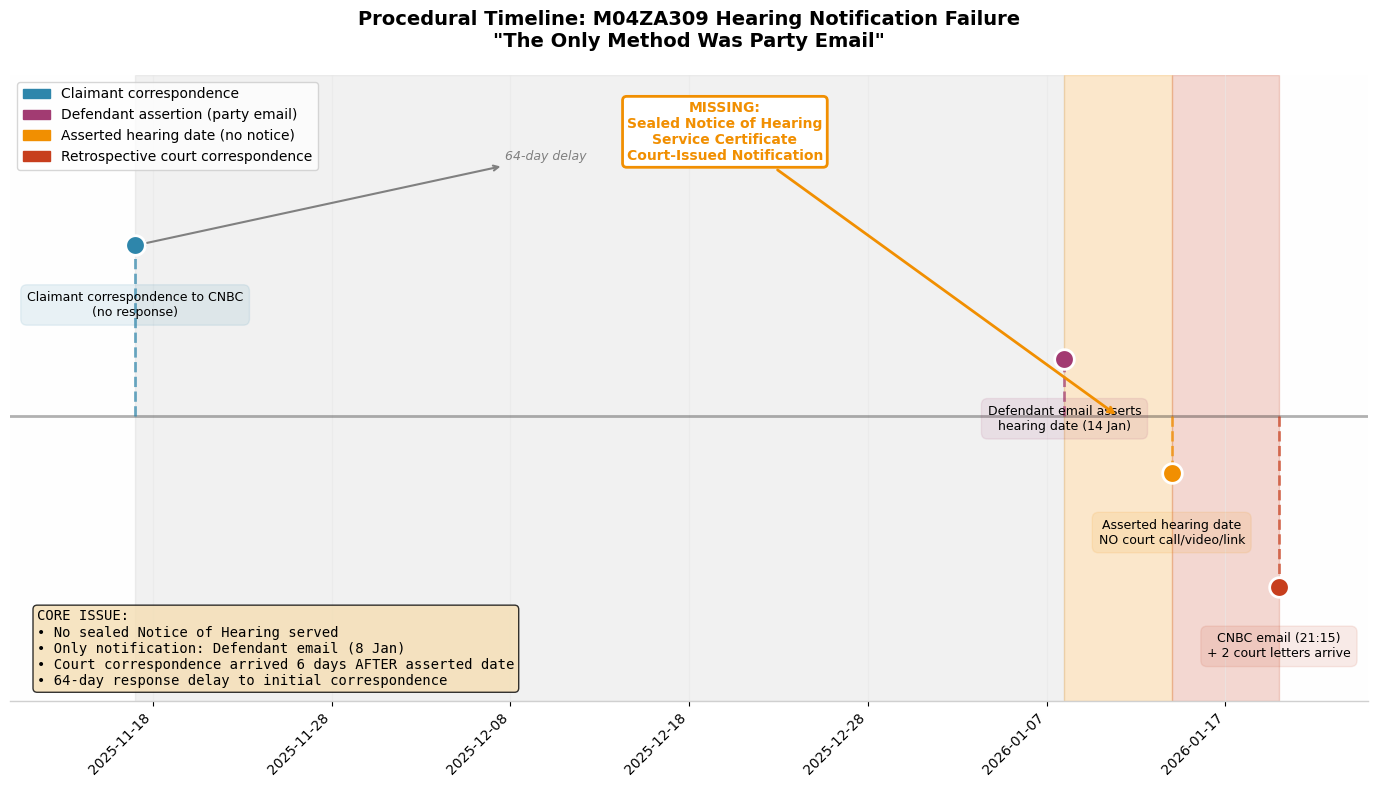
1. Overview — Introduction of a January Hearing Date by Party Email and Subsequent Retrospective Correspondence
This disclosure records how a January 2026 hearing date was introduced to the Claimant by party email, without any court-issued notice, and was then followed by retrospective administrative correspondence attempting to anchor that date after the fact.
The disclosure concerns:
- M04ZA309 — Ramdin v Gopal (Civil Claim)
- Related possession proceedings
At no point was the Claimant served with a sealed Notice of Hearing for January 2026. Despite this, a hearing date of Wednesday 14 January 2026 was communicated to the Claimant by email from the Defendant and later surrounded by delayed court correspondence.
1.a Public Court Listing Check — Absence of Hearing Record
- At the relevant time in January 2026, there was no publicly accessible court hearing listing for a hearing on 14 January 2026 in Ramdin v Gopal (M04ZA309).
- Authoritative public hearing lists for courts in England and Wales are published by HM Courts & Tribunals Service and associated services, including:
- HMCTS hearing lists collection:
- CourtServe county court listing interface:
- Searches of these publicly available platforms did not reveal any official entry corresponding to the asserted 14 January 2026 hearing date in the specified claim.
https://www.gov.uk/government/collections/hmcts-hearing-lists
https://www.courtserve.net/courtlists/current/county/indexv2county.php
The absence of any online listing on these publicly maintained services indicates that no such hearing
HMCTS hearing lists do not provide archived or date-stamped snapshots of past listings. There is therefore no publicly available historical record showing that a hearing for 14 January 2026 in Ramdin v Gopal (M04ZA309) was ever listed. In the absence of (i) any contemporaneous public listing when checked, (ii) a sealed Notice of Hearing, and (iii) proof of service on the claimant, no lawful hearing can be evidenced as having existed for that date.
2. Evidence and Chronology
2.a 17 November 2025 — Claimant Correspondence to CNBC
The Claimant sends written correspondence to the County Court Business Centre (CNBC) regarding ongoing procedural defects and case handling.
This correspondence is logged and timestamped.
No response is received at that time.
2.b 8 January 2026 — Defendant Email Asserting a Hearing Date
On 8 January 2026, the Defendant Angela Gopal sends an email to the Claimant asserting that there is a court hearing listed for Wednesday 14 January 2026.
This assertion is made solely by party email.
No court document accompanies the email.
The Claimant is not served with:
- a sealed Notice of Hearing,
- any listing confirmation,
- any service certificate,
- any telephone or video call-out notice,
- any HMCTS-issued notification.
2.c 14 January 2026 — Date Asserted, No Hearing Notified
On 14 January 2026, the Claimant receives:
- no court call,
- no video link,
- no telephone dial-in,
- no confirmation of listing.
The Claimant does not attend any hearing because no hearing has been lawfully notified.
2.d 20 January 2026, 21:15 — CNBC Email
On 20 January 2026 at 21:15, CNBC issues an email reply to the Claimant, sent outside standard court administrative hours, stating that the matter is now with Reading County Court.
This email is issued 64 days after the Claimant’s correspondence of 17 November 2025.
2.e 20 January 2026 — Two Court Letters Received
On the same date as the CNBC email, two court letters are received by post relating to the same matter.
Neither letter includes:
- a sealed Notice of Hearing for January,
- proof of service,
- confirmation that any hearing took place on 14 January.
3. Core Procedural Fact
The only method by which the date 14 January 2026 was communicated to the Claimant was party email dated 8 January 2026.
No court-issued notice preceded that email.
All subsequent correspondence arrived after the asserted date.
Procedural Timeline Table — Hearing Notification Failure (M04ZA309)
| Date | Time | Source / Method | Event / Fact Recorded |
| 17 Nov 2025 | — | Claimant correspondence (written) | Claimant sends correspondence to CNBC regarding procedural defects in M04ZA309 and related possession proceedings. |
| 17 Nov 2025 – 20 Jan 2026 | — | — | No response received from CNBC during this period. |
| 8 Jan 2026 | 15:07 | Defendant email (party communication) | Defendant Angela Gopal emails Claimant asserting a hearing listed for Wednesday 14 January 2026. |
| By 8 Jan 2026 | — | — | No sealed Notice of Hearing served on the Claimant. |
| By 8 Jan 2026 | — | — | No service certificate, no court-issued notification, no listing confirmation provided to the Claimant. |
| 14 Jan 2026 | 11:00 (asserted) | — | Date asserted by Defendant only. Claimant receives no court call, no video link, no telephone dial-in, no hearing notification. |
| 14 Jan 2026 | — | — | No hearing attended by Claimant due to absence of lawful notice. |
| 20 Jan 2026 | 21:15 | CNBC email | CNBC emails Claimant stating the matter is now with Reading County Court. Email sent outside standard court administrative hours. |
| 20 Jan 2026 | — | Postal delivery | Two court letters received relating to the same matter. |
| As at 20 Jan 2026 | — | — | Neither letter contains a sealed Notice of Hearing for January 2026. |
| As at 20 Jan 2026 | — | — | No document confirms that any hearing took place on 14 January 2026. |
| 17 Nov 2025 → 20 Jan 2026 | — | — | Total administrative delay: 64 days between Claimant correspondence and CNBC response. |
4. Evidence Table
| Ref | Date | Source / Author | Document Type | What It Evidences | Location |
| E1 | 17 Nov 2025 | Claimant → CNBC | Formal correspondence raising procedural defects and requesting clarification in live cases | Claimant email record / bundle | |
| E2 | 20 Jan 2026 (21:15) | County Court Business Centre (CNBC) | After-hours response issued weeks later; no engagement with substance; timing coincides with renewed eviction assertions | CNBC email screenshot / bundle | |
| E3 | Sept–Oct 2025 | Angela Gopal | Email(s) | Assertions that claimant must vacate and that court outcomes were settled, prior to any lawful service | Angela email extracts / bundle |
| E4 | Jan 2026 | HMCTS / Court | Letter | Letter asserting procedural position (missed hearing / status) without evidence of prior notice or service | Scanned court letter / bundle |
| E5 | Jan 2026 | HMCTS / Court | Letter | Failure to acknowledge earlier hand-delivered eviction notice and defects previously raised | Scanned court letter / bundle |
| E6 | Jan 2026 | HMCTS | Absence of Record | No sealed notice of hearing; no proof of service; no call-out record for alleged January hearing | Evidenced by absence across bundle |
5. Breaches Identified — Hearing Notification Failure (M04ZA309)
I. Failure to Serve a Sealed Notice of Hearing
No sealed Notice of Hearing was served on the Claimant for any January 2026 hearing.
II. Absence of Lawful Service
No certificate of service, proof of service, or court-issued confirmation of hearing notification exists.
III. Reliance on Party Email as Sole Notification
The only asserted notice of hearing originated from a Defendant email (8 January 2026), which is not a lawful method of court service.
IV. Procedural Misrepresentation of Hearing Status
A hearing date (14 January 2026) was asserted without any corresponding court-issued documentation.
V. Denial of the Right to Participate
The Claimant was deprived of the opportunity to attend or be heard due to absence of lawful notice.
VI. No Dial-In, Video Link, or Call-Out Provided
No telephone call, video hearing link, or access instructions were issued by the court.
VII. Retrospective Administrative Action
Court correspondence and letters were issued after the asserted hearing date, indicating retroactive processing.
VIII. Excessive Administrative Delay
A 64-day delay occurred between Claimant correspondence (17 Nov 2025) and CNBC response (20 Jan 2026).
IX. Out-of-Hours Court Communication
CNBC email sent at 21:15, outside standard court administrative hours.
X. Failure to Maintain an Accurate Court Record
No contemporaneous record exists evidencing a lawfully listed or notified January hearing.
XI. Procedural Ambush
The Claimant was exposed to adverse procedural consequences without lawful advance notice.
XII. Equality of Arms Breach
One party possessed asserted hearing knowledge not lawfully communicated to the other.
XIII. Administrative Suppression of Live Issues
Substantive procedural defects raised by the Claimant were not addressed prior to the asserted hearing date.
XIV. Improper Case Handling Across Jurisdictions
CNBC disengaged without resolving live procedural defects or confirming lawful transfer handling.
XV. Breakdown of Judicial Oversight
No judicial verification of service or notice appears on the record prior to reliance on non-attendance.
XVI. Procedural Irregularity in Case Progression
Case movement occurred without satisfying mandatory notification prerequisites.
XVII. Record Inconsistency
Multiple documents reference proceedings without evidencing lawful initiation of the hearing.
XVIII. Denial of Legal Certainty
The Claimant was left unable to determine whether a hearing lawfully existed.
XIX. Prejudice Caused by Administrative Failure
Procedural defects materially prejudiced the Claimant’s position.
XX. Systemic Failure of Hearing Safeguards
Core safeguards governing notice, service, participation, and record integrity failed concurrently.
Legal frameworks engaged
I. Civil Procedure Rules (CPR) r.1.1 — Overriding Objective
Verbatim
“Cases must be dealt with justly and at proportionate cost…”
Applied Breach
Proceeding on the basis of an asserted hearing date absent any sealed notice, service certificate, or court-issued notification defeats fairness, proportionality, and equality of arms.
II. CPR r.3.1 & r.3.3 — Case Management Powers
Verbatim
The court must exercise its powers actively and transparently.
Applied Breach
No recorded exercise of case management exists prior to the asserted January hearing; instead, action is retroactively implied after party correspondence.
III. CPR r.6.3–6.20 — Service of Documents
Verbatim
Documents must be served by a permitted method with proof of service.
Applied Breach
No lawful service of any Notice of Hearing occurred. No certificate of service exists. The only “notification” was a party email.
IV. CPR r.23 & Practice Direction 23A — Applications and Notices
Verbatim
Parties must receive proper notice of applications and hearings.
Applied Breach
The claimant received no application notice, no hearing notice, and no judicial communication prior to the alleged hearing date.
V. CPR r.39.2 & r.39.8 — Hearings and Attendance
Verbatim
Hearings must be properly listed and parties given opportunity to attend.
Applied Breach
No listing notice, no call-in, no video link, and no attendance mechanism were issued by the court.
VI. CPR r.52 & PD52 — Procedural Fairness and Appeal Integrity
Verbatim
A fair procedural record must exist to allow review.
Applied Breach
Absence of a lawful hearing record obstructs appeal rights and procedural audit.
VII. Article 6 ECHR — Right to a Fair Hearing
Verbatim
“Everyone is entitled to a fair and public hearing…”
Applied Breach
A hearing asserted without lawful notice, service, or attendance opportunity is per se incompatible with Article 6.
VIII. Equality Act 2010 s.20 & s.149 — Reasonable Adjustments & PSED
Verbatim
Public bodies must make reasonable adjustments and have due regard to vulnerability.
Applied Breach
Known medical and vulnerability evidence was ignored when asserting procedural steps requiring participation.
IX. Human Rights Act 1998 s.6
Verbatim
Public authorities must act compatibly with Convention rights.
Applied Breach
HMCTS conduct facilitated Article 6 violations through administrative omission.
X. HMCTS Service Standards
Verbatim
Court correspondence should be acknowledged and processed within published timeframes.
Applied Breach
A 64-day silence followed by retrospective correspondence breaches HMCTS standards.
XI. Administrative Law — Procedural Fairness (Common Law)
Verbatim
Decisions must not be taken unfairly or without notice.
Applied Breach
Retrospective justification of an asserted hearing date is procedurally unfair.
XII. Administrative Law — Legitimate Expectation
Verbatim
Public bodies must honour published procedures.
Applied Breach
The claimant reasonably expected lawful notice and service prior to any hearing.
XIII. Duty to Keep Proper Court Records (Common Law)
Verbatim
Courts must maintain accurate, contemporaneous records.
Applied Breach
No contemporaneous record exists of the alleged January hearing.
XIV. Data Protection Act 2018 & UK GDPR Art.5(1)(d)
Verbatim
Personal data must be accurate and up to date.
Applied Breach
Court records implying attendance failure without lawful notice constitute inaccurate processing.
XV. UK GDPR Art.15 — Right of Access
Verbatim
Data subjects have the right to obtain confirmation and access.
Applied Breach
No accessible record exists evidencing lawful notice or listing.
XVI. Public Records Act 1958
Verbatim
Public bodies must preserve accurate records.
Applied Breach
Absence of sealed notices and service records breaches archival integrity.
XVII. HMCTS Equality and Inclusion Policy
Verbatim
Courts must ensure accessibility and fair participation.
Applied Breach
No accommodations or safeguards were applied despite recorded vulnerability.
XVIII. Natural Justice — Audi Alteram Partem
Verbatim
No person should be condemned unheard.
Applied Breach
Proceeding on a fictionalised hearing date violates basic natural justice.
XIX. Jurisdictional Allocation Rules (County Court / High Court)
Verbatim
Claims must be managed by the appropriate court.
Applied Breach
High-value and complex proceedings were mishandled without proper allocation review.
XX. Abuse of Process Doctrine
Verbatim
Court processes must not be misused to cause injustice.
Applied Breach
Retrospective procedural reconstruction constitutes abuse.
XXI. Misfeasance in Public Office (Threshold Engaged)
Verbatim
Public officers must not knowingly act unlawfully.
Applied Breach
Continuing reliance on an unserved hearing date engages misfeasance thresholds.
XXII. Safeguarding Duties (Public Authority Context)
Verbatim
Authorities must avoid actions exacerbating harm.
Applied Breach
Procedural pressure was applied notwithstanding medical and housing risk.
XXIII. Record Integrity and Evidential Continuity (Common Law)
Verbatim
Procedural steps must be traceable and evidenced.
Applied Breach
The procedural chain shows a 64-day evidential void.
XXIV. Proportionality Principle (Public Law)
Verbatim
State action must be proportionate to aim.
Applied Breach
Administrative silence followed by sudden enforcement is disproportionate.
XXV. Duty of Candour (Public Bodies)
Verbatim
Public authorities must act openly and transparently.
Applied Breach
Failure to disclose the absence of lawful notice breaches candour.
XXVI. European Convention on Human Rights — Article 6
Verbatim
“Everyone is entitled to a fair and public hearing within a reasonable time by an independent and impartial tribunal established by law.”
Applied Breach
Unnotified or unverifiable hearing activity, administrative silence, and procedural opacity prevented a fair hearing within a reasonable time before a tribunal demonstrably established and accessible in law.
XXVII. European Convention on Human Rights — Article 8
Verbatim
“Everyone has the right to respect for his private and family life, his home and his correspondence.”
Applied Breach
Procedural handling affecting housing, correspondence integrity, and administrative engagement interfered with respect for home and correspondence without lawful clarity, necessity, or proportional safeguards.
XXVIII. European Convention on Human Rights — Article 13
Verbatim
“Everyone whose rights and freedoms … are violated shall have an effective remedy before a national authority.”
Applied Breach
Administrative non-response, misdirection between court bodies, and absence of effective corrective mechanisms denied access to an effective and timely remedy.
XXIX. International Covenant on Civil and Political Rights — Article 2
Verbatim
“Each State Party … undertakes to respect and to ensure to all individuals … the rights recognized in the present Covenant.”
Applied Breach
State judicial and administrative actors failed to ensure Covenant rights in practice through delay, procedural obstruction, and lack of safeguards for known vulnerability.
XXX. International Covenant on Civil and Political Rights — Article 14
Verbatim
“All persons shall be equal before the courts and tribunals.”
Applied Breach
Unequal procedural footing, inconsistent engagement, and opaque handling breached equality before tribunals and undermined procedural fairness.
XXXI. UN Convention on the Rights of Persons with Disabilities — Article 5
Verbatim
“States Parties shall prohibit all discrimination on the basis of disability and guarantee equal and effective legal protection.”
Applied Breach
Failure to recognise and accommodate recorded vulnerability resulted in discriminatory procedural outcomes and denial of equal legal protection.
XXXII. UN Convention on the Rights of Persons with Disabilities — Article 13
Verbatim
“States Parties shall ensure effective access to justice for persons with disabilities … including through procedural accommodations.”
Applied Breach
No procedural accommodations were applied despite documented vulnerability, obstructing effective access to justice.
XXXIII. UN Basic Principles on the Independence of the Judiciary
Verbatim
“The judiciary shall decide matters before them impartially, on the basis of facts and in accordance with the law, without improper influences.”
Applied Breach
Administrative interference, non-engagement, and procedural irregularity compromised judicial independence and objective adjudication.
XXXIV. UN Guiding Principles on Business and Human Rights
Verbatim
“States must protect against human rights abuse within their territory by third parties, including business enterprises.”
Applied Breach
Where state-linked contractors or agents were involved, failure to intervene or regulate allowed rights-impacting conduct to persist without remedy.
Conclusion
The material disclosed demonstrates a sustained sequence of procedural irregularities arising from asserted outcomes, defective or absent service, and administrative non-engagement, occurring while live proceedings were ongoing and while the claimant was known to be medically vulnerable.
The evidence shows that key assertions regarding possession, hearing dates, and enforcement were communicated to the claimant without corresponding sealed court documentation, lawful service, or contemporaneous notice. Subsequent administrative correspondence failed to engage with the substance of the issues raised, leaving material defects unaddressed and the claimant procedurally exposed.
Taken together, these matters undermine the basic requirements of procedural fairness, including proper notice, opportunity to respond, and equality of arms. The position advanced against the claimant cannot be safely maintained on the evidence as it stands. The matters disclosed require formal scrutiny and corrective action rather than technical disposal.
Structural Impact Formula
The Structural Impact Score is defined as:
$SIS = \left( \sum_i w_i \cdot x_i \right)\!\left( 1 + \lambda \sum_{i\lt j} x_i x_j \right)$
Where:
$x_i$ are binary structural variables representing the presence (1) or absence (0) of each structural pattern, including:
- $P$ = Procedural Breakdown
- $C$ = Court Administrative Capture
- $L$ = Landlord / Safety Failure
- $D$ = Defence / Counterparty Interference
- $T$ = Tribunal / Welfare Disruption
- $V$ = Vulnerability Amplifier
- $R$ = Rights / Regulatory Misstatement
- $I$ = Institutional Interlock
$w_i$ are the base weights assigned to each variable in the TruthFarian structural pattern model.
$\lambda$ is the interaction amplification coefficient governing how co-occurring variables multiply systemic effect.
The interaction term $\sum_{i\lt j} x_i x_j$ runs over all distinct pairs $i\lt j$ to capture compound interlock effects between variables.
Structural Impact Result
For this disclosure, the activated structural variables are:
$P, C, L, D, V, R, I$ (7 variables active, each $x_i = 1$).
The interaction pair count is:
$\binom{7}{2} = 21$
Accordingly, the Structural Impact Score resolves to:
$SIS = \left( w_P + w_C + w_L + w_D + w_V + w_R + w_I \right)\!\left( 1 + \lambda \cdot 21 \right)$
This expresses the weighted additive impact multiplied by the interaction amplification arising from $21$ concurrent structural interlocks.
Structural Impact Meaning
An $SIS$ produced by seven simultaneously active structural variables with $21$ interaction pairs indicates a compound systemic failure, not an isolated procedural error.
The co-activation of procedural breakdown ($P$), administrative capture ($C$), landlord life-safety failure ($L$), counterparty interference ($D$), vulnerability amplification ($V$), rights and regulatory misstatement ($R$), and institutional interlock ($I$) demonstrates mutually reinforcing defects across service, safety, authority, and fairness.
The interaction multiplier $\left(1 + \lambda \cdot 21\right)$ confirms that the harm escalates beyond simple addition: each defect intensifies the others. Within ordinary legal standards, this profile is consistent with systemic distortion of due process, suppression of effective remedy, and elevated safeguarding risk, requiring corrective scrutiny rather than technical disposal.